
EU – Christian Project or Catholic Plot?

View our videos:
Firstly, The European Union’s Tower of Babel
Secondly, The European Union’s Woman on the Beast
Thirdly, The European Union’s Pagan Foundation
Fourthly, European Union- Does the Lord Keep the City?
Lastly, The European Union’s Roman Empire
One Christian argument for the European Union, certainly superior to vague sentiments of unity, hospitality and ease of travel, is the one which declares the EU to have been from its inception a Christian project. Of course this argument provokes the response that for ‘Christian’ read ‘Catholic’ and that it was actually a Roman Catholic plot. The two views are two sides of the same coin.
Dr Neil Summerton promotes these views in an article for Future First, a newsletter published by Christian researcher Peter Brierley.
EU PROJECT ‘CHRISTIAN DEMOCRAT’
Dr Summerton was a trustee and board member of Christian Research between 1990 and 1998. He has been in local church leadership. He worked in the Department of the Environment for thirty years. Interestingly, he was involved in negotiations in the European Union in the 1990s. He writes:
‘Most British people are quite unaware that the European project has been deeply Christian Democratic in character, owing much to Catholic social thought. That has now largely been displaced by post-modernist secularism – though Brexit will not defend the UK against that. A vote to leave is a vote to leave something which was at base a Christian project.’
He goes on to warn of ‘an element which owes its roots to right-wing Christian reaction, deeply suspicious of Catholic Europe as a popish plot. This is the Protestant thread which was foremost in British-ness for more than 300 years. It is still very common among older, particularly nonconformist, evangelicals’. Warming to this theme, he concludes ‘I find that they are often sympathetic to, if not active in, UKIP’. UKIP, eh? Enough said.
PAST TENSE FOR CHRISTIANITY

In one sense, by putting the alleged Christian – or Catholic- base of the EU project in the past tense, Dr Summerton has already lost the game. He has to resort to saying Brexit will not defend the UK against post-modernist secularism. In that he is quite right. Our politicians were and are quite willing and able to legislate against Kingdom principles without any help from the European Union. In the event of Brexit the Lord’s people will need to start praying in earnest for national repentance. But at least they will have that opportunity. With the UK in the EU, it does not really exist.
So Dr Summerton would have to concede that if the EU is now post-modernist secularist, it matters not at all what it was when it was founded. The alleged Christianity has gone, if it ever existed at all. But I argue it never existed, however much it is talked about. I believe both views, Dr Summerton’s positive view of the EU as a Christian Democrat project and the Catholic-plot view he sends up are both equally wrong. The answer to this article’s headline is ‘neither’. The European Union, including its forerunner the European Economic Community, was never a Christian, or if you prefer a Catholic, project at all.
CATHOLIC FOUNDING FATHERS
Now, I’ll accept that at least three of the EEC’s prime movers were strong Catholics. In February 2007, in the run up to the 50th anniversary of the Treaty of Rome, the President of the Association of the Europe Foundation, Giorgino Salina, said it was time to combat what he described as ‘the rising anti-Christian attitude of EU bureaucrats’. It is not just Dr Summerton who has noticed it.
Salina praised the ‘spirit, ideals and hopes,’ of ‘the three men credited with founding the European Economic Community’; West German Chancellor Konrad Adenauer, Italian statesman Alcide De Gasperi and French Foreign Minister Robert Schuman. These men, he said, were ‘three Catholic Christians with a great and clear awareness of the common good for which nationalist egoisms must be sacrificed, but also statesmen gifted with great political realism and wide vision.’ (From ‘Time to reclaim EU’s heritage,’ The Universe, February 23, 2007)
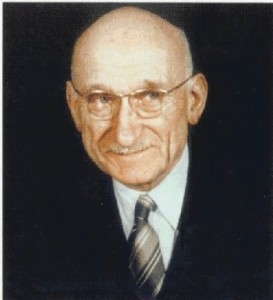
ROBERT SCHUMAN
Indeed, Robert Schuman was an intensely religious man. He was strongly influenced by the writings of Pope Pius XII and St. Thomas Aquinas. He was arrested in 1940 for acts of resistance and protestation at Nazi methods and interrogated by the Gestapo. He escaped in 1942 and joined the French Resistance. He became passionate about Franco-German and European reconciliation and rose to great prominence after the war. He was French Minister of Finance, Prime Minister from 1947–1948 and Foreign Minister in the latter year.
On 9th May 1950, Schuman invited the Germans to manage their coal and steel industries jointly with France. This formed the basis of the European Coal and Steel Community in 1951. He conceived the idea with compatriot Jean Monnet, another Catholic, though not as devout. They suggested if the two countries jointly managed these resources, they would be unable to go to war with each other. At the time, with the erection of the ‘Iron Curtain’, Europe seemed an unstable place. Schuman’s idea made sense in his day.
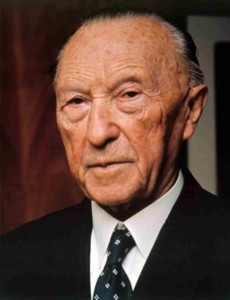
KONRAD ADENAUER
Konrad Adenauer was the first post-war Chancellor of (West) Germany. He developed a “weltanschauung” – a worldview – to provide a complete account of the universe, man, and politics. Adenauer realized that part of the appeal of totalitarianism was the promise of such a worldview. Democracy was seen as neutral about outcomes, simply managing the clash of competing interests. In contrast, communism and fascism offered complete worldviews. However, said Adenaur, they were ones based on ‘atheistic materialism’.
Adenauer said both communism and fascism reduced the individual to an automaton of the state. He argued for a spiritual worldview to replace atheistic materialism. Fortunately, Adenauer argued, Western democracy had such a worldview in Christianity.
Adenauer viewed the formation of the Christian Democratic Union in 1945 as a non-denominational party open to all people, while insisting on a platform that stated: ‘Only Christian precepts guarantee justice, order, moderation, the dignity and liberty of the individual and thus true and genuine democracy … We regard the lofty view that Christianity takes of human dignity, of the value of each single man, as the foundation and directive of our work in the political, economic, and cultural life of our people.’ Well, Amen.
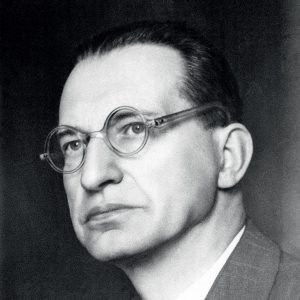
ALCIDE DE GASPERI
The Italian politician Alcide de Gasperi was, like Schuman, deeply affected by the Second World War. He said: ‘the lesson that all Europeans can learn from their tumultuous past is that the future will not be built through force, nor through a desire to conquer, but by the patient application of the democratic method, the constructive spirit of agreement, and by respect for freedom’.
De Gasperi opposed all forms of totalitarianism and when Chairman of the parliamentary group of the Italian People’s Party, he opposed the rise of the fascist party.
From 1943 he occupied various ministerial positions, and continued to oppose the powerful Italian Communist Party. De Gasperi responded immediately to Schuman’s call, and worked closely with the latter and with Konrad Adenauer.
CHRISTIANITY NOT MENTIONED
It was only five years after the end of the Second World War that Schuman said in his 9th May 1950 declaration: ‘Europe will be born from this, a Europe which is solidly united and constructed around a strong framework.’ Oddly enough, Christianity was not mentioned.
So far we have a Frenchman, a German and an Italian launching, as their defenders say, a ‘movement to build a Europe that they hoped would be peaceful, prosperous and democratic.’
What of the other three members of the founding six countries of the European Union, as it would become? During the war, in London, Belgium, Luxembourg and the Netherlands had formed a Benelux customs union and even fixed their currencies against each other. Schuman’s vision went down well with the Benelux countries.

TREATY OF PARIS
So it was that the Treaty of Paris (1951) which formed the European Coal and Steel Community was attended and agreed by ‘the inner six’: France, Italy, the three Benelux countries and West Germany. The United Kingdom refused to participate. Britain’s Government of the day, under Labour’s Clement Attlee, rejected the supranational authority set up by the Treaty.
The Paris Treaty did indeed set up a ‘High Authority’, to which the UK had objected. That would become the European Commission. Its first president was Jean Monnet. There was also a Council of Ministers and a 78-strong Common Assembly.
In 1954, plans for a political union with a common European army came to nothing when the French refused to consider it, so a conference was planned for the next year and was held in Messina in Sicily. It was there all six countries decided upon a customs union and a common market using the Benelux model.
CHRISTIAN / CATHOLIC THREAD UNRAVELS
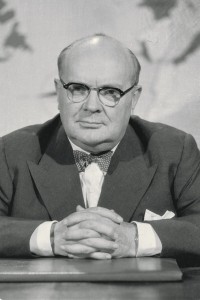
Now here is where the Christian / Catholic thread unravels. Somehow, a Belgian politician by the name of Paul-Henri Spaak was proposed and entrusted with drawing up proposals for a European Common Market. Spaak was neither a Catholic nor a Christian Democrat. He was a socialist activist and a revolutionary who had talks with Trotsky. Well-heeled through family, education and his legal and political career, he led his party’s left wing. Spaak became known as the ‘Bolshevik in the dinner jacket’. He had been instrumental in the Benelux project. Spaak described himself as a socialist and an agnostic.
Paul Belien of the Washington Times, writing at BrusselsJournal.com, contrasts the view of the three Catholic statesmen with that of Spaak like this: ‘Some of the EU’s founding fathers claimed that political unification was needed to prevent European nations from going to war again. Others, such as Paul-Henri Spaak, the Belgian foreign minister who authored the Rome treaty, dreamed of a European superstate. He hoped that such a state might one day become as powerful as the United States.’
‘The Europe of tomorrow must be a supranational Europe,’ Spaak stated in a rebuff to French President de Gaulle’s 1962 ‘Fouchet Plan’. De Gaulle called for a ‘Union of the European peoples’ ‘without supranational institutions.’ Spaak was always intent on a superstate.
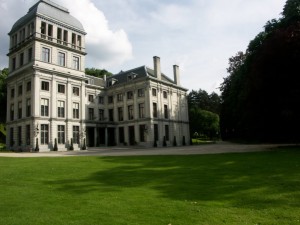
CHATEAU DE VAL DUCHESSE
The Spaak Committee presented its report in April 1956 to another conference of foreign ministers of the six. It was approved, and Spaak went away to draft the full treaty.
His right-hand man in the project was one Baron Robert Rothschild (not to be confused with the New York banker of the same name). In 1954 Rothschild had been appointed Spaak’s chef de cabinet at the Belgian foreign ministry. For two years he worked with Spaak on the Treaty of Rome.
As summer turned to winter during 1956, the ‘Treaty establishing the European Economic Community’ was being put together in a Belgian country house, the Chateau de Val Duchesse.
The first Eurocrats

A BBC webpage says: ‘From the beginning they struck a tone that dogs the European project to this day: they worked largely in secret. There was little reference to public opinion. The political elites laboured on in splendid isolation. The Treaty was put together in secret.’
Even the typists, who included the bilingual Marie-Helene von Mach, had to sign contracts which banned them from talking about their work, even to their families. The team formed, says the BBC, ‘a new kind of public servant: these were the first generation of what would come to be known as the Eurocrats.’
According to the Daily Express, Paul-Henri Spaak claimed in his memoirs that ordinary people were ‘indifferent’ to his plans, but that his elite ignored them anyway.
Mr Spaak wrote: “There were a great many sceptics. Overall, public opinion was not hostile; it was indifferent. The work accomplished was done by a minority who knew what they wanted.”
CHOOSING A VENUE
Not only did Spaak and Rothschild draft the Treaty, they also had the opportunity of deciding where it would be signed. They chose the principal first-floor room of the Palazzo dei Conservatori on the southern peak of the Capitoline Hill in Rome as their venue.
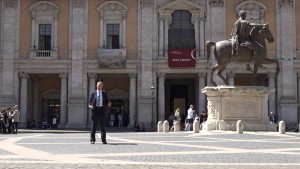
Bedecked with murals depicting Romulus and Remus and the rape of the Sabine Women, the Hall commemorates the battles between the seventh-century BC families of Horatii and Curiatii. At each end of the long hall stands a massive black marble statue of a pope. Innocent X sits at one end and Urban VIII at the other.
But I suggest it was neither the decorations nor the statuary which were the point for Spaak and Rothschild. They knew the Palazzo had been constructed in the middle ages right on top of the Temple of Jupiter. The site had immense spiritual and political significance. Every year, the Roman Senate held their first meeting in the Temple. Jupiter was the protector, the ‘Conservator’ of Rome. Not only that, he was the Roman successor to the head of the Greek pantheon, Zeus. Moreover, if the altar to Zeus in Pergamos was said in the Bible (in Revelation 2:13) to be ‘Satan’s Seat’, this was Rome’s equivalent.

ROMAN EMPIRE RE-ESTABLISHED
The key objectives of the EEC were the establishment of a common market and customs union, ever closer union among the peoples of Europe and the pooling of resources to strengthen peace.
But Spaak and Rothschild had managed not only to avoid any mention of the Christian faith which had allegedly inspired the process. They had also brought Konrad Adenauer (the only one of the ‘Catholic three’ to sign – neither Schuman nor Gasperi represented their countries), to take part in a ceremony held on the principal pagan site in Europe.
In case I am thought to be reading too much into this site, a revealing comment from Spaak confirms it. Baron Robert Rothschild recalls in his memoirs that he was standing beside Spaak gazing over the Forum in Rome on the eve of the signing of the treaty. ‘I think,’ Spaak said, ‘that we have re-established the Roman Empire without a single shot being fired.’

‘WE FELT LIKE ROMANS’
Paul-Henri Spaak moved on to become Secretary-General of NATO. Later he allegedly said: ‘We felt like Romans on that day; we were consciously re-creating the Roman Empire once more’.
I say ‘allegedly’. I have tracked this comment down to a book by American Christian writer Grant R Jeffrey called ‘The Signature of God’. It appears on page 208 of the 2010 third edition of the book. Jeffrey claims in a footnote that Spaak said it in a BBC documentary and also says he found the comment at: http://europa.eu.int/abc/obj/chrono/40years/3testim/coll-en.htm.
Annoyingly, he says the site is now discontinued. Indeed it is, and I have been unable to trace the quote any further. The quote is not on any saved version of the page at www.archive.org. Nevertheless, it chimes with Rothschild’s recollection. On its own, that showed that reviving the Roman Empire, the one mentioned in Daniel’s interpretation of Nebuchadnezzar’s dream as being formed of ‘iron and clay’, was at the front of Spaak’s mind.
I don’t know how such an interest in Classical studies and pagan religion fits in with Spaak’s self-confessed agnosticism. I suppose we are complex beings inclined to spirituality. C S Lewis proposed that when we cease to believe in the Almighty, we do not believe in nothing. We actually believe in anything. It may have been thus with Paul-Henri Spaak. More research, as they say, is necessary.
IMPERIAL AMBITION
Be that as it may, for whatever reason, Spaak himself believed he was reviving the Roman Empire, without firing a shot. It was an empire he hoped would rival the United States in power and influence. Spaak’s was no Christian project and no Catholic plot. Gone was Adenauer’s Christian world-view, Schuman’s humility and Gasperi’s devotion to his church. In their place was Spaak’s imperial ambition. He had found the perfect venue to initiate it. Indeed he could have found no more appropriate site in the whole of Europe.

Moving on some forty-seven years, we come to the attempt at cementing the European Union together with a constitution. In October 2004, Tony Blair and Jack Straw gathered with the representatives of the other twenty-four countries of the EU and signed the document.
They signed it in the same room of the Palazzo die Conservatori on top of the Temple of Jupiter as Spaak, Adenauer and the rest signed the original Treaty of Rome in March 1957.
EU CONSTITUTION PLAQUE
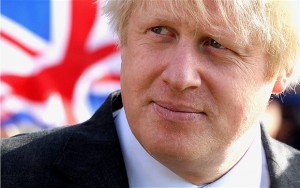
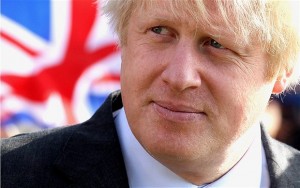
Boris Johnson, in his book ‘The Dream of Rome’, says the Italian government erected a plaque in the Palazzo commemorating the event.
Written in Latin, it translates as follows: ‘On 29 October, 2004 in this most sacred Capitoline Hill, which is the citadel of this bountiful city and of the entire world, in this famous and August hall named after the Horatii and the Curiatii, the high contracting parties of the nations joined in the European Union signed a treaty about the form of constitution to be adopted, so that the nations of Europe might coalesce into a body of one people with one mind, one will and one government.’ (page 31)
‘MOST SACRED CAPITOLINE HILL’
‘Most sacred Capitoline Hill’, it said. The Latin is ‘SACRATISSIMO’. Johnson misses that revealing adjective, referring as it does to the Temple of Jupiter. He also passes over the reference to the site being the ‘citadel’ not just of Rome but ‘of the entire world’.
Nevertheless, he asks: ‘One mind, one will and one government? When did the continent last have one mind, one will, one government? Not since the fall of the Roman Empire. And it is surely no accident that the plaque echoes the old Roman slogan plurimae gentes, unius populis – many nations, one people.’

It is worth noting that despite the prayers of Christians and the lobbying of both the Catholic and Orthodox churches, there was no reference to Christianity or Almighty God in the European Constitution. Mercifully, the Constitution was never ratified. The voters of France and the Netherlands rejected it. Undaunted, the Eurocrats put most of it into the 2009 Treaty of Lisbon anyway.
Continuing the pagan spiritual theme, they have also caused statues of Europa being abducted and raped by Zeus to be erected in Strasbourg and Brussels and the image of this mythical event to appear all over the European Union. Talk about their intentions being ‘hidden in the open’.
EU SPIRIT OF ANTICHRIST
Clearly, if the EU ever had been a Christian project or a Popish plot it had run out of steam by 2004. But of course, as we have seen, it was neither. Schuman’s dream may have been noble, but Spaak turned it into a secularist-cum-pagan nightmare. He made it a revived Roman Empire, one perpetually at war with the Kingdom of God.
Let us make no mistake. The spirit behind the original Roman Empire was the spirit of Antichrist. It had wormed its way from Babel to Babylon and on through Persia and Greece. It ended up in Urbs Aeterna, the ‘Eternal City’.
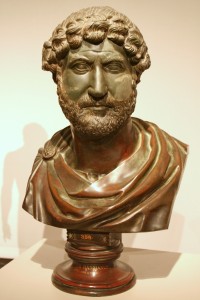
Rome itself was destroyed in a series of sackings during the fifth century AD. On one level ‘Jupiter’ or its Antichrist spirit if you prefer could not save it. But the 2nd-century Roman Emperor Hadrian suggested it was the spirit of Rome itself which was eternal. He said it would be reborn all over Europe. Hadrian may not have realised it, but he was speaking of the spirit of Antichrist.
For a pagan emperor, that man had some vision. And his empire was indeed reborn by Paul-Henri Spaak and the leaders of ‘the six’ he persuaded to sign, wittingly or unwittingly, on top of Jupiter’s Temple in Rome in March 1957.
THE LAMB SHALL OVERCOME THEM
So despite what Dr Summerton says, the European Union was never ‘at base’ or anywhere in its structure ‘a Christian project’. Nor was it ever a Catholic plot. It was a pagan/secularist scheme from the moment Paul-Henri Spaak got his hands on it. And it remains so to this day.
It follows that the EU is dangerous for any nation to be part of, marked as it is for God’s judgment. The Revelation to John addresses the demise of Hadrian’s and Spaak’s revived Roman Empire in chapter seventeen:
Rev 17:12 And the ten horns which thou sawest are ten kings, which have received no kingdom as yet; but receive power as kings one hour with the beast. 13 These have one mind, and shall give their power and strength unto the beast. 14 These shall make war with the Lamb, and the Lamb shall overcome them: for he is Lord of lords, and King of kings: and they that are with him are called, and chosen, and faithful.
It would be sensible for any nation to be on the right side in that battle.
View our EU themed videos:
Firstly, The European Union’s Tower of Babel
Secondly, The European Union’s Woman on the Beast
Thirdly, The European Union’s Pagan Foundation
Fourthly, European Union- Does the Lord Keep the City?
Lastly, The European Union’s Roman Empire
We greatly value your support. Find out how to join Christian Voice and stand up for the King of kings (clicking on the link below does not commit you to join)

Please note that persons wishing to comment on this story must enter a valid email address. Comments from persons leaving fictitious email addresses will be trashed.