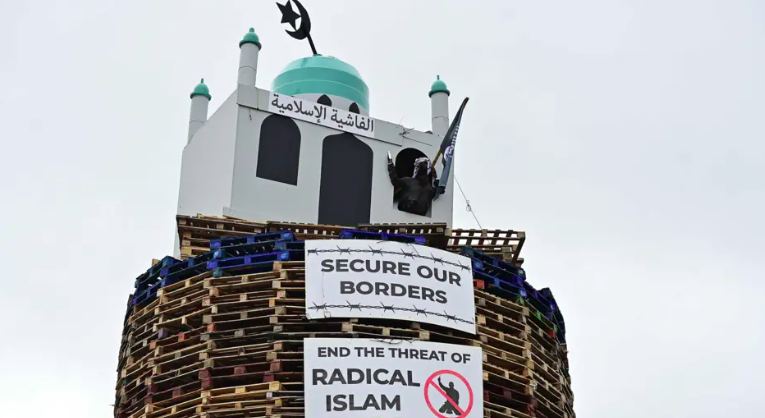
A 56-year-old man has been arrested after a replica mosque was placed on top of a loyalist bonfire pyre in Co Tyrone, with the PSNI calling it a “hate-motivated criminal offence.” That may well be the right legal response. But the wider cultural response is more revealing than the bonfire itself. We are told endlessly that Britain must be tolerant, inclusive and respectful, yet that language seems to apply unevenly. Some communities are expected to apologise for even mild offence, while others are encouraged to treat sacred boundaries as a joke.
That is the real problem here. The stunt is not defensible, but neither is the increasingly familiar habit of pretending that all offence is equal except the offence that happens to be politically inconvenient. Britain’s elites will often denounce a vulgar gesture when it can be framed as “far right” or “sectarian”, yet they grow strangely cautious when the subject turns to Islam, integration, or the pressure ordinary Christians feel to remain silent.
The public is expected to believe that strong boundaries only matter when they are being enforced against the approved enemy. Everyone else is told to be careful, sensitive, nuanced, and inclusive.
Return to the UK’s Christian Constitution →
Christian persecution
Christians, in particular, are often treated as though they should absorb endless disrespect with a smile, then be grateful for the instruction. But there is a difference between turning the other cheek and handing over the table.
A Christian street preacher Shaun O’Sullivan who has now been unanimously cleared of ‘religiously-aggravated intentional harassment’ by a Crown Court jury, was charged for saying phrases such as “We love the Jews,” taking issue with “Jew haters,” and “Palestine lovers”, while preaching in Swindon town centre on 15 September 2024.
Take a guess who reported him- “a Muslim family told police they felt targeted because they were wearing hijabs”. Before any evidence was reviewed, a 999 call-handler immediately labelled the incident a “hate crime”, a decision made without factual basis, corroboration, or investigation.
The preacher, was charged under the Crime and Disorder Act 1998.
Ask us to come and speak at your church →
We stand with the Bible
We do not defend mockery, intimidation or sectarian theatre. We do, however, insist on truth, moral seriousness and equal standards. If Britain is serious about public order, then it should apply the law consistently. If it is serious about religious respect, then it should stop pretending only one set of beliefs is permitted to offend or be offended.
The deeper issue is that a society which loses confidence in truth will eventually lose confidence in judgment as well. It will condemn the obvious outrage while refusing to address the wider cultural drift that makes these flashpoints inevitable. That is why this story matters. Not because the stunt should be excused, but because the response once again shows a country that is better at managing appearances than confronting the causes of its own tension.
Exodus 20:3 Thou shalt have no other gods before me.
Join or Support Christian Voice →
Dominance of boys name in Britain
Another year, another baby-name chart and another awkward question Britain’s political class would rather avoid. Muhammad has once again emerged as one of the most popular boys’ names in Britain. Cue the predictable response: nothing to see here, move along. It is just a name, we are told. A harmless reflection of Britain’s wonderful diversity. A sign of openness. A celebration of multiculturalism.
And perhaps it is. But names do not appear from nowhere. They tell stories about population change, migration patterns and the communities shaping the future of a country. The question is not why Muslim families choose Muhammad. It is why Britain seems increasingly uncomfortable discussing what these changes mean.
For years, politicians have insisted that Britain can absorb large-scale demographic change without any serious conversation about national identity. We are told that asking questions about integration is somehow divisive, while refusing to discuss them is apparently enlightened.
Britain has become remarkably good at celebrating change, provided nobody asks what is being changed. The rise of Muhammad as a popular boys’ name is not evidence that Britain is disappearing overnight. Nor does it mean British Muslims cannot be loyal citizens. But it does highlight a wider debate: what exactly holds a modern nation together when its population, traditions and cultural landscape are changing rapidly?
Oppose Islamophobia Definition →
The integration question nobody wants to ask
The defenders of multiculturalism will argue that Britain has always evolved. And they are right. Britain has absorbed waves of immigration throughout its history. However, previous generations of migrants were often expected to integrate into a recognisable national culture. Today, the direction of travel sometimes appears reversed, instead of newcomers adapting to Britain, Britain is increasingly expected to adapt itself around every cultural difference.
Britain is constantly told it should be proud of diversity, yet anyone asking whether integration is working is quickly accused of intolerance. A confident country should be capable of doing both, welcoming people while maintaining a clear sense of its own identity.
The question is not whether a boy named Muhammad can be British. Of course he can. The question is whether this country still has the confidence to say what Britishness actually means.
A changing country or a country that stopped talking?
The popularity of Muhammad is part of a wider demographic story. Cities across the UK have changed dramatically over recent decades. Immigration has transformed neighbourhoods, schools and workplaces. For some, this represents progress and a richer society. For others, it raises concerns about social cohesion and whether communities are becoming more separate.
Neither side benefits from pretending the debate does not exist. The concern is that Britain’s political establishment has often preferred reassurance over discussion. Every demographic change is presented as automatically positive while every concern is dismissed as prejudice.
The Muhammad name debate is ultimately not about a name, it is about whether Britain wants to remain a nation with a shared culture and common identity, or whether it wants to become a collection of communities connected mainly by geography.
Alleged asylum seeker
An alleged asylum seeker is reportedly being sought by Irish authorities after an American woman was found dead in County Kerry.
Jamey Carney, 43, originally from New York, had made Killarney her home for around five years, living there with her teenage daughter.
She was discovered dead at a property on Muckross Road on Tuesday, prompting an investigation by An Garda Síochána, Ireland’s national police service, who have appealed for witnesses and information.
According to reports in the Irish Mirror, investigators are searching for a Middle Eastern man who was known to Ms Carney and had previously lived in France. The newspaper reported that concerns have been raised the suspect could leave Ireland following the attack.
Police have not publicly confirmed all details surrounding the suspect or the motive behind the killing, and enquiries remain ongoing.
Previous Articles
Charles: Synagogue Attack ‘Out of the Blue’? →
Croydon Street Preacher Confronted by Police →
‘Street Preaching is Legal‘ ! →
Muslims slaughter Christians in Nigeria →
American evangelist arrested in Dundee Scotland →
Police disrupt London street worship →
Read and pray
READ: Psa 118:9; 146:3; Prov 14:34; Micah 6:8; Matthew 5:10 Rom 3:13.
PRAY: Pray for truth, wisdom, and courage to speak plainly.
Pray for peace, restraint, and protection from division.
Pray for Britain’s leaders to act with justice and moral clarity.
Let us know what YOU think in the comments below.
Support us!
We appreciate your support; it enables our research and helps us inform your prayers.
So click below to support Christian Voice and stand up for the King of kings

Or fill in the form below to keep in touch:
Click on the social media links below to share this post: