
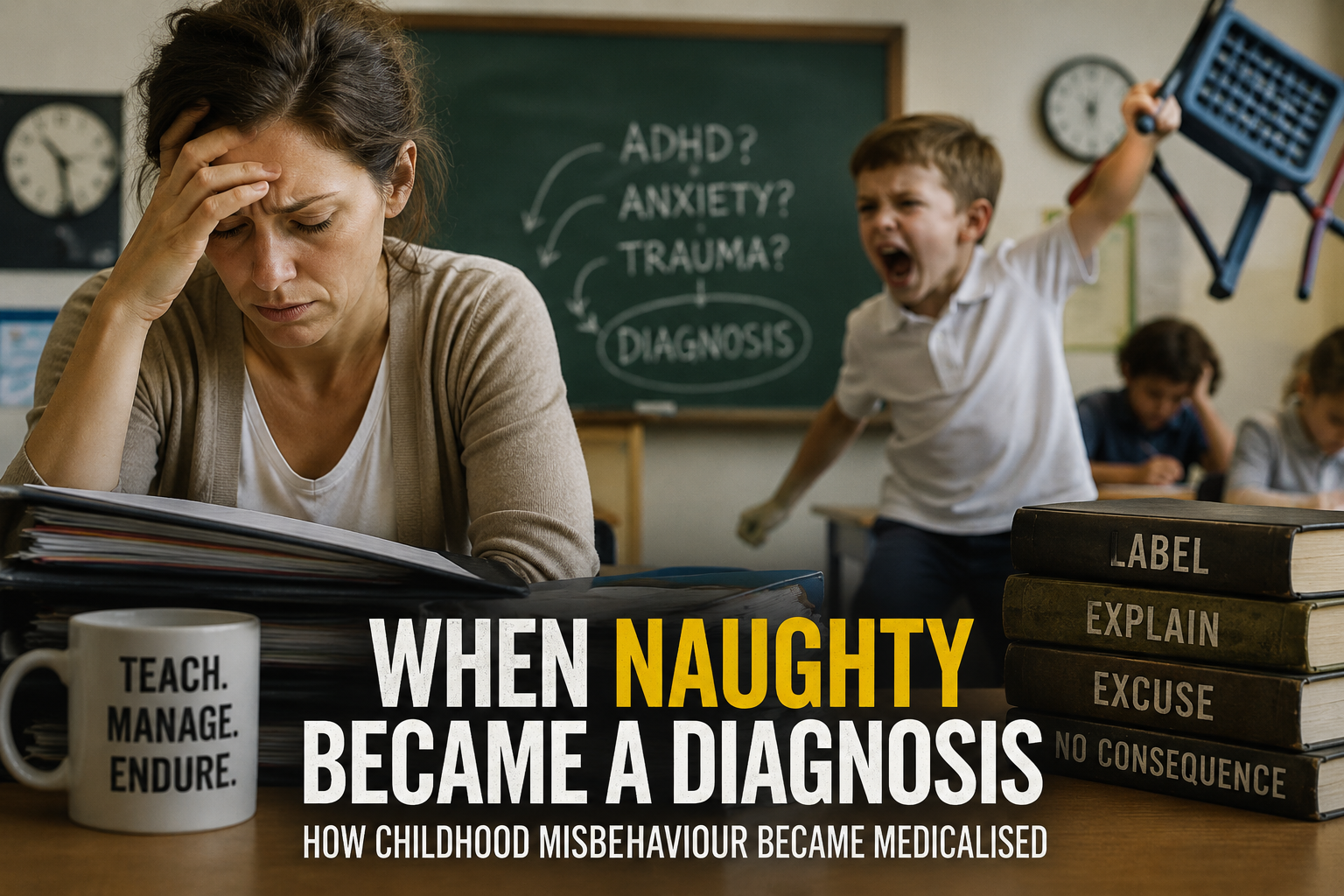
There was a time when a child throwing a chair across a classroom would have been described as exactly what it was: unacceptable behaviour. Today, before anyone dares to utter the dangerous word “naughty”, the modern British instinct is to reach for a clipboard, a questionnaire and a diagnosis.
Perhaps the child is not misbehaving. Perhaps the child is expressing a complex unmet need or perhaps the chair was not thrown, it was an unconventional method of communication.
Welcome to the age where bad behaviour must first pass through the medical-industrial filter before anyone is allowed to ask the old-fashioned question: “Who is teaching this child right from wrong?”
That question landed Paul Sheward, a teaching assistant at Great Missenden Church of England Combined School in Buckinghamshire, in the middle of a national debate.
His crime? Saying something increasingly unfashionable: that not every badly behaved child has an underlying condition.
“There has to be an underlying explanation,” Mr. Sheward told a tribunal. “I do not believe this is the case. My belief is that some children are just badly behaved. There are no underlying issues. It’s purely down to how they’ve been brought up.”
For expressing that view and after describing disruptive pupils in strongly worded Facebook posts, Mr. Sheward faced disciplinary action. He later resigned and brought claims of unfair dismissal, which the tribunal rejected.
But the irony is that a case intended to silence an uncomfortable opinion has instead opened a conversation Britain desperately needs to have. Because behind the argument about one teaching assistant is a much bigger question: Have we created a society where explaining behaviour has become easier than correcting it?
Nobody disputes that children with genuine special educational needs deserve support. They do. However, somewhere along the way, Britain has developed a strange habit: the moment a child behaves badly, adults rush to find a reason, anything except the possibility that the child has simply learned that rules do not apply.
Proverbs 13:24 He that spareth his rod hateth his son: but he that loveth him chasteneth him betimes.
Proverbs 22:6 Train up a child in the way he should go: and when he is old, he will not depart from it.
Support NCCSS / Christian Voice →
“The diagnosis culture”

Modern Britain has become remarkably talented at discovering explanations. When a child refuses instructions? There must be a reason. A child disrupts lessons? There must be a condition. A child repeatedly assaults classmates? There must be an external factor, and sometimes there is. But in most instances, this is the part many people now find impossible to say, “a child behaves badly because children are capable of behaving badly”.
This is not a revolutionary idea. It was once considered basic knowledge. Yet today, suggesting that discipline matters can make someone sound like they have proposed returning to the Victorian workhouse.
The same debate has appeared in the wider workplace. Former Prime Minister Rishi Sunak warned about what he called “sick note culture” and the “over-medicalisation of everyday challenges”.
The argument was not that genuine illness does not exist. It was that a society cannot function if every difficulty is automatically transformed into a medical problem requiring exemption. The same principle applies in schools. A diagnosis should unlock support, it should not become a magic shield that prevents any discussion about behaviour.
As Britain’s “strictest headteacher,” Katharine Birbalsingh has argued, “children with SEND SEND (Special Educational Needs and Disabilities) also benefit from structure, order and clear expectations”.
Apparently, the radical idea that children including vulnerable children benefit from boundaries has somehow become controversial. Who knew that a quiet classroom where children can actually learn would become such an extreme concept?
Ephesians 6:1–4 Children, obey your parents in the Lord: for this is right.
Honour thy father and mother;which is the first commandment with promise;
And, ye fathers, provoke not your children to wrath: but bring them up in the nurture and admonition of the Lord.
Return to the UK’s Christian Constitution →
The classroom battlefield
Across Britain, teachers have warned that behaviour standards have deteriorated. Reports from education organisations have highlighted rising concerns about disruption, violence and abuse directed towards school staff.
The classroom has become a place where some teachers spend more time managing behaviour than teaching. And yet the solution offered increasingly seems to be: understand the behaviour. Of course we should understand behaviour. But understanding why someone does something does not mean accepting it. We understand why someone breaks a window, we still expect them to replace it.
We understand why someone speeds dangerously, we still issue penalties. Astonishingly, when it comes to children, some parts of society seem to believe the only unacceptable response is to expect better.
A child can be loved and corrected, a child can have difficulties and still have responsibilities, a child can need compassion and still need consequences.
These ideas are not enemies. They are the foundations of raising human beings.
Hebrews 12:6–7 For whom the Lord loveth he chasteneth, and scourgeth every son whom he receiveth.
If ye endure chastening, God dealeth with you as with sons; for what son is he whom the father chasteneth not?
Proverbs 29:15 The rod and reproof give wisdom: but a child left to himself bringeth his mother to shame.
The Smacking Debate
The argument over discipline inevitably leads to one of Britain’s most heated questions: should parents ever physically discipline their children?
The law is now different across the UK. In England, reasonable punishment remains lawful, although any punishment causing injuries such as bruising or lasting marks can amount to assault. Wales banned physical punishment in 2022, removing the defence of reasonable punishment. Scotland banned physical punishment in 2020. In Northern Ireland still retains the defence of reasonable punishment. However, the deeper issue is not about smacking, it is about whether Britain still believes adults have the authority to raise children with boundaries.
A society that teaches children that every correction is harmful should not be surprised when children struggle with correction.
The goal is not fear or cruelty, but responsibility. Because children do not become responsible adults by being endlessly reassured that every action has an explanation and every consequence is unfair.
Sometimes the most loving word a child hears is not “you are a victim” or “No, that is wrong, you can do better.”
Proverbs 13:24 He that spareth his rod hateth his son: but he that loveth him chasteneth him betimes.
Related Stories
Young Britons Trapped on Benefits Since the Pandemic →
Sir Keir Starmer taking control of people’s lives’? →
One in eight parents claim child has ‘a disability’ →
Social Media, the Weapon Fashioned Against Children →
How the SNP Spent £1m of Taxpayers’ Money on Paparazzi →
Read and pray
READ: Lev 19:35; Prov 29:2; Prov 16:12; Isa 1:23; Isa 10:1-2;Micah 6:8; Matt 20:26-28; James 3:1; 1 Peter 5:3..
PRAY: Pray for our children that they will grow in grace, obedience and wisdom.
Pray for godly wisdom for Britain’s leaders, that they would promote truth, responsibility, meaningful work, and policies that strengthen families, young people, and the moral foundations of society rather than deepen confusion and division.
Let us know what YOU think in the comments below.
Support us!
We appreciate your support; it enables our research and helps us inform your prayers.
So click below to support Christian Voice and stand up for the King of kings

Or fill in the form below to keep in touch:
Click on the social media links below to share this post: