This June, ITV ran a shocking documentary on the UK’s forced adoption practices. Titled ‘Exposure – ‘Please Don’t Take My Child’, the film chronicled the ongoing scandal of social workers abducting children from loving parents. Read more about the documentary on the ITV news website or watch the full video below.
The video should impress upon all of us who have ‘child protection’ policies in place that great damage can be done to a child and indeed a whole family by involving Social Services – which can be seen as a betrayal.
It may be far better for a church to help a struggling family to get on its feet financially and socially.
After all, the families we are talking about are often those on the margins of society – the very people our gracious Lord would have us help and stand up for.
[facebook-comments-master-un]
Find out how to join Christian Voice and stand up for the King of kings (clicking on the link below does not commit you to join)
Please note that persons wishing to comment on this story must enter a valid email address. Comments from persons leaving fictitious email addresses will be trashed.
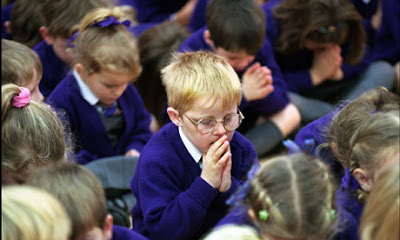
The NGA, which told Christian Voice that one-fifth of state school governing bodies are members, says staff are “unable or unwilling” to lead pupils in prayer and that worship is ‘meaningless’ to non-Christian schoolchildren.
In a policy statement, the body said schools were “not places of worship but places of education” and “the worship of a religion or religions in all schools should not be … compulsory.”
“Few schools can or do meet the current legislative requirement for a daily act of collective worship, partly because there isn’t space in most schools to gather students together and often staff are unable or unwilling to lead a collective worship session,” it said.
“There is also the added issue that worship implies belief in a particular faith – if the ‘act of worship’ is not in your faith then it is meaningless as an act of worship.”
The NGA said dropping collective Christian worship from schools’ remit would “not prevent them from holding assemblies that address a whole range of topics, including faith and belief.”
The Church of England said dropping Christian assemblies would “deny children the opportunity to experience something they wouldn’t experience elsewhere in their lives”.
In 2012, Welsh Evangelical Alliance National Assembly Liaison Officer Jim Stewart said of Christian worship in schools: “If this right were taken away from us it would lead to further marginalisation of Christianity in public life. This is not just something that is beneficial to us though – it is for the common good and other faith groups in Wales are supportive of it as are people who don’t have a particular faith.”
Naturally, the British Humanist Association and the National Secular Society welcomed the NGA’s comments, with the BHA saying schools should be “holding inclusive assemblies that forward the spiritual, moral, social and cultural development of all pupils and staff”.
However, it isn’t at all clear what ‘spiritual, moral, social and cultural’ values would qualify as ‘inclusive’ nor whom or what they could be founded on if not on the God who brought this nation victorious through two world wars.
It is no good appealing to ‘multi-culturalism.’ Even though Islam is the UK’s fastest-growing religion, its practitioners still only number 5% of the population. Our African and Caribbean populations are overwhelmingly Christian. Britain is not ‘multi-cultural’ in any meaningful sense.
In a country with such a rich Christian heritage, who defines what is ‘right’ and what is ‘wrong’ if not Almighty God? The school head? The school governors? On what basis?
A collective act of worship has been a statutory requirement in state schools since the Education Act 1944 stated that ‘the school day in every county school and every voluntary school shall begin with collective worship on the part of all the pupils in attendance’. The Act gave parents the right to withdraw their child, perhaps in favour of separate arrangements. The Education Reform Act 1988 reaffirmed that position and reinforced it, stating that the act of worship should be ‘mainly of a broadly Christian character’.
Children in state schools should engage in a collective act of worship because ours is constitutionally and demographically a Christian country. As we lose respect for the sacred, we lose respect for each other. Britain would become just a bit more brutal, crass and disrespectful as a result.
The elimination of school prayer would rank alongside amoral sex education and the silencing of any possibility of creation as a prime motivator of antisocial behaviour. It would be irrational for anyone to ask why God permits this or that outrage of violence in schools which have legislated God out of the door.
The National Governors’ Association cannot claim to represent anything approaching a majority of school governors. But if it is true that staff are unable or unwilling to conduct an act of Christian worship, the way is open for a local church to offer the services of its pastor, youth leader or another committed member of the congregation. So there is an opportunity in the present situation for closer relationships between schools and churches.
Find out how to join Christian Voice and stand up for the King of kings (clicking on the link below does not commit you to join)
Please note that persons wishing to comment on this story must enter a valid email address. Comments from persons leaving fictitious email addresses will be trashed.
Jayden Wray’s vitamin deficiency was to blame for the broken bones which led to him being taken ‘into care’.
The much-trumpeted legal reforms announced today will not end the secrecy and injustice which surrounds the Family Court.
The plan includes new time limits for cases where children are taken into care, which could work against parents struggling to meet demands placed upon them by social services departments.
Ministers said the changes would put the welfare of children at the centre of the system. But that is what they have always said. The suspicion is that the welfare of the system itself is paramount.
Sir James Munby, President of the Family Division, said the changes were the biggest in a lifetime. But they will not end the cosy relationship of social workers, Cafcass officials, paid ‘experts’ and child panel solicitors.
Crucially, they will not end the cloak of secrecy imposed on all dealings in the Family Courts. No-one may speak outside of what occurs inside on pain of imprisonment. This mafia-like omerta allows injustice to flourish. Justice can only happen when it is seen to be done. We are told the secrecy is imposed to protect the child. In reality, it is there to protect the system.
Care cases will be completed in six months in a single Family Court, which replaces the current three-tier court system in family cases. Although it could be good that cases are followed through by a single judge – assuming he or she is not corrupt – this time-scale will increase the sense parents have of their children being rushed into the adoption process against their wishes – the so-called ‘freed for adoption’ mechanism.
There are also supposed to be limits placed on the amount of expert evidence that can be used in cases involving children, only being permitted when it is ‘necessary to resolve the case justly’. Whether that will end the careers some experts have made out of backing up social workers with spurious observations and biased conclusions, or whether coaches and horses will be driven through it, remains to be seen.
Just yesterday, a distraught mother put up this comment on an older story on our website:
‘Please can you help me get my daughter back from social services? My daughter was kidnapped in 2011 when she was age 11.a teacher and s.s said I hit my daughter. I did not and never have. Police came and took her away. The next day she was taken to a children’s hospital where a doctor lied and made a false report saying she had unexplained bruises. She did not have any bruises.’
The Jayden Wray case exposed how dangerous it is these for parents to take a child to hospital. Jayden had brittle bones from rickets but doctors and social workers demanded the parents confess that they had caused Jayden’s injuries.
Clive Coleman, legal correspondent, BBC News, said: ‘Babies, toddlers and teenagers going through care proceedings have been removed from their parents for their own well being’. Sometimes they are. But in too many cases, when parents cannot explain a bruise a child acquired in the garden, or the child suffers from a mystery illness, they are removed, and even when the mistake is found, social workers will not return the child and fabricate evidence.
Short of death, there is no penalty more draconian than for the state to take people’s children from them.
Our readers or their churches are certain to come into contact with parents whose children have been taken from them by social services.
We are constantly told that homosexuals are the sort of people the Lord Jesus would have ‘been alongside’ as they are on the ‘margins of society’? Are they really? No, they are in the media, in diversity departments and government, with their feet under the table at No10, feted to the skies.
Would you like to know who really are on the margins of society? It is parents who feel totally inadequate and overwhelmed in the face of a machine which grinds them to powder in its quest to assume their function and to strip their children from them.
We should be standing with them, praying with them, showing how God hates injustice, fighting with them to have their children returned.
A summaryof this article, published by the Gatestone Institute, discusses the key points of the report, highlighting how “police, social workers, teachers, neighbors, politicians and the media” turned a blind eye to the crimes of these Muslim gangs for fear of being accused of racism or “Islamophobia.”
Muslims at prayer – in the street
The “conspiracy of silence” regarding child grooming by Muslim gangs was exposed in 2010 when the underground investigation Operation Retriever found and convicted 13 Muslim men for grooming approximately 100 underage girls for sex. This generated more investigations and led to the discovery of several Muslim grooming gangs. Although many offenders were identified, few were prosecuted.
According to the “Easy Meat” report, these offenders are 154 times more likely to be Muslims, while the victims are almost always non-Muslim girls. But authorities have “never deemed it important to declare this, or even denied the pattern existed.”
These incidents were deemed unimportant because of multiculturalism. The report tells us:
“There is far more to this story than has come out so far. The population are already outraged by what they have learned in the last year or two, but know only a fraction of the scandal… This massive over-representation of Muslim men in this crime spree has been borne out by the prosecutions of the last three to four years, but it is clear that it must have been known long ago and should have been made public. Because the predators were Muslims, the agencies responsible for child-protection have almost entirely failed in their job to protect vulnerable children. From a fear of being called ‘racist,’ police forces across the country have buried the evidence.
“On the rare occasion when the phenomenon [of child grooming] would be discussed in more than the briefest details, political activists and the authorities would come together to stop the public from knowing more. Political correctness would be used to make sure that people did not speak about this phenomenon, enabling the perpetrators free rein to sexually abuse schoolgirls for decades. Yes, decades. We know that in an age where parents are not allowed to smack their children, this sounds unbelievable.”
The problem is much more prevalent than previously reported. In fact, as many as 10,000 schoolgirls have been victimized over the years by these Muslim gangs. According to a House of Commons report, as of November 2012 “at least 16,500 children were identified as being at risk of child sexual exploitation during one year.”
Their method is to drive around towns at night and zero in on young, non-Muslim schoolgirls between the ages of 11 and 16. They often give the girls drinks and drugs to entice them into the car. Many of the victims are from care or foster homes, where they might not be immediately missed. The younger the better is usually the policy with the girls they target. The younger the girls are more likely to be virgins who are free from any sexual diseases. (Most of these men have Muslim wives whom they do not want to contaminate.)
The report criticizes British Government for using multiculturalism as an excuse to turn a blind eye to this issue. The Government continues to excuse Muslims because many of the crimes they commit under British law are not crimes according to Sharia law. As the report says, “Multiculturalism is a fundamentally incoherent doctrine, invented to conceal the serious conflicts which have arisen when peoples from vastly different cultures, with different values, are forced to live together.”
In its reluctance to be even-handed and non-discriminatory, the Government has outright refused to take into account religious or ethnic connections to these and other crimes perpetrated by Muslims. The possibility that Islamic law might have something to do with this behaviour is not worthy of consideration.
The British Government expects all its citizens, including Muslims, to embrace multiculturalism. However, the religion of Islam is by its very nature opposed to the principles of multiculturalism through its intolerance of all dissenting voices. Moreover, the symbiotic relationship between Islam and the political left cannot last since once Muslims achieve power, they kick behind them the ladder of multiculturalism that they used for climbing to power.
We appreciate your support; it enables our research and helps us inform your prayers.
So click below to support Christian Voice and stand up for the King of kings
Click on the social media links below to share this post:
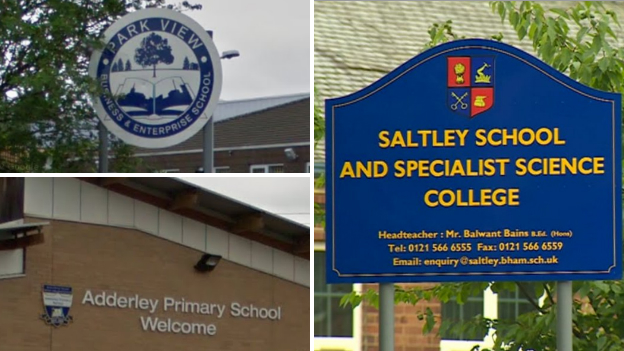
Targeted schools. Saltley School’s head teacher, Mr Bains, resigned last year after a critical Ofsted report and a campaign against him instigated by Islamist governors.
A Muslim plot to take over schools in Birmingham and Bradford shows how good they are and how poor Christians are at advancing their respective world-views.
Operation Trojan Horse, as the Islamic scheme is called, involves identifying schools in predominantly Muslim areas which are struggling. For each school, a group of parents committed to Islam is built up.
Next comes a campaign to elect one or more faithful Muslims to the school governing body.
After that, the head teacher is undermined by the use of complaints to local MPs and education authorities as well as by identifying “weak and disgruntled staff” who can cause problems for the head with Ofsted.
A letter containing the details of the Muslim schools take-over plot came to light after it was leaked to the National Association of Head Teachers.
Muslim Campaign secures leadership changes in schools
It claims responsibility for leadership changes at four schools, Adderley Primary, Saltley School, Park View School and Regents Park Community Primary School.
The inspectors’ statement appears to confirm claims in the letter that the group has “caused a great amount of organised disruption in Birmingham and as a result we have our own academies and are on the way to getting rid of more head teachers and taking over their schools”.
The letter, seen by the BBC, targets another 12 schools in Birmingham, and was also sent to a contact in Bradford.
It urges the recipient to use Ofsted reports to identify schools in predominantly Muslim areas which are struggling and adds: ”Operation ‘Trojan Horse’ has been very carefully thought through and is tried and tested within Birmingham, implementing it in Bradford will not be difficult for you.”
Schools ‘corrupting their children with sex education’
It states that parents could be encouraged to turn against the leadership team if they are told the school is “corrupting their children with sex education, teaching about homosexuals, making their children pray Christian prayers and [carrying out] mixed swimming and sport”.
Needless to say, the revelations have sent the politicians into a spin, with Liam Byrne, Labour MP for Hodge Hill, holding ‘urgent talks’ with Ofsted, City Council officials, the office of Michael Gove and DfE officials.
“These are deeply disturbing allegations, which is why Ofsted has been called in,” he said.
The chastening point for Christians will be that the inbuilt corruption in sex education and the pro-sodomy teaching which is now mandated by the Equality Act 2010, not to mention the pro-evolution slant of biology, affect Christian children as well, but that Christian parents have in the main shown not the slightest inclination to protect them from such ungodly influences.
Secularists and Muslims advancing their world-views
It may well be that Christian parents have always assumed that schools are much as they were when they went to school or that, believing in shared cultural values, they put too much trust into schools, teachers, experts and those in authority, even those in sex education promotion groups and working parties.
It has been obvious for some time that Secularists are far better at advancing their world-view than Christians, and it comes as no surprise given what we know of Islamic ambitions of world dominance to discover that Muslims are interested in advancing their world-view as well.
As the letter states: “We have an obligation to our children to fulfil our roles and ensure these schools are run on Islamic principles.”
Do Christians even know what a Christian world-view is?
But do Christians know what Christian principles are, apart from ‘love’? We speak above of a secularist world-view, and of a Muslim world-view, but do Christians even know what a Christian world-view is? Do Christians even know we have one?
Do we know that the ‘earth is the LORD’S, and the fulness thereof; the world, and they that dwell therein’? (Psalm 24:1)
Are we aware that ‘Righteousness exalteth a nation: but sin is a reproach to any people’? (Prov 14:34)
Do we know that we are to teach the ways of the Lord ‘diligently unto thy children, and shalt talk of them when thou sittest in thine house, and when thou walkest by the way, and when thou liest down, and when thou risest up’? (Deut 6:7)
Have we read that as much as parents should ‘provoke not your children to wrath’ that we have a responsibility to ‘bring them up in the nurture and admonition of the Lord’? (Eph 6:4), to ‘Train up a child in the way he should go: and when he is old, he will not depart from it’ (Prov 22:6)
Do we ‘go in the strength of the Lord GOD’ and ‘make mention of thy righteousness, even of thine only’? (Psalm 71:16).
Are we certain to say of God ‘Thy righteousness is an everlasting righteousness, and thy law is the truth’? (Psalm 119:142).
Or do we think that Jesus has swept away all the Old Testament to replace it with a ‘law of love’ that requires us to give in to evil, roll over and let our children take their chance?
Do we personalise away the injunction to go about ‘Casting down imaginations, and every high thing that exalteth itself against the knowledge of God, and bringing into captivity every thought to the obedience of Christ’? (2Cor 10:5)
Have we remembered that providing for our families includes defending and protecting them: ‘But if any provide not for his own, and specially for those of his own house, he hath denied the faith, and is worse than an infidel’? (1Tim 5:8)
Advance the Christian faith
The Muslims behind ‘Operation Trojan Horse’ are simply doing what they should do as Muslim parents; make sure their children are being taught according to their faith.
Yes, there are Christian academies doing great work, but Christians could and should have been getting themselves onto school governing bodies and removing ungodly head teachers not just by ‘praying them out’ but by seeking God for what to do themselves. It isn’t ‘unsporting’ or not quite ‘British’ to fight for what is right and advance the Christian faith in every avenue of life!
And we can surely think of a more positive and imaginative name for such a campaign than ‘Operation Trojan Horse’!
Find out how to join Christian Voice, stand up for the King of kings and advance his kingdom here on earth (clicking on the link below does not commit you to join but tells you more about us).
Please note that persons wishing to comment on this story must enter a valid email address. Comments from persons leaving fictitious email addresses will be trashed.
Dominic Crouch, bullied to death after a homosexual role-play game.
School children will be taught that not all pornography is bad and act out scenes as homosexuals if teachers follow sex education guidance just issued by the Department for Education.
The Times says that it is the first time for 14 years that advice on sex education has been updated. The guidance currently in use makes no reference to issues such as internet safety or “sexting” using mobile devices.
However, rather than just update the advice to warn about those topics, the new guidelines have included pro-gay propganda and taken a sexual libertarian slant.
The guidelines were drawn up by Brook Advisory, the PSHE Association and the Sex Education Forum, all of which are pro-contraception, pro-abortion, pro-homosexual and frankly pro-promiscuity.
Although supported by the Department for Education, the new guidelines do not have legal force. But many teachers will assume they come down from authority and those who were already inclined that way will seize upon them to justify their position to worried parents.
One of the resources recommended to teachers, an e-magazine from the Sex Education Forum, advises teachers to “teach in a non-judgmental way” about pornography and tells them: “Pornography is hugely diverse — it’s not necessarily ‘all bad’.”
Last year Ofsted published a report saying that sex education was taught badly (whatever they mean by that) in between a third and half of schools and said that secondary schools should teach about the influence of pornography on students’ understanding of healthy sexual relationships.
It also says that sex education must not deal only with heterosexual relations. “Teachers should never assume that all intimate relationships are between opposite sexes. All sexual health information should be inclusive and should include LGBT people [lesbian, gay, bisexual and transgender] in case studies, scenarios and role-plays.”
The advice ignores the dynamics of the playground. A pupil acting out a gay role-play will have that stigma attached for the rest of his school life. It will give bullies a weapon and could cement the idea in an adolescent mind that he or she might indeed be homosexual.
The guidance is a recruiting-sergeant for the homosexual world and is certain to bring misery and possibly death in its wake.
On 18 May 2010, Dominic Crouch committed suicide by jumping off the roof of a six-storey block of flats near his school in Cheltenham. He was 15. In the note he left his family, he wrote: “Dear Family, I’m so so sorry for what I’m about to do. I have been bullied a lot recently and had a lot of shit made up about me that ain’t true.”
It emerged that Dominic had taken up a dare to kiss another boy on a school trip during a game of spin the bottle. Some participants recorded the game on their mobile phones and the images circulated. Dominic, who was dyslexic and found it difficult to formulate a quick retort, became the butt of jokes when he returned to St Edward’s after the trip.
The Stonewall homosexual campaign group jumped on the idea of ‘homophobic bullying’ and started putting it about that Dominic might have been homosexual, something he and his family always denied. Stonewall even persuaded his father, Roger, to go around schools on a non-bullying mission and made him ‘hero of the year‘ on 3rd November 2011, the night Melanie Phillips was named ‘bigot of the year’ at the ceremony hosted by Stephen K Amos. Weeks later, in December 2011, Roger Crouch committed suicide as well.
Let us pray that the authors of this guidance do not end up with blood on their hands.
Find out how to join Christian Voice and stand up for the King of kings (clicking on the link below does not commit you to join)
Please note that persons wishing to comment on this story must enter a valid email address. Comments from persons leaving fictitious email addresses will be trashed.
The Romeike family will be able to stay in the United States following a remarkable turnaround by the federal government.
Uwe and Hannelore Romeike have been fighting to keep their family in the United States, where they immigrated legally from Germany in 2008.
Had the family stayed in Germany they would have faced heavy penalties because of their decision to home-school.
All went well until the Obama administration began threatening to deport the family to Germany, where the state would be able to take custody of their children as they did in the case of the Wunderlich family.
It came as a surprise to everybody when a Supervisor with the Department of Homeland Security called HSLD to say the Romeikes had been granted “indefinite deferred status”. The federal government’s 24-hour turnaround was announced today on the Home School Legal Defense Association (HSLDA) Facebook page.
Uwe Romeike commented in a statement on the HSLDA website: “We are happy to have indefinite status even though we won’t be able to get American citizenship any time soon. As long as we can live at peace here, we are happy. We have always been ready to go wherever the Lord would lead us—and I know my citizenship isn’t really on earth.”
HSLDA Chairman Michael Farris gave the glory to God.
“This is an incredible victory that I can only credit to Almighty God. I also want to thank those who spoke up on this issue—including that long ago White House petition. We believe that the public outcry made a huge impact. What an amazing turnaround—in just 24 hours,” he said.
What the video below for the full story:
Find out how to join Christian Voice and stand up for the King of kings (clicking on the link below does not commit you to join)
Please note that persons wishing to comment on this story must enter a valid email address. Comments from persons leaving fictitious email addresses will be trashed.
The Scottish Parliament has passed a bill that assigns one social worker to every child in Scotland.
The controversial measure, Known as ‘Children and Young People (Scotland) Bill’, was passed in Edinburgh last week with a vote of 103-0 with 15 abstentions. It allocates a ‘named person’ with unspecified powers to each child.
Christian groups in Scotland have spoken out against the controversial proposal.
A Free Church of Scotland spokesman said there has not been “sufficient evidence” to apply the plans universally or to ensure “parents are protected from undue interference by the state”.
Among the other organisations that have spoken out against the move are the the Law Society of Scotland, the Faculty of Advocates, the Church of Scotland and the Catholic Church.
Stephen Green, National Director of Christian Voice, said, ‘This is a massive and expensive intrusion into family life. It comes from the totalitarian philosophy that the State owns the nation’s children.’
Christipher Booker, writing in the Telegraph, said: ‘In fact, the Bill is remarkably vague about the powers to be given to these “named persons”. Will they be free to arrive unannounced at the family home to check on how a child is being treated by its parents, when it goes to bed, what food it is given, what political or religious opinions it is being brought up with? In other words, the Bill gives no idea of how this hugely ambitious scheme, estimated to cost Scotland’s local authorities up to £138 million a year, will work in practice. And most worrying of all, to anyone familiar with the failings of our existing “child protection” system, is how often the most damaging errors can arise when professionals are charged with reporting to social workers their suspicion that something in a child’s life might be amiss.’
The bill was framed in an attempt to bring under Scotland under obligations stipulated in the United Nations’ Convention on the Rights of the Child (CRC). The UN Convention includes a provision to assign a specific government worker to every child at birth.
Normally a social worker is only assigned to a child in cases of child abuse or neglect. Once this bill is implemented, there will be a named guardian for every child in Scotland from when the child is born to when they reach eighteen.
Tories have warned that the bill will almost certainly be challenged. Liz Smith, the Tory spokeswoman for young people, said “If this goes through, it will almost certainly be subject to legal challenge.
“That is because it is a measure that will intrude on family life, and divert resources away from those who really need help.”
Find out how to join Christian Voice and stand up for the King of kings (clicking on the link below does not commit you to join)
Please note that persons wishing to comment on this story must enter a valid email address. Comments from persons leaving fictitious email addresses will be trashed.
The three-year-old was due to be handed over by Harrow Borough Council but a week of protests have left the Council with no alternative but to put the adoption on hold.
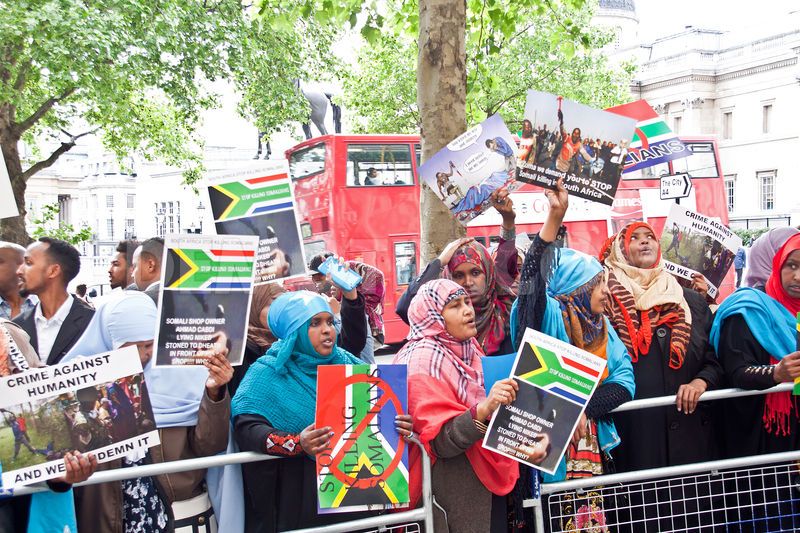
More than 50 women from the Somali community demonstrated outside the headquarters of Harrow Council to protest against the decision and urge the local authority to reconsider the adoption.
Tory-controlled Harrow say the girl and two older siblings were ‘taken into care’ after they decided the children’s mother had ‘mental health problems’. In a cultural context, children of a mother who could not cope would always be taken in by relatives, but despite offers from the family, Harrow told the child’s mother by letter that there were no Muslim Somali adopters available.
According to the Daily Mirror, a family member named Ibrahim told the Sunday Times they want the little girl to be brought up by a family who share their religious and ethnic background.
He claims four blood relatives on the mother’s side were willing to adopt the toddler but were turned down.
A spokesman for Harrow Council said: “Adoption decisions are taken after lengthy and extremely thorough consideration of what is in the child’s best interests.”
(When adoptions are carried out against parents’ wishes the children are euphemistically ordered by the court to be ‘freed for adoption’.)
The 2002 Adoption Act allowed same-sex couples to adopt and that in turn has led to complaints from biological relatives of adopted children.
In 2009, one mother in Scotland went public when her children were placed with homosexuals after an offer to adopt from their grandparents was turned down. Councils have been receiving as many as 50% of their applications to be considered as adoptive parents from pairs of homosexuals.
Find out how to join Christian Voice and stand up for the King of kings (clicking on the link below does not commit you to join)
Please note that persons wishing to comment on this story must enter a valid email address. Comments from persons leaving fictitious email addresses will be trashed.
The Wunderlich family with members of Home School Legal Defense
A German family court judge has refused to give the Wunderlich parents custody of their own children following the family’s decision to homeschool.
The Wunderlich are Christians and chose to homeschool for religious and educational reasons.
In the verdict last month, judge Marcus Malkmus defended his decision on the grounds that homeschooling is allegedly a “concrete endangerment to the well-being of the child.” He pointed out that if custody were returned to the parents then they would be able to obtain visas and travel to another European country where homeschooling is legal.
In September we reported on the armed raid in which German social services abducted the Wunderlich children on the sole grounds that the parents were exercising their right to home-school. In October we reported on how the German government promised to return the children on the condition that the Wunderlich family send their children to the state schools.
In order to keep their children, parents Dirk and Petra had no choice but to comply with German social services and put their children in the state schools where they face potential indoctrination in paganism, homosexuality and witchcraft.
Despite the fact that the parents have complied with these demands, and despite the fact that the children are once again living at home, and despite the fact that the eldest child (Machsejah Wunderlich, age 14) has made her own application to the court, the German social services have been obdurate in their refusal to return custody to the parents.
In his ruling, Judge Marcus Malkmus compared homeschooling to a “straitjacket” which allegedly condemns children to “years of isolation.” He continued: “The request of the parents to reinstate their right to determine the location of the children, the right to make educational decisions for the children, as well as the right to file legal applications for their children is being refused.”
Key documents in international law, including the Universal Declaration of Human Rights, grants parents the right of movement. However, in Germany this right does not extend to those wishing to homeschool. Last month’s ruling further declares,
It should be considered that emigration plans of the parents indicate that the parents will continue to prevent schooling of their children in a public school. Even though there are no suspicions of any parental care right abuses, besides the prevention of public school attendance, the further withdrawal of the part of parental care rights is considered necessary to help and support the education of the children, to ensure the children’s attendance of a regular school.
Dirk Wunderlich compared the ruling to policies of the Nazis
This totalitarian ruling starkly reveals the totalitarian drift of German secularism, which finds it increasingly
impossible to envision a society where differences can be tolerated. It is more than a little ironic that Judge Marcus defended these totalitarian measures on the grounds that homeschooling
allegedly prevents children from “having learned to be integrated or to have a dialogue with those who think differently and facing them in the sense of practicing tolerance.”
Dirk Wunderlich said the ruling is comparable to what happened under the Nazi regime.
“Judge Malkmus has erected another Berlin Wall apparently designed to prevent all parents who might leave to homeschool from leaving Germany. This is no different than what happened in the former East Germany under communism and before that under the Third Reich. We need help from others around the world to help our country see this terrible violation of human rights.”
Find out how to join Christian Voice and stand up for the King of kings (clicking on the link below does not commit you to join)
Please note that persons wishing to comment on this story must enter a valid email address. Comments from persons leaving fictitious email addresses will be trashed.
New research published last week in the journal Pediatricsshows that more than one in five middle-school aged children with behavioural or emotional problems have recently engaged in “sexting.”
This study builds on previous research by the Pew Internet & American Life Project which found that nearly a third of all seventeen-year olds have received a ‘sext’ at some time in their life.
In 2012 researchers at the Archives of Pediatrics & Adolescent Medicine studied 948 teenagers and found that 28 percent reported sending a naked picture of themselves via text or e-mail, while 31 percent had asked for explicit photos to be sent to them.
In Romans Paul warned us that when men cease glorifying God, they are given over to sinful lusts (Romans 1:21-24), and one of the results of these lusts is that they will invent new ways of doing evil. (1:30). We see this outworked today, as new technologies are providing sinful men and women with opportunities to devise new forms of sinning. Often these newly invented sins require new words to describe the deviant actions.
The evilness of sexting should be immediately apparent from scriptures such as Galatians 5:19, which condemns impurity and sensuality, or Romans 13:13 which commands us to not only avoid sexual promiscuity, but also sensuality.
In addition to the obvious lewdness and sensuality of sexting, the practice also reveals a deeper culture-wide pathology that is often overlooked. At a time when our digital technologies allow relationships without presence, many people are increasingly coming to view flesh and blood encounters as an unnecessary inconvenience. If co-habitation promises the pleasures of intimacy without the obligations of commitment, sexting promises the excitement of a sexual relationship without the encumbrances of actual intimacy. As such, it is the full flowering of the truly misogynist trajectory of the sexual revolution.
In this sense, sexting works on the same principle on which pornography has always hinged. But there is a crucial difference. The women who become victims of the porn industry are lured primarily by money and prestige; by contrast, women who participate in ‘sexting’ are lured by what promises to be a quick and easy substitute to the vulnerability and fragility attached to embodied relationships.
It may come as a surprise that women are sexting more than men. In one sense, of course, sexting makes women more vulnerable: a man who has no scruples when it comes to receiving or asking for explicit pictures is probably going to have no scruples when it comes to forwarding those pictures to his mates. A woman who engages in sexting thus sets herself up for the worst sort of public exploitation and is forever under the power of the man she trusted. But in another sense, sexting makes women less vulnerable, because a girl can experience the excitement of giving her body to a man without ever having to do business with him as an embodied person, without having to approach him in all her vulnerability, fragility and humanness. For many women, this is precisely the appeal of sexting. Sexting is thus seen as liberating sex from the problem that has dogged it from the beginning, namely having to deal with real people. An article in Sans Magazine was exuberant about sexting’s potential to free sexual relationships from the constraints that come with physical presence:
No longer do we actually have to commit to a single task of actually physically undressing, warming up our partner and then engaging in the carnal act of intercourse…. Plus, we don’t ever have to actually see the person.
This quote demonstrates how sexting is the culmination of the dehumanizing principles behind the sexual revolution. The promise of the sexual revolution was that intimacy could be fulfilling outside the obligations of marriage, a promise that researchers have now discovered to be false. The lie of the 21st century is that sex can be fulfilling without actual intimacy. This too will be found to be a lie. In the meantime, the problem is that by coupling sexual pathologies with extremely addictive digital technologies, that brain is being rewired to think differently about sex, relationships and what it means to be human.
The solution is a return to the Biblical understanding of what it means to love and what it means to be human. As Christians we recognize that it is God who created the powerful urge to physically connect with members of the opposite sex. But God also created the context in which that desire for physical connection can flourish and achieve its proper end.
Find out how to join Christian Voice and stand up for the King of kings (clicking on the link below does not commit you to join)
Please note that persons wishing to comment on this story must enter a valid email address. Comments from persons leaving fictitious email addresses will be trashed.
Jayden Wray’s vitamin deficiency was to blame for the broken bones which led to him being taken ‘into care’.
The BBC’s flagship current affairs programme has investigated child-snatching by social services.
In a landmark edition of Panorama screened last night (13/01/2014) entitled ‘I want my baby back’, a number of cases of horrific injustice were revealed.
According to the write-up: ‘Panorama reporter John Sweeney investigates the secretive world of the family courts and asks whether some parents may have unfairly lost their children forever’.
Presenter Sweeney traveled to Spain to interview one mother who fled the country after her elder daughter was taken and ‘freed’ for adoption in the secret family courts.
Like other parents in the film, and many others whose stories were not told, her child was taken after X-rays showed multiple bone fractures, leading to accusations that she or her partner had physically abused the infant.
But new evidence is linking fragile bones with vitamin D deficiency. In the landmark case of baby Jayden Wray, his death from multiple fractures led to his parents being charged with murder and having their surviving child taken ‘into care’.
Paediatric Pathologist Irene Scheimberg’s brilliance should lead to a major rethink on juvenile fractures.
Some very uncomfortable details emerged during the Panorama programme.
Firstly, parents like those of Jayden Wray who protest their innocence are looked upon as uncooperative and ‘in denial’ by social workers, value-judgments which lessen their chances of being re-united with their child. However, if they admit any kind of guilt, they won’t have their baby returned anyway.
Secondly, the programme revealed something of the merry-go-round of medical experts who are paid to present evidence on behalf of social services departments in the family courts. Thousands of pounds are paid out for preparing evidence and presenting it at a hearing. The experts find themselves depending on social services for a considerable income which they know will only continue if they present evidence which supports the position of social services, which appears always to hang on to a child until the bitter end.
Investigative journalist John Sweeney of Panorama
One qualified expert radiographer even told a court that cases of vitamin D deficiency were unknown in white children of Caucasian parents, something which is blatantly untrue.
What the programme did not investigate was the huge sums paid to social services and adoption agencies in the event of a successful adoption. This successor to targets, which also had financial rewards for being met, mean that a single baby is worth £27,000 in adoption grants to somebody.
That might explain why children’s charities always seem so keen on the present system and, put with panic over cases like that of ‘Baby Peter’ why SS departments are so eager to take children ‘into care’.
There are so many children in care now that a scheme to speed up the adoption process has recently been trialled. This, according to the Guardian, has left parents reporting being ‘bulldozed’.
The only bit of possible good news is that Sir James Munby, president of the Family Division of the High Court, said in November last year that parents of children taken into care should no longer be gagged by the courts and journalists should be allowed to report on proceedings. Only the death penalty is more drastic than removing a child, he has said.
But opening up the family courts is not going to happen any time soon, and until it does, what John Hemming MP described last night to Mr Sweeney as ‘a tsunami of injustice’ will continue in the secret family courts with their retinue of tame experts and their backdrop of adoption payments.
Find out how to join Christian Voice and stand up for the King of kings (clicking on the link below does not commit you to join)
Please note that we welcome comments on this story but that all persons wishing to comment must enter a valid email address. Comments from persons leaving fictitious email addresses will be trashed, however meritorious they appear.
The nightmarish series of events began last June when Alessandra Pacchieri travelled from her native Italy to Essex for a two-week training course with Ryanair at Stansted Airport in Essex.
Having had a history of ‘manic episodes’, Alessandra was on medication. Concerned that her drugs might harm her unborn baby, Alessandra stopped taking them and had a panic attack as a result. During her panic attack Alessandra phoned the police.
TRICKED BY THE POLICE
Upon arrival at her hotel room, the police made telephone contact with Alessandra’s mother, who informed them about her daughter’s condition and explained that Alessandra needed to take her medication.
“They said they wanted to take me to hospital to check my baby was OK” Alessandra explained. “I agreed to go with them.”
It wasn’t until they arrived at the ‘hospital’ that Alessandra realized that she’d been tricked. To her horror, she found herself locked in a psychiatric unit where she was held against her will. Alessandra was prevented from returning either to the hotel or to her native Italy.
Months went by, during which time Alessandra was still banned from returning to her family in Italy.
“I begged the doctors to let me go back to my country” Alessandra recalls. “I said I wanted to go to court to get it sorted out.”
FORCED CAESAREAN
By now Alessandra was nearing the end of her pregnancy. On Friday, 24th August 2012, four days before her due date, Alessandra went to prepare her breakfast as she had done every other morning. But this time she found the hospital kitchen locked. Officials informed her that she couldn’t have breakfast because she would be having a C-section.
“I was crying. I could feel my baby kicking inside me. I begged them not to do the caesarean. The due date was four days later and there was no reason for me to have such an invasive operation with anaesthetic. I wanted a natural birth.”
Alessandra’s protests were ignored. To her horror, she found herself strapped down by a team of five nurses and forcibly sedated.
A few hours later Alessandra woke up to find that she was no longer pregnant. While asleep her child—a baby girl—had been forcibly extracted from the womb and handed over to Essex social services. Alessandra was allowed to hold her baby intermittently for the first few days although she was commanded not to breast feed. On the third day, she was informed that the baby was being completely removed.
Little did Alessandra realize that this forced Caesarean had been carefully planned and authorized by the secret courts. A transcript from the hearing in which Mr Justice Mostyn approved the procedure, reveals the judge telling the court: “She should not know about this order before she is taken and goes to hospital.” The judge authorised the use of “reasonable and proportionate force” if needed.
FORCED ADOPTION
The forced Caesarean was just the beginning of Alessandra’s British nightmare.
Throughout the following autumn Alessandra was allowed access to her daughter for half an hour once a week. In two family court hearings in Chelmsford, Alessandra pleaded to have her child returned to her and to be allowed to go home with her baby to Italy, but to no avail. The child had already been earmarked for adoption.
In October 2012, social services obtained formal permission to put Alessandra’s daughter up for adoption. Only then was Alessandra able to return to Italy.
Back in Italy Alessandra received treatment for her condition. Having completely recovered, she now maintains a home and holds down a job. Yet the authorities in England will not allow her to see her child.
Alessandra returned to Britain earlier this year for a hearing at Chelmsford County Court. While Judge Roderick Newton criticized the local authority for going against the advice of the doctors who had urged the baby to be left with her mother at the hospital, he did not reverse the decision.
In a desperate attempt to keep her daughter within the family, Alessandra has requested that her baby be allowed to go and live with her husband’s sister, who has been recognized as a very capable mother. However, Essex Social Services have refused to even consider this option on the grounds that the baby’s aunt has no “blood” tie to the baby even though she is technically kin. In the minds of Essex social services, placing a baby with a complete stranger is preferable to letting her live with kin.
INTERNATIONAL CONTROVERSY
These events have created international controversy this week, and threaten to strain relations between Italy and the UK. An eminent judge in Milan has declared that a forced caesarean under sedation is an act of extreme violence.
“Your family courts and your social workers invaded my body and stole my baby”, Alessandra told the UK press. “I believe that the British authorities planned to adopt my daughter from the very beginning.”
“Something very unfair has been done to me. I am fighting to get my daughter back and I never want another innocent mother in your country to suffer as I have.”
‘PURE BRUTALITY’
Melita’s lawyer, Stefano Oliva, commented that these events were “unprecedented” and added that he was amazed to see this happening in a European country. “I’ve been a lawyer for 20 years,” he said. “I’ve never seen something like this.”
“Judges can have a different opinion than you, or not look at the papers correctly, but in the particular case I’ve seen pure brutality.”
“Such an invasive treatment of my client, forcing birth from her – I can’t think that any Italian judge would have done it under any circumstance.”
“She has proved to the Italian social services that she is trustworthy”
Mr Oliva went on to compare the case to events that occurred under Hitler or in North Korea. “To snatch children from their own family has happened in history, under other regimes in which there was no democracy – think of the Hitler Youth or the gathering of children in North Korea.
“You can’t think of this happening in a Western European country, a European Union country.”
“She’s a mother. And like all mothers, she wants to be with her daughter. She realises that she has problems.”
“She’s now getting treatment, she’s doing better, she has a job. She has proved to the Italian social services that she is trustworthy.”
Find out how to join Christian Voice and stand up for the King of kings (clicking on the link below does not commit you to join)
Please note that persons wishing to comment on this story must enter a valid email address. Comments from persons leaving fictitious email addresses will be trashed.
The Wunderlich children have been taken from their parents because of the decision to homeschool.
German social services officials have raided the home of a family and abducted their children on the sole grounds that the parents were exercising their right to home-school.
The armed raid occurred on the morning of 29 August, just as the Wunderlich family was beginning lessons.
The team of 20 SS personnel, police officers and special agents approached the home with a battering ram after Judge Koenig, a Darmstadt family court judge, authorized force “against the children” since the children had “adopted the parents’ opinions.”
The four children, ages 7-14, were all forcibly removed and taken to unknown locations, leaving the parents devastated.
Home School Legal Defense Association obtained the court documents authorizing the seizure. The documents reveal that the only legal grounds for action against the family was their decision to home-school. There were no allegations of abuse or neglect, nor any concern that the children were receiving inadequate education.
Dirk Wunderlich, the father, reported, “I looked through a window and saw many people, police, and special agents, all armed. They told me they wanted to come in to speak with me. I tried to ask questions, but within seconds, three police officers brought a battering ram and were about to break the door in, so I opened it.
“The police shoved me into a chair and wouldn’t let me even make a phone call at first. It was chaotic as they told me they had an order to take the children. At my slightest movement the agents would grab me as if I were a terrorist. You would never expect anything like this to happen in our calm, peaceful village. It was like a scene out of a science fiction movie. Our neighbors and children have been traumatized by this invasion.”
The Wunderlich family with members of HSLDA, taken prior to the raid.
“When I went outside, our neighbor was crying as she watched. I turned around to see my daughter being escorted as if she were a criminal by two big policemen. They weren’t being nice at all. When my wife tried to give my daughter a kiss and a hug goodbye, one of the special agents roughly elbowed her out of the way and said, ‘It’s too late for that.’ What kind of government acts like this?”
Having been pestered by the state for their decision to home-school, the Wunderlich family has traveled throughout the EU in the last four years looking for a place to live in freedom. Sadly, the family was forced back to Germany by lack of work. Upon returning to the country, the children’s passports were immediately seized to ensure they could never leave again.
The right of German parents to home-school is recognized by the Universal Declaration on Human Rights, the European Convention for the Protection of Human Rights and Fundamental Freedoms, the United Nations International Covenant on Economic, Social and Cultural Rights and the International Covenant on Civil and Political Rights.
Ignoring these and other declarations, the German government seems to be following the directives of Adolf Hitler, who wrote in 1937: “The youth of today is ever the people of tomorrow. For this reason we have set before ourselves the task of inoculating our youth with the spirit of this community of the people at a very early age, at an age when human beings are still unperverted and therefore unspoiled. This Reich stands, and it is building itself up for the future, upon its youth. And this new Reich will give its youth to no one, but will itself take youth and give to youth its own education and its own upbringing.”
Dirk Wunderlich spoke with Mike Donnelly, HSLDA Director for International Affairs. “These are broken people,” Donnelly said. “They said they felt like they were being ground into dust. They were shaken to their core and shocked by the event. But they also told me that they had followed their conscience and the dictates of their faith. Although they don’t have much faith in the German state, they have a lot of faith in God. They are an inspiring and courageous family.
“I’ve been fighting for German home-school freedom for years,” he continued, “and I had hoped that things were changing in Germany since it has been some time since brutality of this magnitude has occurred. But I was wrong.”
Petra Wunderlich said her heart was shattered. “We are empty,” she said. “We need help. We are fighting but we need help.”
Obama Interferes to Deport German Homeschool Family
The Obama administration has ordered the Romeike family to be deported to Germany, where the parents will almost certainly lose custody of their children for their decision to home-school.
Many other families have been persecuted at the hands of the totalitarian German state for wanting to home-school. One particular family, the Romeikes, fled Germany in 2008 after being ordered not to home-school. They hoped to find safety in the United States. In 2010 the Romeike family were granted asylum to remain in the U.S. on the grounds that returning to Germany would be dangerous for them (Michael Farris has pointed out that the German High Court is on record for saying that religious home-schoolers should be targeted and severely punished). Since then they have been living in Tennessee, where they purchased a farm and have been educating their children according to their evangelical Christian beliefs.
In an unexpected act of executive interference, President Obama appealed the ruling which allowed the Romeike family to remain in America. In April, the Obama administration obtained an order from a higher court to deport the family., arguing that parents essentially have no right to determine how and what their children are taught. At the same time, Obama is granting amnesty to millions of people who have gone to the US illegally. He has also released thousands of illegals who have committed crimes.
In the German state schools, children are exposed to graphic sex education, violence, witchcraft and atheism. Moreover, the German government has openly declared that its policy is based on suppressing minorities. One German court decision explained their opposition to home education explicitly in terms of ideological thought control:
“The general public has a justified interest in counteracting the development of religiously or philosophically motivated ‘parallel societies’ and in integrating minorities in this area. Integration does not only require that the majority of the population does not exclude religious or ideological minorities, but, in fact, that these minorities do not segregate themselves and that they do not close themselves off to a dialogue with dissenters and people of other beliefs. Dialogue with such minorities is an enrichment for an open pluralistic society. The learning and practicing of this in the sense of experienced tolerance is an important lesson right from the elementary school stage. The presence of a broad spectrum of convictions in a classroom can sustainably develop the ability of all pupils in being tolerant and exercising the dialogue that is a basic requirement of democratic decision-making process.”
Find out how to join Christian Voice and stand up for the King of kings (clicking on the link below does not commit you to join)
Please note that persons wishing to comment on this story must enter a valid email address. Comments from persons leaving fictitious email addresses will be trashed.
More babies were born in the UK in 2011-12 than any year since 1972, says the Office for National Statistics, as reported by the BBC.
In all, 813,200 UK births were recorded in the year, said the ONS, contributing to population growth that was, in absolute terms, the highest in the European Union.
ONS estimates say the population of the UK grew by 419,900 to 63.7 million between June 2011 and June 2012.
There were 254,400 more births than deaths and 165,600 more people coming to the UK than leaving.
There were 517,800 migrants from overseas while 352,100 people left the country.
Population growth is highest in London with the South-East of England coming in second. Channel 4 has a useful map showing where population growth is highest.
After the low birth-rate a decade ago, births are on course to emulate the nineteen-eighties in around three years and to outstrip the sixties by 2020.
The difference is, in the sixties and eighties it was people of British origin having the babies. Now, that demographic group are averaging below 2 children per woman of child-bearing age, while all the headline-grabbing stuff is coming from immigrants whose cultures still celebrate fecundity.
One Simon Ross, of anti-growth pressure group Population Matters, was reported widely, not least in the Daily Mail (which also has an interesting population chart by age).
He whined: ‘Our growing population is the root of many of our most pressing problems, including a lack of housing, pressure on services and development threats to our countryside and green spaces.
‘These, together with consequent infrastructure investments and transport issues are increasing costs for everyone. Measures by the Government to limit net migration are to be welcomed. However, the Government should also promote the benefits to individuals and society of smaller families.’
That is actually nonsense. The greater pressure on housing is coming from allowing families to split up so nonchalantly through divorce on demand. Services and transport do not stand still. They increase with population. There is no benefit to society from smaller families. A more informed opinion came from Jonathan Portes, director of the National Institute of Economic and Social Research.
He said: “The medium to long-term benefits are substantial. The people who are being born now or the immigrants who are coming here now will help pay for our pensions and public services in the future.”
The danger is not increased population as such but the way our population is being skewed towards a particular religious group.
Dr Leon Moosavi of Liverpool University says the Muslim population in the UK grew from 1.5 million in 2001 to 3.0 million in 2011, from 2% of the total population to something between 4% and 5%. And they are not slowing down yet. If anything, those Muslims born here are even more culturally Islamic and productive of the next generation than their parents.
Vincent Cooper, writing for The Commentator, argues that on present population trends, Muslims will be in a majority in the UK by 2050. Many of our cities will suffer that fate a lot earlier. Ten years before that, the tipping point at which Muslims will form a majority in the House of Commons will arrive.
But let us not blame individual Muslims, let alone Muslim women, for having more children than the current 1.8 norm. They are simply doing what God designed their bodies to do. They are doing what Christians should be doing: Working hard and increasing in a land where they feel like the underdogs.
Centuries ago, before the time of Christ, the people of Judah were carried off to Babylon. What did the Prophet Jeremiah urge them to do? Sit around moping? Watch the skies for their deliverance? No, he told them to build, to plant, to increase and to pray:
Jer 29:4 Thus saith the LORD of hosts, the God of Israel, unto all that are carried away captives, whom I have caused to be carried away from Jerusalem unto Babylon; 5 Build ye houses, and dwell in them; and plant gardens, and eat the fruit of them; 6 Take ye wives, and beget sons and daughters; and take wives for your sons, and give your daughters to husbands, that they may bear sons and daughters; that ye may be increased there, and not diminished. 7 And seek the peace of the city whither I have caused you to be carried away captives, and pray unto the LORD for it: for in the peace thereof shall ye have peace.
What did the Lord Jesus tell his followers to do before his return? ‘Occupy till I come.‘ (Luke 19:13)
Our society has a death-wish. We kill our own children, we encourage families to fracture, we whisk children off into ‘care’ to be abused by paedophile rings, we celebrate sexual license, pornography and perversion, even allowing the practitioners of the latter to pretend to ‘marry’.
But the secularists who have engineered our present debauchery have a very short time in which to celebrate. Like every civilisation which has ploughed this furrow before, we shall go down the rubbish-chute of history, being taken over within a generation by a stronger, monogamous culture. That culture, on current trends, will be Islam.
If only it would be Christianity. But that depends on the Church finding some confidence in historical, traditional, red-blooded Christianity. The very future of the United Kingdom depends on whether Christian men will stand up to be counted.
Find out how to join Christian Voice and stand up for the King of kings (clicking on the link below does not commit you to join)
Please note that persons wishing to comment on this story must enter a valid email address. Comments from persons leaving fictitious email addresses will be trashed.
Now who would force schoolgirls into lesbian role-play? Would it be some sadistic sex-maniac? The correct answer is the Principal of Linden Avenue Middle School in Red Hook, New York.
As part of an ‘anti-bullying presentation on gender identity and sexual orientation’ given to a class of 8th-graders (that’s 13-14 for us Brits), at least one of the girls was instructed to ask another girl for a kiss.
The story was reported by Todd Starnes of Fox News, who was immediately castigated by the liberal press. Alternet accused him and Fox news of having got the story about a ‘forced lesbian kiss’ wrong. But Starnes never said there was a forced kiss, only that the girls were forced to ask for one. Another blogger said, amid bad language, that Starnes was wrong to call it ‘lesbian role play’, but it is difficult to know what else to call it.
But the line Starnes took was defended in eloquent terms by another blogger, Mr Conservative whose post is worth a read. (In the US, we should point out, a ‘conservative’ is someone concerned to defend the status quo, including the Christian faith, the institution of the family and basic morality.)
According to the local paper, the PoughKeepsie Journal, parents were especially angry that no notice was given about the class, which included the now mandatory sex education propaganda about it being OK to have sex ‘when you are ready’.
‘”I am furious,” said Mandy Coon, whose daughter was in the class. “I am her parent. Where does anyone get the right to tell her that it’s okay for her to have sex?”’
Comments like that, of course, betray the 20th-century thinking that so many parents have. Times have moved on. The State is now your child’s parent, Mandy. You are just her birth mother. Or so it seems.
Mandy Coon told reporters that her daughter said, ‘Mom we all get teased and picked on enough. Now I’m going to be called a lesbian because I had to ask another girl if I could kiss her.’
The case illustrates that anti-bullying classes run by homosexuals, or designed to further the gay cause, are not about reducing bullying, they are about desensitising and indoctrinating with the ruling State philosophy that homosexuality is not just acceptable but good and to be promoted.
Tolerance towards homosexuals will hardly be increased by such lessons, but maybe just one child will start to think ‘maybe I’m gay’ and be recruited to the lifestyle.
This side of the pond, we have Sir Ian McKellen, Stonewall and organisations such as School’s Out driving the push to normalise homosexuality.
As the US National Organisation for Marriage points out, such lessons will become the norm in schools the moment ‘gay marriage’ is legalised, as it was in New York in July 2011.
The story has implications for the United Kingdom. We should never think things can’t get worse.
Find out how to join Christian Voice and stand up for the King of kings (clicking on the link below does not commit you to join)
Please note that persons wishing to comment on this story must enter a valid email address. Comments from persons leaving fictitious email addresses will be trashed.
A Scottish pastor has criticised the Scottish Government’s decision to give £1.6 million to a homosexual organization’s school campaign.
Rev David Robertson, minister of St Peter’s Free Church in Dundee and director of the Solas Centre for Public Christianity, warned that the decision to give so much taxpayers’ money to Equality Network will further undermine Christianity and do little to stop bullying.
He commented: “The Equality Network have a definition of homophobia which means that anyone who disagrees with their position is homophobic.
“For example, I am not homophobic but am opposed to the redefinition of marriage.
“The Equality Network has now been given money, not to combat homophobic bullying, but to promote their own views and to suppress any other view.
“Ironically this is more likely to increase bullying than to decrease it.”
“The Scottish Government is not giving money to combat other kinds of bullying.
“I am sure there are as many Muslims and Christians who have experienced Islamophobic or Christophobic bullying as there are homosexuals.
“But the power of the homosexual lobby is such that any application for funding is going to be accepted by the government because not to do so would mean that the government themselves would be accused of homophobia.
“We do not accept the narrative that you are either a homophobe or support the self-styled Equality Network’s position.
“Indeed the current climate is such that we fear people are being bullied into accepting a position they do not hold, because they are afraid of being labelled homophobic.
“Questioning, rational discussion and decisions based on evidence rather than emotion, seem to have been thrown out of the window.”
“The totalitarian bullying in this country is not coming from Christians who are seeking to uphold the Christian values of tolerance, love and free speech, but from the new fundamentalist secularist moralists who will not allow any deviation from their point of view and are prepared to use the power and money of the State to get their ways.
“The obvious wrong of the bullying of homosexuals is being used as a tool to further undermine the Christian morality and tradition of Scotland.
“It is to the Scottish Government’s shame that it cannot either see this, or is not prepared to stand up to it.”
Find out how to join Christian Voice and stand up for the King of kings (clicking on the link below does not commit you to join)
Please note that persons wishing to comment on this story must enter a valid email address. Comments from persons leaving fictitious email addresses will be trashed.
Andrea Sutcliffe, head of the ‘Social Care Institute for Excellence’
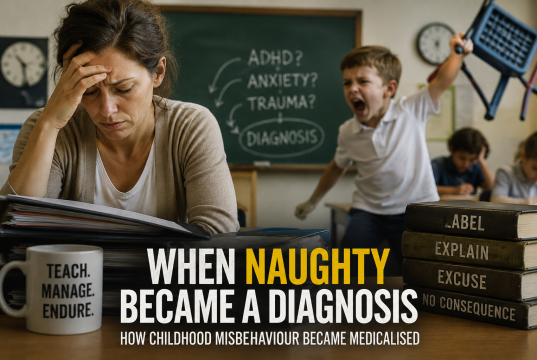
A new mental condition – ‘Conduct Disorder’ – was invented yesterday in a report commissioned by the National Institute for Health and Clinical Excellence (NICE).
‘Antisocial Behaviour And Conduct Disorders In Children And Young People – Recognition, Intervention And Management’ is National Clinical Guideline Number 158 and was jointly written by the National Collaborating Centre for Mental Health and the Social Care Institute for Excellence.
Pages 29 and 30 offer advice to parents, who are told to ‘encourage wanted behaviour rather than criticise unwanted behaviour’. ‘Shouting at a child to stop being naughty does not tell him what he should do, whereas, for example, telling him to play quietly gives a clear instruction which makes compliance easier,’ they say.
This ‘positive parenting’ model is very fashionable and sounds fine in principle but it may not be too firmly anchored in reality. The advice says of good parents:
‘For example, instead of shouting at the child not to run, they would praise him whenever he walks quietly; then he will do it more often. Through hundreds of such prosaic daily interactions, child behaviour can be substantially modified.’
NICE assert that when parents ‘find it hard to praise, and fail to recognise positive behaviour when it happens, the result is that the desired behaviour becomes less frequent’.
It isn’t too clear if there is any evidence to support this model. Telling a child hundreds of times a day that he is doing things well amounts to at least a dozen times an hour, or once every five minutes. Such a relentless barrage of praise is highly likely to exasperate the child, even if any parent in the real world actually has the time.
‘You are reading that book nice and quietly, Samantha!’
‘Yes, Mum, you told me that five minutes ago. And five minutes before that. …’
Andrea Sutcliffe, Chief Executive of SCIE, defended the report on the BBC Today Programme yesterday morning against a skeptical John Humfrys and a down-to-earth psychiatrist Dr Sami Timini, author of ‘Naughty Boys – Anti-Social Behaviour, ADHD and the Role of Culture’, who objected to the invention of a new medical condition.
The interview is well worth listening to; move the cursor to 1:33:45:
Professor Sami Timini – opposes labelling children with psychological condititions
Professor Timini said that diagnosis in mental health ‘only provides a description of a set of symptoms’ and that diagnosis is ‘a poor indicator of outcomes’. Naughty children had a variety of backgrounds, he said, and the guidelines ‘flew in the face’ of the research.
John Humfrys wondered if parents actually needed all the state agencies named in the report to fly to their aid.
Stephen Green, National Director of Christian Voice, said today:
‘No-one could be against praising children and building them up, but to contend that there is no place at all for correction and discipline, as the NICE report does, is to propose a simplistic and one-dimensional framework of parenting which only works in the imaginations of social workers.
‘Add to the mix the idea that anyone delinquent must be labelled with a mental condition and the full machinery of the state is starting to swing into play whenever a child is playing up.
‘I don’t want to be mean, but Ms Sutcliffe of SCIE, whatever that is, is exactly as I imagined her. In fact the whole executive of SCIE are much as one would imagine them: short-haired, greying, smiley women and a token man all committed to the idea that the state knows best.
‘Ms Sutcliffe is a member of the Department of Health’s Transformation Group and Care and Support Implementation Board. Did anyone know the DoH actually had such a body? And yet we are paying for it.’
Andrea Sutcliffe lives in Crouch End with David Stout, deputy chief executive of the NHS Confederation, the membership body for health service organizations, according to the Guardian. It is very much an NHS insiders enclave.Another Guardian report gives the impression that there are no children in the Stout / Sutcliffe home upon whom to try out the ideas in the NICE guidance.
(The title of this article is based on a quote from the song ‘Gee, Officer Krupke’ from West Side Story in which the Jets mock the kinds of medicalised excuses liberal authorities use to rationalise the existence of hooligans like themselves. Full lyrics here.)
Find out how to join Christian Voice and stand up for the King of kings (clicking on the link below does not commit you to join)
An RE teacher who recommended her pupils to sleep around instead of getting married has been banned from the profession, reports the Daily Telegraph.
The ban is for at least five years and has been imposed by Education Secretary Michael Gove. A disciplinary panel found her guilty of “unacceptable professional conduct” whilst employed at Saddleworth School, High Street, Uppermill, Oldham.
Catherine Reynolds, 29, also used abusive and profane language to pupils and spoke about her drinking habits.
Christian Voice National Director Stephen Green is due to speak about the matter on the Jeremy Vine show at 12.30 this afternoon, in a three-cornered discussion with someone who is actually prepared to defend her on the grounds that the occasional ‘loose cannon’ of a teacher adds colour to the profession.
Somehow we can’t see that defence being advanced from the sexual libertarian corner to defend someone teaching creationism in a biology class.
Find out how to join Christian Voice and stand up for the King of kings (clicking on the link below does not commit you to join)
Please note that persons wishing to comment on this story must enter a valid email address. Comments from persons leaving fictitious email addresses will be trashed.