
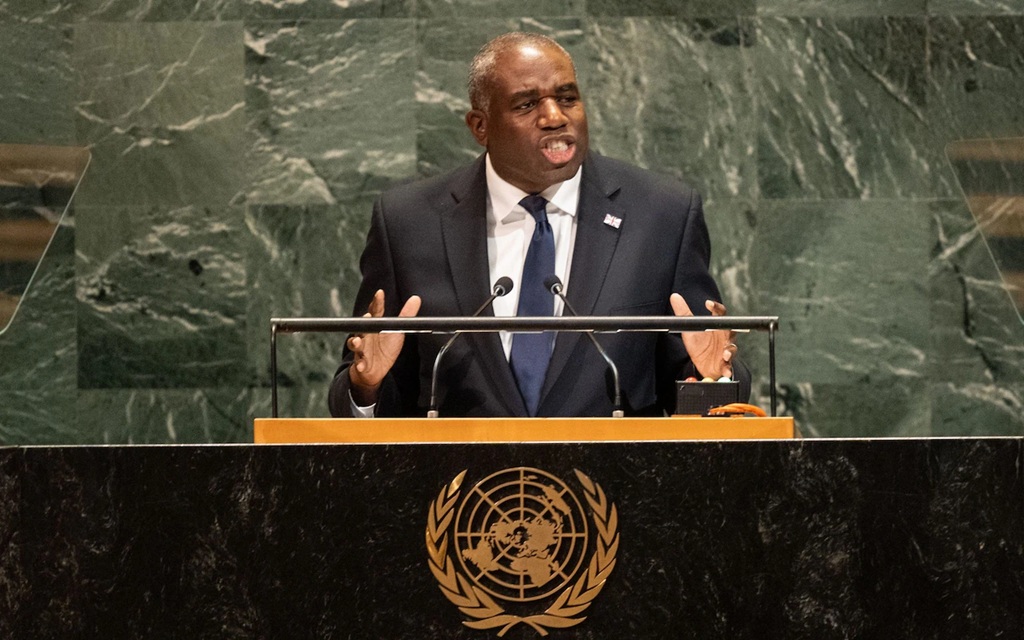
David Lammy has discovered Westminster’s latest solution to Britain’s family crisis: make marriage matter less. The man who claims to be a Christian has come up with a stupid idea because he fails to seek the Lord:
Psa 10:4 The wicked, through the pride of his countenance, will not seek after God: God is not in all his thoughts.
Jer 4:22 For my people are foolish, they have not known me; they are sottish children, and they have none understanding: they are wise to do evil, but to do good they have no knowledge.
Under proposals being considered by the Ministry of Justice, couples who have lived together for three years or who share a child could be granted inheritance rights similar to those enjoyed by married couples and civil partners. Cohabiting partners may also gain legal claims over property when relationships break down. The justification is “fairness”. Yet one awkward question remains. If marriage and cohabitation are effectively the same thing, why does marriage exist at all?
The Justice Secretary argues that many unmarried couples lack “adequate legal protections” when a relationship ends or when a partner dies. Well, yes. That’s because society should recognise marriage not as a private arrangement between two people, but as a public commitment that benefits children, families and communities. That’s why there has been some sort of ceremony or celebration for a marriage for millennia:
John 2:1 And the third day there was a marriage in Cana of Galilee; and the mother of Jesus was there: 2 And both Jesus was called, and his disciples, to the marriage.
Mr Lammy has not told us why cohabiting couples should receive the same inheritance protections as married couples. Marriage and civil partnerships already provide a clear legal framework, together with the rights and responsibilities that accompany them. Those who choose to cohabit have consciously decided not to enter those arrangements, despite being fully aware of the legal protections the state affords to marriage and family life. The result could easily be fewer people deciding to cohabit, and fewer still deciding to make that permanent with marriage and/or have children at a time when we are failing even to replace our population.
And if avoiding inheritance tax is an issue, the answer is simple. It’s ungodly, as we explain below. Abolish it altogether. Let the state raise money honestly in accordance with scriptural principles.
Genesis 2:24 Therefore shall a man leave his father and his mother, and shall cleave unto his wife: and they shall be one flesh.
For decades, the British state has devalued marriage, risk making it increasingly irrelevant. Marriage is the bedrock of a stable society, but our Establishment have stopped encouraging marriage in the tax system.
The Forgotten Benefits of Marriage
David Lammy’s proposals overlook a simple reality repeatedly confirmed by social research: marriage benefits not only couples but society itself.
Marriage provides stability, responsibility and permanence. Children raised in stable married households generally experience better educational outcomes, stronger emotional wellbeing and lower levels of poverty. Married couples often enjoy better health, longer life expectancy and greater financial security. These are not just religious observations. They are conclusions supported by decades of evidence, and by scripture:
Gen 1:28a And God blessed them, and God said unto them, Be fruitful, and multiply, and replenish the earth, and subdue it:
Yet while marriage rates continue to decline, Britain’s political class seems more interested in diluting the institution than strengthening it. The irony is difficult to miss. As family breakdown rises and birth rates fall, ministers remove the few remaining incentives for people to marry.
Marriage is a covenant, not a temporary arrangement. It is designed to provide stability for husbands, wives and children alike. Rather than extending marital privileges to every other arrangement, perhaps government should be asking how it can make marriage attractive again. After all, if every relationship receives the same recognition, eventually none of them mean very much at all.
Ecclesiastes 4:9 Two are better than one; because they have a good reward for their labour.
Support NCCSS / Christian Voice →
The Death Tax That Refuses to Die
Inheritance Tax is often presented as a levy on the wealthy who can easily afford to pay it. The reality is rather different. Under current rules, estates valued above £325,000 can be subject to a 40 per cent tax charge on assets above that threshold. In some circumstances, the threshold can rise to £500,000 when a family home is passed to children or grandchildren. Married couples and civil partners can also transfer unused allowances between them.
But it is the principle which is wrong from the spiritual dimension. It’s an ungodly tax, condemned by scripture:
Micah 2:2 And they covet fields, and take them by violence; and houses, and take them away: so they oppress a man and his house, even a man and his heritage.
After decades of paying income tax, National Insurance, council tax, VAT, stamp duty and countless other charges, families find the state wants even more when we die. Parents work, save and make sacrifices precisely because they hope to leave something behind for their children. Scripture presents inheritance as a blessing for families, not a revenue stream for the state:
Proverbs 13:22 A good man leaveth an inheritance to his children’s children.
Sign our petition for those in authority to return to Christian principles:
Return to the UK’s Christian Constitution →
The £12,000 Penalty on Family Life
Politicians claim to support families. The tax system tells a different story. Research shows families relying on one primary breadwinner can be more than £12,000 worse off than households where earnings are split between two parents.
Once a single earner crosses certain income thresholds, the family begins losing childcare support, child benefit and other allowances. Meanwhile, two parents earning similar combined incomes can keep many of those benefits simply because their earnings are divided differently.
The message seems clear: government increasingly favours households where both parents work full-time, putting their children into daycare. Unbiblically high taxation forces both parents out to work, further depressing the birth-rate.
Christian Voice has long argued that married couples should have fully transferable tax allowances between them. If one spouse earns less or stays at home to raise children, the the other can make use of any unused part of their personal allowance. In the 1960s, people earned less but could afford more. A married man on a family wage was scarcely in the tax system at all.
Strong families save the state billions through the care, stability and support they provide. Yet Britain’s tax system fails to recognise marriage as a social institution to be encouraged.
1 Timothy 5:8 But if any provide not for his own… he hath denied the faith.
Children are the Lord’s heritage
Byline Times reports that a Reform UK councillor has backed local cuts to NHS-funded IVF treatment, saying prospective parents should “cut their garment according to their cloth.”
The comments by Bridget Porter, a member of Reform-controlled Kent County Council, comes amid cuts to NHS-funded IVF treatment in the region, which will reduce eligibility for those seeking fertility treatment.
Bridget Porter said: ‘I’d also say this is evidence-based, from your experiences… A lot of people on subsequent cycles drop out of the system because they don’t like the discomfort of the treatment. … if people are on a low income, they should not be bringing babies into the world that they can’t afford them. They must cut their garment according to their cloth.’
She added: ‘These treatments are not health necessities — they’re lifestyle choices. So I think to have one cycle of IVF at the taxpayers’ expense is very generous.’
Antony Hook, Lib Dem Leader of the Opposition at KCC, said the comments were “utterly outrageous.”
Infertility is heartbreaking for those affected, but there is also a lot going on. Women are too often delaying having children into their late thirties when they are far less fertile. Should the state be funding IVF at all? But the Councillor’s view that people on a low income should not be having children is lacking in both compassion and any grasp of reality. If we all waited until we could ‘afford’ to have children, hardly any would be born at all. Human beings are not expenses on a spreadsheet. God’s command to humanity was simple: ‘Be fruitful, and multiply.’ And scripture says:
Psalm 127:3 Lo, children are an heritage of the Lord: and the fruit of the womb is his reward.
On the other hand, celebrity gays are viewing IVF as a consumer purchase, and if society gushes over them, we shall be forgetting something fundamental about family life, namely, that everyone alive has a father and a mother, like it or not and children should be brought up by a husband and wife, not pairs of gays. IVF can even be offered on the NHS to lesbians, when the solution to their problem is obvious, even if aesthetically or emotionally difficult for them.
Related articles
The elite taking farmers’ fields →
UK Facing Demographic Crisis →
Lesbians waste our money on IVF →
No, Tom Daley and Dustin are not ‘having a baby’ →
Ruth Davidson is having her baby, not ‘theirs’ →
Read and pray
READ: Genesis 1:28; Gen 2:18; Psalm 128:3–4; 127:3 Prov 13:22; Prov 31:11–12, Eccl 4:9–10; Mark 10:9; 1 Corinth 6:18 Heb 13:4; 1 Thessalonians 4:3, and Eph 5:3..31.
PRAY: Pray for the sanctity of marriage
Pray that newly elected leaders will govern with integrity, justice, and a commitment to serving all residents faithfully.
Pray that God will grant Godly leaders discernment to make decisions that promote truth, unity, and the common good.
Let us know what YOU think in the comments below.
Support us!
We appreciate your support; it enables our research and helps us inform your prayers.
So click below to support Christian Voice and stand up for the King of kings
Click on the social media links below to share this post: