
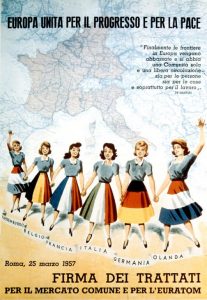
European Leaders are gathering in Rome, the Emperor Hadrian’s ‘Eternal City’, to celebrate the 60th anniversary of the Treaty of Rome. The Treaty was signed on 25th March 1957.
The champagne quaffing will however be somewhat tempered by the imminent arrival of That Article 50 Letter. UK Prime Minister Theresa May is set to start the Brexit process next Wednesday. Indeed, EU leaders pleaded with her not to do it during this week.
Where was the Treaty of Rome actually signed?
The Europa website says: ‘This will be an occasion to reflect on the state of the European Union and the future of the integration process.’ Integration process? Donald Tusk, President of the European Council also spoke of ‘sixty years of integration’. They don’t give up, do they?
We praise Almighty God for pulling the United Kingdom out of the ambitious, vainglorious Euro-Empire. But we can do so with even more enthusiasm. To do that we need to ask a couple of very simple questions:
Firstly, exactly where was the Treaty of Rome actually signed in ‘the Eternal City?’
Secondly, why was that spot chosen, and by whom?

A Revived Roman Empire
This author stood, almost a year ago, in the very room in which the Treaty of Rome was signed. It is now part of a museum. But what was there before? What was it built on? No-one before had joined together these particular spiritual dots. The resulting 3 minute 40 second video gives the answers: The European Union’s Pagan Foundation. (All links open in a new tab automatically.) It traces a link from Babel through Babylon and the Pergamos of Revelation 2:13 to ancient Rome.
But why was the Treaty of Rome signed in this particular spot? And make no mistake, it is a place with great significance to the European Union. In fact, the doomed Constitution was signed by European leaders at the very same place in 2004. To answer the question, It is only necessary to look at the intentions of the man who became known as the first Eurocrat. Paul-Henri Spaak, the EU’s architect, was convinced he was reviving the Roman Empire. This second video, The European Union’s Roman Empire, explains all. It’s just under 4 minutes.
If you prefer the written word to video, this author’s article: EU – Christian Project or Catholic Plot? tells you all you need to know. And maybe a bit more!
An apology!
Sorry for not giving you the answers to the questions immediately within this post. That would have meant rehearsing everything in the videos or the article. Please click on those links, which open automatically in new tabs, to get all the information to inform your prayers.
Article 50 will be triggered next week, God willing. But we still need to remember it’s not over till it’s over. This author will be delighted to come to your church or fellowship to share insights into the European Union and help keep the prayer going.
Pray: Praise God for his mercy in taking the UK out of the EU’s revived Roman Empire. And as the leaders of the remaining 27 gather to celebrate 60 years of the Treaty of Rome, pray for an end to the EU’s ambitions. Pray the EU comes to an end peacefully.
This article by the BBC’s David Willey confirms the spiritual significance of the venue. It is worth a read.
He says the signatories, ‘were gathered at the very hub of the ancient world where, 2,500 years ago, six centuries before Christ, the foundations were laid of Rome’s first major temple, dedicated to Jupiter, king of the gods’. A Revived Roman Empire indeed.
Revelation 17:14 These shall make war with the Lamb, and the Lamb shall overcome them: for he is Lord of lords, and King of kings: and they that are with him are called, and chosen, and faithful.
Psalm 2:4 He that sitteth in the heavens shall laugh: the Lord shall have them in derision.
Please click on the icons below to share as widely as possible:


I must ask Stephen’s forgiveness for disagreeing with him on this. There are other explanations why the Treaty of Rome was signed in this particular room.
Firstly, why Rome ? One has to remember that at the time, Berlin was not the capital of Germany, and to sign this treaty in Germany at all at that date would not have been a popular move. Equally, perhaps, to choose Paris would have been to suggest the future dominance of France, with memories of Napoleon.
This leaves Rome as the natural choice, the grand capital of a country which never manages to be very powerful . Somewhere in Benelux might have been equally suitable, and of course Brussels did develop an important role later. But for that moment, it was Rome which seemed a good choice.
Why that room ? Although open to the public, which in Italian or French makes it rank as a museum (the inside of Windsor Castle is a museum in those languages), and although arranged as part of what we would call a bona fide museum too, this grand place is used for important civic occasions, rather like the Guildhall in London. It’s where the then mayor of Rome entertained Kaiser Wilhelm II , for example. It’s not for nothing that pictures of the signing are reminiscent of a Lord Mayor’s Banquet.
Forgive me if I find Stephen’s explanations a trifle little far-fetched. I’m sure very few people present had Jupiter or the Caesars in mind. Mussolini had consciously tried to recreate the Roman Empire, and failed. This was not intended to be a second attempt at it.
Well, Paul-Henri Spaak was clear about the significance of the venue, as is reporter David Willey. His quote I added admittedly after your comment. Perhaps you need to get over your presumption that there never can be a spiritual dimension to a story. Very often the unseen realm is behind a great deal of what goes on. As here.
Well yes, I don’t want to throw out the baby with the bathwater.
Once chosen, it was a nice place to meet, and one makes the most of that. They were keen on Charlemagne too, and similar statements would have been made if they had met in Aix-la-Chapelle / Aachen, recalling the unity of France and Germany during the “Ersten Reich” (a term which would probably not have been used !). If they had met in Dijon, that would have been praised as the capital of Burgundy (which in its heyday included much of Benelux and more, lying between a much smaller France and Germany), Then the new European entity would have been hailed as an extended Burgundy.
You seem to forget that the influence of the old gods very much waned in the Roman empire, with new religions from the East like Mithraism being widely adopted. Finally, it was a Christian empire — if it hadn’t been, Christianity might well have died out. The reason that the equestrian statue of Marcus Aurelius is proudly displayed here at the heart of Rome is that it was originally thought to be Constantine, so was preserved from destruction. There is also a huge foot of Constantine there, even a head (the main part of the colossal statue would have been of inferior construction, so mostly did not survive),.
I do realise that there is a spiritual dimension to Europe, not just an economic one. Where I think the remain campaign went wrong was in ignoring that. They could have stressed that we are Europeans, and so Mozart and Picasso are ours as well as Shakespeare; the Mediterranean and the Alps as well as the Lake District. They could indeed have stressed that European culture has developed as a Christian culture. Perhaps all this was discouraged because of the problem of attracting “Asian-Europeans”, and the possible accusations of racism. Perhaps best also not to stray into rivalry between Catholicism (where most of the old cultural aspects are to be seen) and Protestantism.
We can enjoy European art without being in the European Empire.
Certainly.
And you can sign a modern treaty in the principal ceremonial room of the municipality of Rome without reviving the pagan Roman Empire.
Except that reviving the Roman Empire is precisely what the architect of the whole process, Paul-Henri Spaak, intended to do.
As you know, Spaak was an agnostic. However much he had the Roman Empire in mind as an obvious model for a united Europe, he would not have intended it to be dominated by the worship of the Christian god, or of Jupiter, or of any pagan god, or of Allah. That was never the idea, and he would not have approved of such a thing.
He could quite easily be agnostic and harking back to the glories of the Roman Empire with or without full-on Roman paganism. People are complex, you know.