
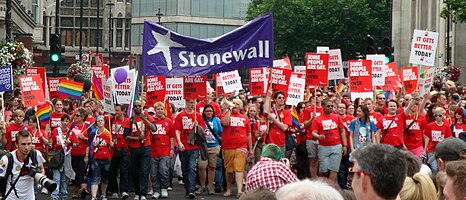
Stonewall is facing a serious financial crisis after years of aggressive activism and ideological campaigning.
Newly published accounts show the group recorded a deficit of almost £1 million in the last financial year, as income collapsed and spending continued to outstrip resources.
Its total reserves fell to just £91,811 by March 2025, down from nearly £1 million a year earlier. The figures show that Stonewall’s income dropped sharply from £6.9 million in 2024 to £4.7 million, while expenditure remained high at £5.6 million.
Much of the shortfall came as public bodies and major corporations withdrew funding or declined to renew contracts, particularly those linked to Stonewall’s ‘workplace diversity schemes’.
Fees from these programmes fell by more than £600,000 in a single year, reflecting growing institutional reluctance to be associated with the group’s agenda.
Political lobbying disguised as charity work
Despite presenting itself as a ‘charity’, Stonewall continues to operate as a political pressure group, lobbying government departments, regulators, the NHS, and police forces to adopt contested policies on sex and gender.
In recent years, its focus shifted decisively toward ‘trans activism’, including the promotion of ‘self-identification’ policies, ‘gender-neutral language’, and the removal of sex-based distinctions in public services.
Stonewall’s influence extended into schools, prisons, women’s refuges, healthcare settings, and policing, often with little democratic oversight. It interventions undermined safeguarding, parental rights, freedom of belief, and sex-based protections, particularly for women and children. These concerns were frequently dismissed by the organisation as bigotry rather than addressed substantively.
As opposition grew, including from parents, clinicians, teachers, feminists, and faith groups, Stonewall’s once-unquestioned authority began to erode. The financial consequences now visible in its accounts suggest that the public have seen Stonewall for what it truly is.
Isaiah 5:20 Woe unto them that call evil good, and good evil; that put darkness for light, and light for darkness.
Join or Support Christian Voice →
Controversies, legal risks, and public backlash
Stonewall’s decline coincides with a broader reckoning over the consequences of policies it helped normalise. Legal cases challenging sex-based rights, safeguarding failures in schools, and NHS treatments for children with ‘gender dysphoria’ have intensified scrutiny of the ideological framework Stonewall promoted. Institutions that once relied on Stonewall guidance have found themselves exposed to litigation, regulatory intervention, and public criticism.
Several high-profile organisations, including government departments and broadcasters have formally cut ties with Stonewall, citing concerns over neutrality and legal compliance. These departures were not symbolic; they represented a rejection of Stonewall’s assertion that its positions reflected settled law or public consensus.
For us at Christian Voice, the financial crisis is not accidental but the result of sustained overreach. But also, in a sense, Stonewall have won. The establishment, the quangocracy, now engage in trans activism, even trying to act as if the Supreme Court ruling last April, stating that sex is biological, never took place.
Numbers 32:23 Be sure your sin will find you out.
What this moment reveals
Stonewall’s financial predicament highlights the risks of allowing unelected lobby groups to shape public policy without accountability or restraint.
For taxpayers, the episode raises serious questions about how public money is allocated and whether ideological enforcement should ever have been funded in the first place. For Christians and others concerned with truth, order, and justice, the situation underscores the consequences of abandoning moral clarity in favour of political fashion.
As Stonewall’s resources dwindle, the wider lesson remains: movements built on coercion, ideological conformity, and the silencing of dissent rarely endure. But ‘trans’ ideology is taking a long while to die.
“Why trans is a mental-health issue”
For years, clinicians were trained to approach gender-related distress through careful psychological assessment, recognising it as a serious form of human suffering requiring evidence-based care. That professional framework has steadily collapsed.
As practising psychotherapist Stella O’Malley recently wrote on Spiked Online, “what was once clearly understood as a mental-health issue has been rebranded as a matter of personal identity, beyond clinical questioning or therapeutic challenge. This shift has left families and vulnerable individuals without clear guidance at the very moment clarity is most needed.”
Medical leadership has played a central role in this retreat. Rather than defending rigorous diagnosis and long-term risk assessment, professional bodies increasingly adopted euphemistic language, avoiding words such as “disorder” or “distress” in favour of affirming narratives. In doing so, they effectively abandoned their duty to weigh harm, risk, and irreversible outcomes. The result has been confusion, not compassion, and a clinical culture reluctant to speak honestly about long-term consequences.
“The move away from a mental-health framework was not accidental. In 2010, international organisations such as WPATH deliberately promoted “de-psychopathologisation”, reframing gender distress as a neutral human variation rather than a condition requiring psychiatric care. Governments and health services were encouraged to follow suit. What began as an attempt to reduce stigma evolved into a wholesale rejection of mental-health language altogether,” She added.
This redefinition has had serious consequences. By removing clinical caution, medical interventions with permanent effects were recast as routine and celebratory. Risks such as infertility, sexual dysfunction, bone density loss and chronic pain were marginalised.
Suspect attack JD Vance home transgender Democrat donor

The collapse of clinical restraint has not occurred in a vacuum. Cultural narratives that frame identity as absolute and unquestionable increasingly spill into public life, sometimes with disturbing consequences.
This was evident in the recent attack on the home of US Vice President JD Vance, allegedly carried out by a transgender-identifying individual now facing multiple criminal charges. The incident was not merely an act of vandalism, but an escalation that raised serious questions about radicalisation and grievance politics.
The accused individual was not marginalised in the conventional sense. Reports indicate a background of considerable wealth, elite education, and political connections. This challenges the commonly repeated claim that extreme behaviour in such cases is driven solely by social exclusion or poverty. Instead, it raises the uncomfortable possibility that ideological certainty, when reinforced by institutional affirmation, can contribute to volatility rather than stability.
Public trust erodes further when political, media and institutional leaders appear unwilling to confront this complexity. By refusing to acknowledge the role of ideology in shaping behaviour, they leave society ill-equipped to respond when belief hardens into action.
English courts defy own ruling on trans toilets

Nowhere is institutional confusion more evident than in the response of English courts to their own legal rulings.
Despite a landmark Supreme Court judgment clarifying that “sex” in the Equality Act refers to biological sex, court authorities have continued to allow biological males into women’s toilets. This refusal to implement settled law has alarmed campaigners and undermined confidence in the justice system’s impartiality.
The courts’ explanation that they are awaiting further guidance from the Equality and Human Rights Commission has only deepened concern. The EHRC itself has stated that public bodies are expected to follow the law as it stands, not delay compliance indefinitely. That the courts, of all institutions, appear to be defying legal clarity has been described as both absurd and dangerous.
Women’s rights advocates warn that this reluctance to act places women at risk, particularly in enclosed and vulnerable spaces. The issue is not abstract. It concerns safety, dignity, and the principle that legal rulings should be applied consistently, not selectively. When law is treated as optional, public confidence fractures.
This episode reflects a broader failure of leadership. Ideological pressure has overridden legal duty, leaving taxpayers to fund institutions that refuse to uphold their own rules.
Related Story
Royal College of Psychiatrists cut ties with Stonewall →
Schools defy ministers: children ‘change gender’ without parental knowledge →
Mother banned from seeing sex-ed materials →
Costa promotes mutilation as Government
delays schools “transgender” guidance →
NHS bans puberty blockers for children →
UK in disarray over “puberty blockers” →
Who Are The Trans Activists Influencing British Schools, Sports and the NHS? →
Read and pray
READ: Isa 5:20; Prov 31:8–9; Matt 6:24; Rom 1:18-32, Gala 6:7; Jhn 1:5.
PRAY: Thank God for opening the eyes of organisations who have chosen to withdraw funding.
Pray that God will continue to expose lobby groups disguised as charity.
Pray for the protection of children and the restoration of moral boundaries.
Let us know what YOU think in the comments below.
Support us!
We appreciate your support; it enables our research and helps us inform your prayers.
So click below to support Christian Voice and stand up for the King of kings
Or fill in the form below to keep in touch:
Click on the social media links below to share this post:</span