
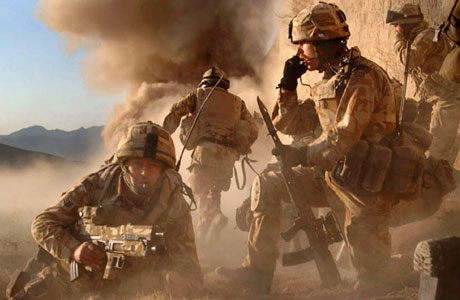
 As the U.N. General Assembly continues its 67th session, two things have become clear about the Middle East: (1) it’s a mess; (2) the West cannot fix the endemic problems.
These two things were clear from day one of the General Assembly. Of course, the fact that the West cannot fix the problems in the Middle East does not mean that America will cease to try. All indications suggest that America’s involvement in the Middle East will only increase in the days ahead, even if it ends up plunging the nation (and, by extension, all the nations who depend on the dollar as a reserve currency) into economic Armageddon.
Is there a solution? Gary Johnson believes there is. Johnson is the former Governor of New Mexico and the Libertarian Party nominee for the 2012 Presidential Election. Writing in the Huffington Post earlier this month, he made a statement that at one time might have seemed axiomatic: “Foreign policy is supposed to make us safer, not get Americans killed and bankrupt us.”
Johnson’s article, titled ‘Libya, Afghanistan and the Middle East — Why Obama and Romney are Both Wrong’ went on to propose an astonishingly straight-forward solution:
Stop trying to manipulate and manage history on the other side of the globe and then being shocked when things don’t turn out the way we wanted. As far as what we do right now in response to the tragic events of this week, it’s actually pretty simple. Get our folks out of places they don’t need to be — and out of harm’s way — and cut off every dime of U.S. tax dollars we are sending to clearly ungrateful regimes.
Johnson went on to point out the irony that America’s ‘War on Terror’ is actually self-defeating, since it has been systematically empowering the most dangerous terrorist regimes:
Let’s review American foreign policy during the Bush-Obama years. Just imagine for a minute that, in 2002, President Bush granted Iran’s Ayatollah one wish above all others. It is not unreasonable to assume that the Supreme Leader would have said, “Can you please kill Saddam Hussein and make sure our mortal enemy Iraq can no longer threaten us. Then, we can get about our goals of destroying Israel, building a nuke and becoming a legitimate thorn in the side of the Western infidels.”
Well…
And then there are Afghanistan and Pakistan. After 9/11, going after Bin Laden and al Qaeda was exactly the right thing to do. We were attacked and we attacked back. We must defend ourselves, and we absolutely must have a strong defense. But within a few months, our troops had scattered al Qaeda like ants from a kicked anthill, and Bin Laden had set up housekeeping in Pakistan. Al Qaeda left, but we stayed — and kept fighting a war that was, in terms of our immediate interests, over. And we’re still fighting it today, ignoring the lessons learned at great cost by the Soviet Union and the British Empire.
While we’re fighting a war we don’t need to fight in Afghanistan, we’re pumping billions of dollars into the coffers of our new best friend Pakistan — making them the second largest recipient of our borrowed and printed dollars on the globe. When we finally found and killed Bin Laden, was anyone surprised that we found him — you got it — in Pakistan? And our new best U.S.-financed friends are treating the good Pakistanis who helped us find him like criminals.
Fast forward to Libya. Make no mistake, Muammar Gaddafi was a despicable human being and no reasonable person mourns his demise. But toppling dictators we don’t like has not worked out very well for us. We launched hundreds of millions of dollars’ worth of missiles to kill the guy, and what do we get? A Libya that cannot even keep its benefactors safe — and may not even be trying very hard. Somebody needs to ask, and I will be that somebody: As despicable as he was, would our ambassador and three other dedicated public servants have been killed in a Gaddafi-controlled Libya? Are we safer today after launching all those missiles and killing Gaddafi? Clearly not.
So much for Iraq, Afghanistan, Libya and Pakistan. But what about last year when America supported protests in Egypt to topple President Mubarak? At the time many Christians saw this as a good thing, and yet in all the excitement about democracy coming to Egypt, we felt compelled to offer some warnings. In our newsletter we wrote that,
Despite the criticisms that can be made against him, President Mubarack has provided a stabilizing influence in the region, helping Israel secure its borders and keeping radical Islam in check…. What Obama’s approach overlooks is that the “free elections” in Middle Eastern countries can often be a summons for the advancement of Islamic radicalism and fundamentalist groups like the Muslim Brotherhood.
We then went on to point out that American interference in Middle Eastern politics has normally backfired, and we predicted that President Obama’s support of the Arab Spring in Egypt could prove to be an uncanny repeat of what happened in Iran during the Middle of the last century.
In an attempt for the West to regain control of Iran’s oil, Britain had urged the United States to intervene in Iranian politics during the Truman’s administration. Truman’s Secretary of State, Dean Acheson, refused, urging that the British were “destructive and determined on a rule or ruin policy in Iran.” It was not until General Dwight Eisenhower was elected President in 1953 that Britain had another chance to regain control of Iran’s petroleum reserves. Churchill put an embargo on Iran’s oil industry while the CIA began spreading anti-Mossadegh propaganda, hoping to convince the Shah to dismiss Mossadegh from the post of prime minister. At first the Shah refused to go along with the American plan to overthrow his democratically elected government (a plan known to the CIA as ‘Operation Ajax’). However, after continued pressure from America the Shah relented. The prime minister was then arrested and kept under house arrest until his death in 1967.
With Iran’s democratic government out of the way, the Shah’s rule became increasingly autocratic. While he made friends of America (granting US companies the majority of the country’s oil contracts, which had been the intended outcome of Operation Ajax), he steadily alienated his own people by crushing all political dissent. This set the stage for Iran’s Revolution in 1978 when the religious leader, Ayatollah Ruhollah Khomeini helped to mobilize opposition to the Shah and his pro-American policies. The following year 98% of the country voted to replace the monarchy with an Islamic Republic, unaware that Khomeini was planning to use the new government as a front to rule as a dictator. Since then Iran has suffered under a theocratic Shiite government and remains a focal point for militant Islam and is one of the worst countries for the persecution of Christians. How much better it would have been had America never got involved in undermining Iran’s government.
We haven’t had to wait that long before being able to say, of Egypt, “How much better if America had never got involved.” (And yes, America did act behind the scenes to topple President Mubarack.) Since President Mubarack was forced to step down, the one thing that has stepped-up is the killing of Christians. Compass Direct News has been regularly reporting on the violence against Egypt’s Christian population, which has escalated relentlessly since President Mubarack was forced from power.
So much for Iraq, Afghanistan, Libya, Pakistan and Egypt. But what Iran. Should America begin bombing Iran to stop them getting a nuclear bomb? If only it were that easy! Defence analysts Anthony Cordesman has put together a pdf outlining exactly what America would have to do to take out Iran’s nuclear facilities. A less technical summary of Cordesman’s findings were put together earlier this month in Noah Shachtman’s article ‘U.S. Attack on Iran Would Take Hundreds of Planes, Ships, and Missiles.’ As the title of Shachtman’s piece suggests, taking on Iran won’t be a cakewalk. As The Week magazine wrote, summarizing these findings:
…it would require “an all-out effort” involving squadrons of bombers and fighter jets, interceptor missiles, drones, Navy carrier strike groups—in other words, a war. …the mission would begin with at least 90 fighter jets launching simultaneous attacks on the country’s extensive air-defence network and numerous missile sites. B-2 stealth bombers would then drop 30,000-pound bunker-busting bombs on Iran’s nuclear sites, some of which are buried beneath mountains. After that first strike, U.S. warships and minesweepers would fight for months to stop Iran from blocking the Straight of Hormuz and cutting off 20 percent of the world’s oil supply. Despite our best efforts, Cordesman warns, Iran’s retaliation against Israel and U.S. allies in the Gulf would be fierce, with “devastating regional consequences.”
Is there a solution to this mess? Probably not, as long as Islam reigns supreme in the Middle East. Behind the Middle East’s increasing political problems is a spiritual problem, and the only way for that to be adequately addressed is through the power of the gospel.
PRAY: Sometimes human problems are so complex that only God can solve them. Pray that He would turn around the mess in the Middle East and bring glory to His name as a result. Also pray for the struggling Christian population throughout the Middle East and for the safety of Israel as her enemies are growing in both strength and number.






I don’t see any chance at all of Islam not staying predominant in the Middle East. It certainly makes sense to leave the place alone unless things really get out of hand, and then to intervene as little as possible.
It’s a shame that there is no chance of this Gary Johnson winning.
Good point, Rox. The crusades were counter-productive wars by a corrupt Christianity, which ensured enduring hostility. When Bush announced his CRUSADE against terrorism, the Muslim regimes immediately understood what he meant. If he had not used the pejorative word, the ensuing wars have made it clear.
We do not make ourselves safer by multiplying enemies. The wonderful thing about the Gospel of Jesus is that it makes enemies into friends.
Or, the crusades were an honest attempt to rescue the Holy Land from anti-Christian, anti-Jewish aggressors.