
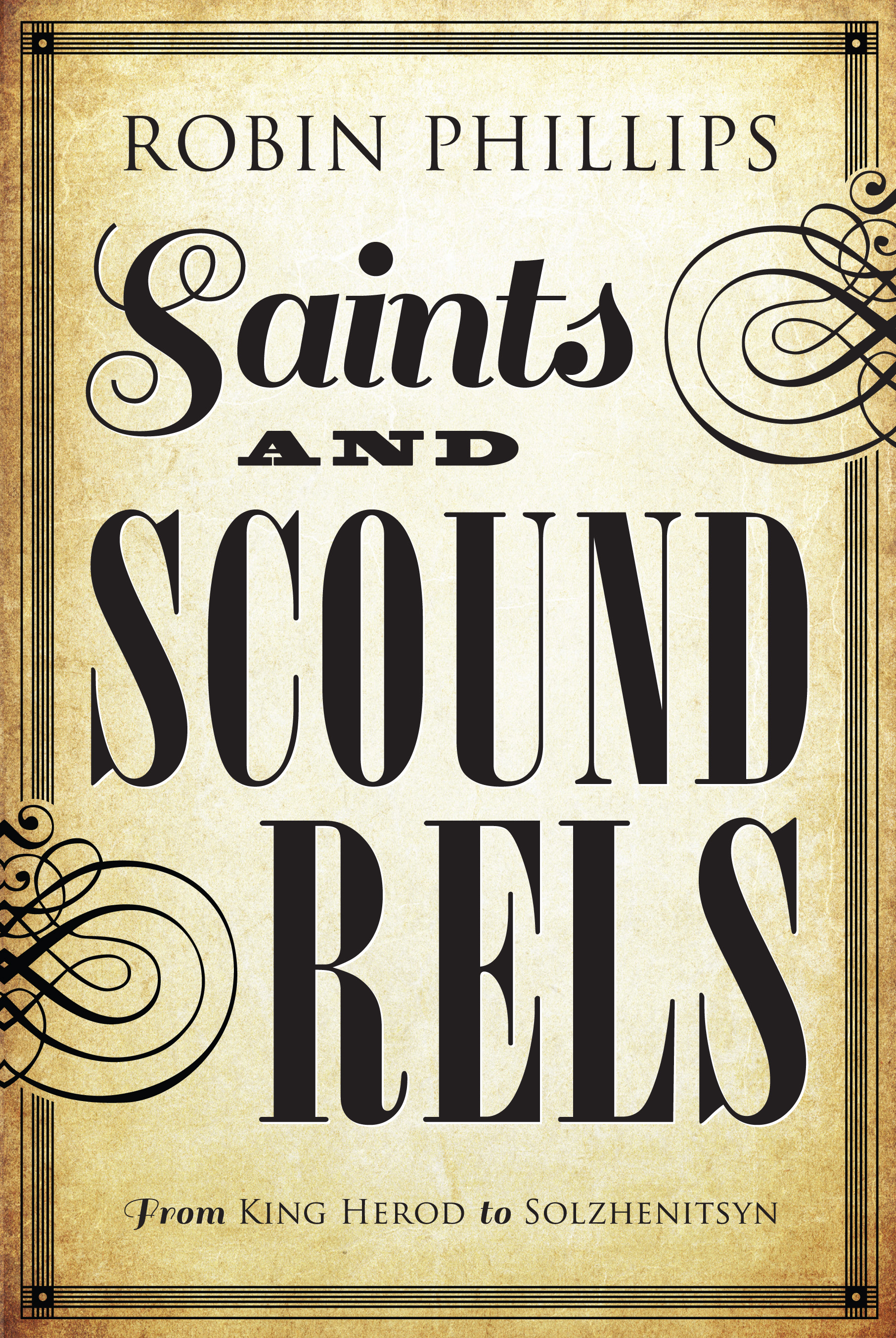
 Christian Voice journalist, Robin Phillips, has released a book about some of the good guys and bad guys of history.
Titled Saints and Scoundrels and available through Amazon,co.uk, the book promises to be rewarding to Christian Voice members who enjoy reading Robin’s column on Christian reformers in the monthly newsletter, or have been inspired by the Heroes of the Faith section of this website.
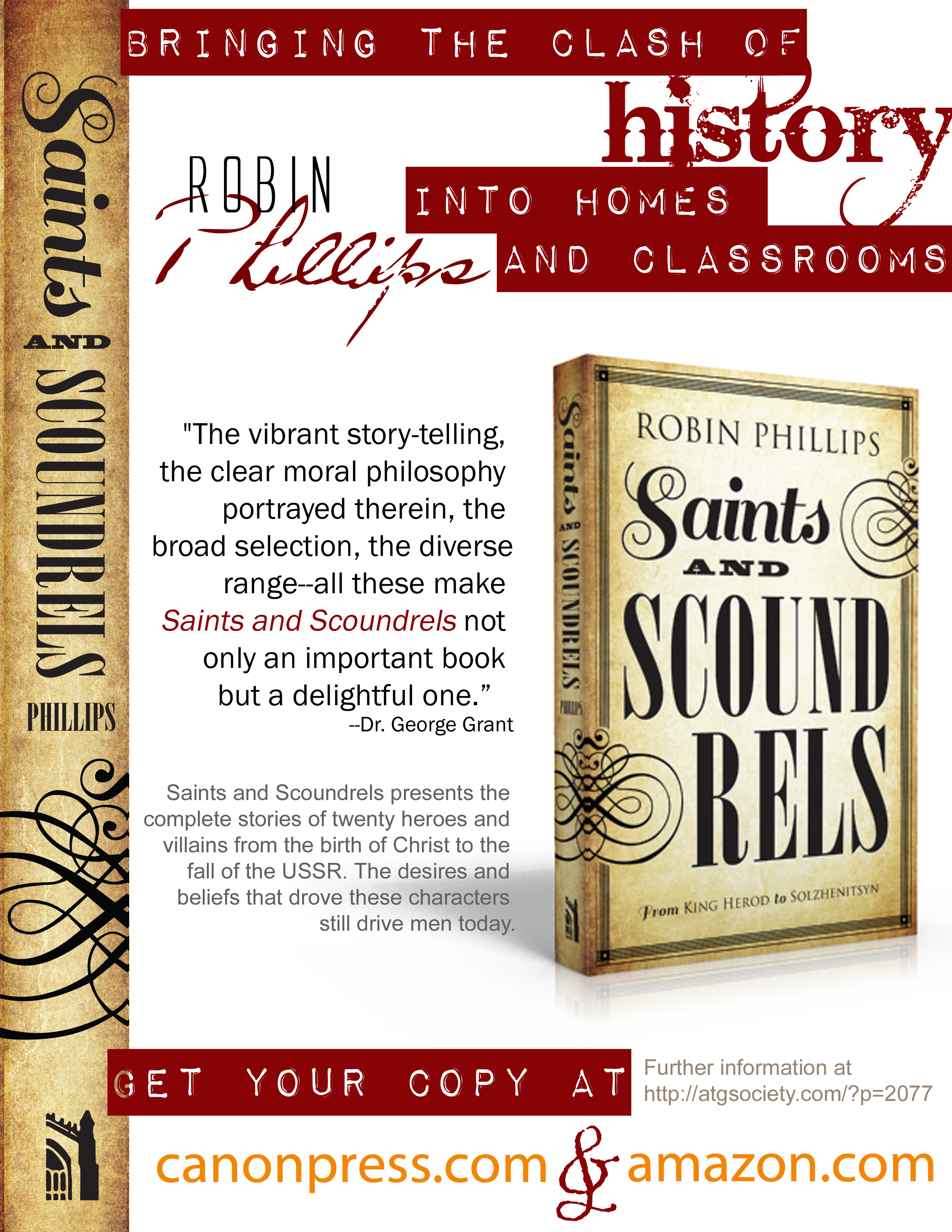
The book presents complete stories of twenty heroes and villains from the birth of Christ to the fall of the USSR. At the end of each chapter are discussion questions relating the chapter’s themes to larger issues and a personal challenge applying the lessons from these lives to the reader and current society.
What Others Are Saying
Author and public speaker Dr. George Grant has called Saints and Scoundrels, “not only an important book but a delightful one.”
Reviewer Matthew Sims has commented, “His writing was approachable for the average reader and engaging …Everything is covered from a Christian world-view and will help nurture discernment in the young and up-and-coming reader in your family.”
In an interview with Robin Phillips for the program Trinity Talk, Pastor Uri Brito commented, “The book is not just biographical you actually deal with the implication of their lives and how their lives testify to a particular worldview whether good or bad.”
The Good and the Bad
 Mr Phillips covers the following men and women in the book:
- Herod the Great (bad guy)
- Saint Perpetua (good woman)
- Saint Irenaeus (good guy)
- Saint Columbanus (good guy)
- Alfred the Great (good guy)
- King John (bad guy)
- William the Silent (good guy)
- Richard Baxter (good guy)
- J. S. Bach (good guy)
- Jean-Jacques Rousseau (bad guy)
- Edmund Burke (good guy)
- William Wilberforce (good guy)
- Thomas Chalmers (good guy)
- Joseph Smith (bad guy)
- George MacDonald (good guy)
- Dietrich Bonhoeffer (good guy)
- Dorothy Sayers (good guy)
- Jim Elliot (good guy)
- Aleksandr Solzhenitsyn (good guy)
In discussing each of these good guys and bad guys, Phillips draws lessons that can be applied not only to our personal lives, but which also offer a vision for a godly society.
Below are some notable quotes from Saints and Scoundrels.
On Building Christendom
What is just as important as defeating or converting God’s enemies is the positive work of building up the culture of Christendom. For every Berlin wall that crashes to the ground, there are dozens of churches to be raised up, schools to be created, homes to be established. For each Roman coliseum that decays into ruins, there remain hundreds of libraries to be built, hymns to be composed, families to be nurtured in the faith. Here again, God does not work ex nihilo but calls men and women to be agents in His kingdom-building work.” Saints and Scoundrels, pages 13-14
On Goodness, Truth and Beauty
“…the greatest defense against evil is to enjoy the good…the strongest bulwark against unbelief is our capacity to love what is beautiful…the surest support against the lies of the devil is to be attracted to what is true.” Saints and Scoundrels, page 14
On the Messiah’s Kingdom
“…throughout the Old Testament, first-century Jews looked forward to a climactic event that would establish the God of Israel as the sovereign God of the entire world. While many have supposed Christ’s coming to be something which changes people’s hearts but makes no difference to the public order, this was not the hope of the Jews. Had they expected that kind of a kingdom, Herod may not have lifted an eyebrow when the news reached him that the Messiah had been born in Bethlehem. As it was, however, Herod knew what Zacharias knew and had prayed about— that when the Messiah came, the game would be up for tyrants like himself, and a new order of justice and peace would be introduced. (Lk. 1:67–79).” Saints and Scoundrels, page 35
On Christ’s Kingdom being for this World
“Jesus never said that His kingdom is not of this world, despite wrong translations of John 18:36. The Revised Standard Version translates John 18:36 closest to the original Greek: “My kingdom is not from this world.” Christ’s kingdom is certainly of and for this world, but it does not arise from the authority of worldly powers in the way that Herod’s kingdom did. Rather, it descends from heaven to earth, like Jesus. Thus, Christ taught us to pray, “Thy kingdom come on earth . . . as it is in heaven” (Mt. 6:10). As used in the gospels, the expression “kingdom of heaven” refers to God’s lordship being brought to bear in the present reality. This draws on the theology of passages like Daniel 7: 26–27 and is the same crowning vision we find in Revelation 11:15: “The kingdoms of this world are become the kingdoms of our Lord, and of his Christ.” Saints and Scoundrels, page 36
On Jesus vs. Caesar
The Christians, like the Caesars, applied the language of euangelion (“gospel” or “glad tidings”) to their movement. The Christians, like Rome, taught that they held the answer for bringing justice, order ,and peace to the world (Lk. 2:13–14; Jn. 14:27). The Christians, like the Romans, claimed that a single man had rightful dominion over the whole earth (Mt. 28:18). The Christians, like the imperial religion, offered a sense of community to previously warring pluralities (Gal. 3:28). The Christians, like the religion of Rome, were intent on evangelizing the world (Mt. 28:19). But whereas the Caesars sought to Romanize the world through brutality, force, and bloodshed, the Christians sought to evangelize the world through love, self-giving, and sacrifice. The glad tidings of Jesus was therefore bad news for Caesar, since it proclaimed there was another way to transform the world that was superior to Caesar’s way. It announced that God had called out a people whose vocation was to work for peace and justice on Jesus’ terms, not Caesar’s.
Even when the early Christians submitted to the ruling authorities, there was an implicit challenge. In writing to the Romans, Paul made clear that the reason Christians were to submit to the civil magistrates is because the rulers have been placed there by the higher authority of God (Rom. 13:1). Though the Caesars liked to think of themselves as subject to no one, Christians proclaimed that earthly rulers are God’s ministers, responsible for carrying out His business here on earth (Rom. 13:2–7). The idea that Caesar’s authority was derivative rather than ultimate was nothing less than fighting talk in the politically tumultuous days of the first and second centuries.” Saints and Scoundrels page 43-44
On Growing in Wisdom
“The Christian life is both practical and intellectual, and that we separate these two facets at our peril. The Christian life should be practical, since the effectiveness of our witness for Christ depends on the gospel flowing out of our fingertips, being constantly applied to the material of our daily lives. But in order for a Christian to serve Jesus in practical ways, he must also grow in wisdom and understanding.” Saints and Scoundrels, page 85
On Christendom
The life of the nation, no less than the life of the individual, needs to be regulated by Christ’s lordship. The Bible is not simply a devotional manual for our private lives, but a template for bringing all of culture into subjection to Christ… “Christendom” is not simply a collection of Christians living together in society, but it comprises the institutions, literature, manners, works of arts, educational values—in short, the entire fabric of culture—which emanate from Christian civilization. A moment of time is all it takes for a person to turn from unbelief to faith in Christ, but it takes hundreds of years to build Christendom out of a previously pagan society.” Saints and Scoundrels, page 87-88
On Culture
Geniuses do not arise out of a vacuum. They are the product of years—often centuries—of collective input from dozens of individuals. Most of these individuals will probably be unaware of the heritage they are contributing to, yet their collective efforts help to foster and sustain a culture in which greatness can thrive.” Saints and Scoundrels, page 142
On Self-Regulation
Those who have never learned to be responsible and self-regulating have difficulty conceiving solutions to life’s problems apart from the extremes of complete antinomianism, on the one hand, or complete totalitarianism on the other.” Saints and Scoundrels, page 169
On the Weapons of our Warfare
We remember Wilberforce for what he achieved. Yet the most valuable lesson from his life comes not from what he accomplished, but how he accomplished it. Unlike in America, where abolitionists were willing to use violent force to achieve their ends, in England abolition remained a peaceful movement. This was no accident, for Wilberforce steadfastly refused to pursue revolutionary means for achieving his goals. This is because he recognized that the slave trade was not itself the root problem but merely a symptom of a society that had rejected God’s laws. It followed, he believed, that spiritual rather than revolutionary means were necessary in the fight for justice.” Saints and Scoundrels, page 193
On Faithfulness
God calls us to be faithful in the jobs He has given us, but He does not guarantee the consequences of doing right. Faithfulness, not success, is what truly matters in the Lord’s economy.” Saints and Scoundrels page 194
On Changing the World
Thomas Chalmers teaches us the importance of having bold and outrageous vision. He once remarked, “Regardless of how large, your vision is too small.” Chalmers lived by these words, always seeking ways to expand his vision. His vision was so large that it went beyond the confines of his own country and was international in its scope. He was concerned, not just with Scotland, but with Christendom. But although Chalmers’ vision for God’s kingdom was a vision for the whole world, it always started with the needs that lay closest to home. Unlike Rousseau, who neglected the needs of those closest to him in order to save the world, Chalmers’ love for mankind always manifested itself in his love for the person next door. The key to changing the world was to change the neighborhood.” Saints and Scoundrels, page 206
On Liberty
Liberty is not a natural right of man (as Rousseau had claimed), but the product of tradition, family, and faith. It is passed on in much the same way as property is transmitted, from one generation to another, namely, through inheritance. To support this notion of liberty as an inheritance, Burke pointed to the great freedoms of the British tradition, showing that they had accumulated over a period stretching back to the Magna Carta, the Declaration of Rights, and the entire network of common law freedoms which the hereditary succession of the monarchy helped to preserve. The legacy of these liberties would not long abide a generation that was willing to cast off the heritage of their ancestors. Because of this, whenever Burke wished to reform, it was in order to conserve.” Saints and Scoundrels, page 181
On False Prophets
false prophets always speak what the people around them want to hear. Though false prophets usually like to think of themselves as modern-day Jeremiahs, going against the grain of popular opinion in order to proclaim God’s truth, their messages are usually carefully constructed to mesh with the biases already popular within the wider community.”Saints and Scoundrels, page 255
On Christian Parenting
The task of Christian parents is not merely to pass on the truth to their children, but also to show the next generation that the truth is lovely. Many Christian young people have willingly walked away from a faith they once believed to be true because they were enticed by the illusory attractiveness of idols. But few will abandon a faith they believe to be both true and beautiful.” Saints and Scoundrels, page 227
On Suffering
George MacDonald helps us to understand that suffering can be redemptive. His was not an easy life. Providing for eleven children was always a great weight on his mind, even after his books began to sell. Witnessing the death of four of his children was even harder. MacDonald also experienced physical suffering, struggling all his life with eczema, asthma, and bronchitis. Moreover, he often experienced periods of intense doubt, depression, and dryness. However, throughout all these trials, he retained a childlike trust in God, believing that his heavenly Father was using everything that happened to him—including the challenging circumstances—to make him more like Jesus. This perspective helped him to see his periods of spiritual dryness as gifts sent for the perfecting of his faith. “That man is perfect in faith,” he once wrote, “who can come to God in the utter dearth of his feelings and desires, without a glow or an aspiration, with the weight of low thoughts, failures, neglects, and wandering forgetfulness, and say to Him, ‘Thou art my refuge.” Saints and Scoundrels, page 249
On Bonhoeffer’s Gratefulness
Even in the midst of the agonizing circumstances of a Nazi prison, Bonhoeffer never ceased to overflow with gratitude to God. Facing the daily possibility of death, he regarded each day as a precious gift from the Lord, to be received with thankfulness and joy. One English officer imprisoned with him later commented: “Bonhoeffer always seemed to me to spread an atmosphere of happiness and joy over the least incident and profound gratitude for the mere fact that he was alive.” Thankfulness did not come easy to Bonhoeffer. He had much to be troubled over. His worst torment was the separation from his beloved fiancee, Maria, and the uncertainty of not knowing whether she was safe. During these sufferings, Bonhoeffer’s approach was not merely to refrain from complaining. Nor was it to be joyful in spite of the hardship. Rather, he teaches us that we can be grateful not just in suffering but for the suffering itself. Bonhoeffer believed that difficult circumstances, no less than pleasant ones, come from the hand of God.” Saints and Scoundrels, page 264
On Bringing Communism to the Inner Man
Communism, as such, never worked. Even during the heyday of the Soviet Union, the outcomes that Marx predicted never materialized. Yet even as the visible symbols of Marxism came crashing down at the close of the twentieth century, there was another, more subtle, version of Marxism coming to fruition. The apparent downfall of communism merely masked the imminent victory of a new variant, one that was less visible yet more subversive, less observable yet more insidious.”
“Gramsci realized, that the proletariat revolution could never succeed until the integrity of the culture that was blocking it had been compromised. Before the political hegemony of communism could emerge, the ideological hegemony of Christianity would first have to be dismantled. Workers must begin to see themselves as being separated from the ruling classes not through economics but through ideology. Marxist categories must first be internalized by the masses before they could be externalized by the socialist political parties. This could happen only to the degree that such categories came to permeate every level of society, becoming part of the very air people breathed. Once the new values formed the unchallenged assumptions—the collective “common sense”—of society, the aims of the revolution could be brought to bear. When that happened, a revolution would not be necessary, for the people would willingly embrace the communist solution.” Saints and Scoundrels, pages 270 & 274
On The Cultural Revolution of Herbert Marcuse
Instead of seeking to give the working classes control over the means of production, Marcuse sought to give groups aligned with the Left control over the intellectual infrastructures of the West. One of the ways he approached the goal was through redefining the notion of tolerance. Marcuse considered that the traditional way of conceiving tolerance—permitting another person’s viewpoint regardless of how one personally felt—to be “repressive tolerance.” What was needed instead was what he termed “liberating tolerance.” Significantly, liberating tolerance involved “intolerance against movements from the Right and toleration of movements from the Left. Movements from the Left included various groups that Marcuse encouraged to self-identify as oppressed, including homosexuals,women, blacks, and immigrants. Only groups such as these could be considered legitimate objects of tolerance.”Saints and Scoundrels, pages 284-285
On the Medieval Vision
When medieval man looked up into the sky and contemplated the heavens, he was greeted not with a deep vacuity, but with a delightful dance; not a mechanical unwinding like clockwork, but a magnificent, unfolding play. It was a cosmos that C. S. Lewis described as “tingling with anthropomorphic life, dancing, ceremonial, a festival not a machine.” Saints and Scoundrels, page 291
On 20th Century Gnosticism
By the twentieth century, this separation of matter and spirit not only permeated universities like Oxford and Cambridge but had affected the outlook of much of the British church. In the Church of England, it began to be seen as a badge of intellectual sophistication for clergy to water down, and sometimes even reject completely, the supernatural aspects of the Christian faith. The Anglican laity were hardly any better, having imbibed a sentimentalized, moralistic faith that had become unhinged from any spiritual reference point. Even those Englishmen committed to espousing a biblical faith often colluded with the modernist separation of the physical from the spiritual. This false separation resulted in the British church imbibing a Gnostic-like spirituality which failed to see how the world of ordinary things—work, matter, creativity, culture, to say nothing of the universe itself—was spiritually infused and dynamic….The false separation of the physical and the spiritual had led to an unofficial theology which stressed that the fundamental Christian hope is immortality rather than physical resurrection. This notion was reinforced by the Platonic bent of post-Victorian evangelicalism, in which the word “resurrection” began to be used simply as an approximation for the soul’s immortality. It even became fashionable for Anglican bishops to spiritualize away Christ’s own resurrection.” Saints and Scoundrels, page 299
On Critical Thinking
In our era, young children are continually being pressured to engage in self-expression before they are shown how to think coherently, and they are pressured to engage in reasoning before they are given the facts with which to reason. The result is not intellectual freedom but enslavement, for someone that is never taught how to think is by default trained to be a bondservant to the latest fad or fashion.” Saints and Scoundrels, page 302
On Dorothy Sayers’ Integralism
She was particularly gifted at showing how things that people viewed as separate and distinct were in fact two sides of the same coin. The false antithesis between faith and fact, work and glory, spirit and matter, religion and reason, dogma and drama, the sacred and the secular, the head and the heart, and many other false dualisms came crashing down under the hammer of her incisive logic. By emphasizing that redemption involves the whole personality, she showed that there is no part of creation untouched by the magic of the Incarnation. There is no aspect of life separate from the demands of Christ’s lordship.” Saints and Scoundrels, page 304
On Solzhenitsyn’s View of Democracy
Given the crucial role that repentance played in his thought, Solzhenitsyn cautioned us not to put too much confidence in political solutions, including the solution of democracy. Democratic institutions, he warned, cannot act as a hedge against the latent corruption of the human heart any more than communism could. This is because democracy is just as capable of being corrupted, and Solzhenitsyn pointed to the triumph of mediocrity “under the guise of democratic restraints” as an example.”Saints and Scoundrels, page 334







[…] Christian Voice Researcher Releases Book […]