
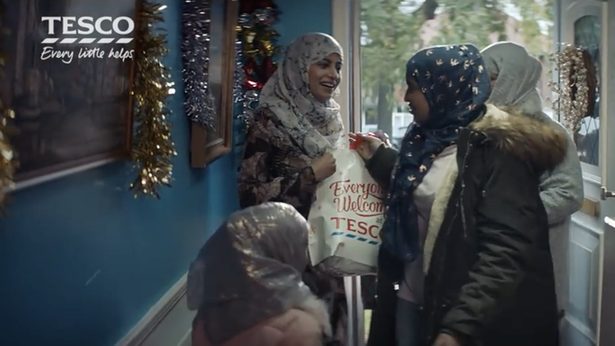
Supermarket chain Tesco are under fire for including a Muslim family in an advertisement about Christmas. ‘However you do Christmas, we’ve got a turkey for you.’
Here is the story in the Independent.
Tesco want ad award
Naturally, the ad is supposed to be ‘inclusive’ and ‘promoting diversity’.
But a supermarket does not have to do that. All it needs to do is make money for shareholders.
It does that by selling what it puts on the shelves. Moreover, it does that by bringing in customers, not by putting them off. Tesco did not have to sponsor London Gay Pride in 2012 either. But they did that too. And it backfired on them as disaster followed financial disaster in the succeeding years. Of course there are a couple of gays in the advert, one of whom is holding a baby, just so we get that grindingly politically-correct point as well.
So what we have here is a combination of social engineering and virtue signalling. Perhaps the food giant’s bosses are hoping for some kind of award for their advert. And there are hundreds of those to apply for.
No, we are not being ‘racist’
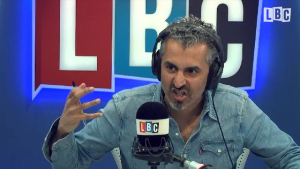
Some are crying ‘racism’ here, as has LBC’s Maajid Nawaz. Mr Nawaz is deliberately trying to obscure the actual point. And he is hoping the smear will make us back off. But this is not a race matter. It is to do with religion. There is a black woman and an Asian family in the advert. No-one is complaining about that. It’s the women showing off their hijabs (headscarves) which has struck a discordant note.
Moreover, this is a deliberate, gratuitous, incongruous inclusion of Muslims in an advert about Christmas. And why are Muslims out of place in a Christmas ad? It is because Christmas is a religious festival. Also, it is because Christian festivals such as Advent, Christmas, Easter and Whtisun proclaim this nation’s Christian heritage. Above all, it is because Christmas celebrates God becoming one of us in his Son, the Lord Jesus Christ:
John 1:14 And the Word was made flesh, and dwelt among us, (and we beheld his glory, the glory as of the only begotten of the Father,) full of grace and truth.
Muslims deny Christmas:
And that is an event Muslims and their Quran maintain did not happen:
Surah 19, Mary: 88. They say: “((Allah)) Most Gracious has begotten a son!” 89. Indeed ye have put forth a thing most monstrous! 90. At it the skies are ready to burst, the earth to split asunder, and the mountains to fall down
in utter ruin, 91. That they should invoke a son for ((Allah)) Most Gracious. 92. For it is not consonant with the majesty of ((Allah)) Most Gracious that He should beget a son.
Surah 3, The House Of ‘Imran: 59. The similitude of Jesus before Allah is as that of Adam; He created him from dust, then said to him: “Be”. And he was.
Surah 4, Women: 171. O People of the Book! Commit no excesses in your religion: Nor say of Allah aught but the
truth. Christ Jesus the son of Mary was (no more than) an apostle of Allah, and His Word, which
He bestowed on Mary, and a spirit proceeding from Him:
Total hypocrisy
And now for the totally hypocritical part. Tesco are not even selling halal turkeys. So if you are Muslim, Tesco do not have a turkey for you. They sell halal lamb and chicken however without telling customers it has been dedicated to Allah. So not to include turkeys is a good thing. Every little helps. But don’t pretend you have a turkey for everyone when you don’t.
To be fair, many Tesco stores support food banks, most of which are run by churches. They often allow collections of tinned food. But to think a good deed outweighs an evil one is to fall into the Muslim error itself. There is only one who forgives sin, and his name is Jesus.
So once again, just like over London Gay Pride, we are calling for a boycott of Tesco. Tesco are trying to take Christ out of Christmas. So let Christians and all who value the UK’s Christian heritage buy our Christmas turkey elsewhere. Moreover, let us pray that Tesco will have mountains of turkeys left unsold. Lastly, let us pray God will be glorified and that supermarket bosses will trust in Jesus.
Petition
Sign our petition calling for a boycott of Tesco:
https://www.petitions24.com/boycott_tesco_over_muslim_advert
Click on the links below to share this story:





Boycott Tesco – yes! And also all those who promote Christmas as a Christian festival. It isn’t.
Actually, James, it is. The Celtic Christians took over the midwinter festival for Christ to stop the pagan Celts worshiping their gods. Savvy decision. They took over pagan burial sites and built churches and monasteries on them and seized healing wells for Jesus as well. And the festival has become part of our Christian culture.
I am disinclined to support a ban – indeed the term ‘begotten’ is unbiblical and misleading IMO and I side with the Q’ran here – but perhaps Tesco’s should be rightly done for misleading advertising unless making halal turkeys available on demand – is the A.S.A. in the picture?
Thank God for Tesco! They’re including Muslims in Christmas.
Let’s all do that. Give them Christmas cards with a meaningful message. Invite them in for halal/vegetarian goodies…. or take them round to their house.
Let’s seek opportunities to share the real meaning of Christmas – not Santa, snow and robins. But God sending Jesus into the world to help us all.
Nice idea. They won’t accept your ‘halal’ goodies, because you have touched them and made them haram, or ‘forbidden’, but share with them that God became man and went to the cross for their sins as well as yours, by all means!
I don’t know if you have a Tescos or lots of Muslims near where you live, but in the real world, Muslims buy all kinds of goodies at Tescos regardless of the fact that they have been touched by all kinds of hands, You make them sound like very orthodox Jews, but in fact very few Jews require complete orthodoxy in food to this extent, and consequently those that do have to live around areas where it is available. like Stamford Bridge*. I don’t think the vast majority of Muslims are in the habit of refusing free food unless it is obviously pork,
* One can scarcely not notice this if passing through, and Wikipedia calls it :
“the largest concentration of Haredi Jews in Europe” .
I haven’t come across large group of Muslims in England who are a bit quirky like this.
Well, if Christians can take over a pagan festival, surely Pagans can take it back again, or it can be shared by Christians, Pagans, Muslims, Hindus, the generally irreligious, and anyone who cares to take part, as happens (at the best of times) in India. Christians took over the idea of Christmas presents (from the Romans ?), but you really can’t hope to stop non-Christians giving each other Christmas presents, can you now ?
But what have turkeys got to do with it ? None in the Bible, none at the time of Celtic Christianity, none in the days of Merry England and Good Queen Bess except occasionally at the very richest tables, and then Cromwell would have nothing to do with such things at all. Not as many in the 19th century as Dickens would have us believe, either.
Turkey is traditionally a Muslim country, but turkeys don’t come from Turkey.
However, if Muslims want to eat turkey in December, that really is up to them. If they are prepared to waive the requirement for any meat to be prepared in a “sacred” way, I would have thought that was to be encouraged. Pointless for Christians to complain “Oh no, you must be strict Muslims ! ”
I think it’s undeniable that the date, 25th December, has more to do with the Sun than with the Son. Depending a bit where you are, the solstice is technically 21st December, but it’s frightening that the sun does not seem to relent and the days do not in fact get longer afterwards (the sun stays still , “sol stit” in Latin). But depending a bit where you are and how observant you are, on 25th December you can see that the day is at last longer, and you celebrate. (It’s also essential that the calendar you are using hasn’t slipped out of kilter, which is why Pope Gregory XIII updated it). There is nothing about this in the Bible. Isn’t the best guess that Jesus was born in March ? And no turkeys for thousands of miles, in fact no modern domestic turkeys anywhere for centuries.
In the past, beef, chicken, and rabbit have been more popular than turkey for Christmas dinners, even when turkeys had made it to England (no doubt rather reluctantly). In some European countries various fish are eaten at Christmas .Would you ban all this to Muslims too ? Why, and how ?
I have only just been able (late last night) to insert a little picture again, and now I can’t work out how I did it. It would be helpful to have instructions on how to do this, so that other contributors can identify themselves more clearly too,
[…] Click here for the story. Be prepared to log in or register. […]
Sorry, Stephen, but in 99% of cases you’ll find that your Muslim friends, neighbours and colleagues will accept anything halal or vegetarian you give them. How on earth would Tesco sell anything to Muslims that had been placed on the shelves by non-Muslim shelf-stackers!
Things become “haram” by being contaminated with blood, faeces etc. NOT by being handled by a non-Muslim.
The only reason they may regard something you have prepared as “haram” might be because they think that you might not be aware of the details of what haram is, so inadvertently include something like pork gelatin or products derived from animals not slaughtered in the prescribed manner.
If you’re worried about that, just go for the vegetarian option. Everything with a vegetarian label is ipso facto halal.
One last thing. If a Muslim eats something that is haram, without realising that it is, they have not sinned. So, if you don’t offer a list of the contents, and your friend doesn’t ask, there’s no real problem.
Yes, OK, but I think you’ll find Muslims buy their meat from the halal butcher outside Tesco. For those who don’t know, the label ‘halal’ on cornflakes, for example, will just mean no alcohol cleaners have been used on table tops etc in production.
Muslims do eat halal turkey, of course, often in unrecognisable processed form imported from Germany or Benelux. This comes in sealed packages from the fridge of many a corner shop.
Will we be making their dainties here after Brexit ?
No doubt some sharp Muslim business man will already have spotted that opportunity.
Alongside the goodies, you may consider giving your Muslim (and other) friends an attractive scripture calendar at Christmas. Dual-language Urdu-English, Arabic-English, Bengali-English etc all available from Word of Life at http://www.word-of-life.org/Calendars-s/100.htm
Great idea.
According to the Bible, Jesus was born in October during the Feast of Tabernacles.
He was conceived (by the Holy Spirit) during Hanukkah, the Festival of Lights which is about the same time as Christmas.
The story is found in chapter 1 of Luke’s gospel.
A priest called Zechariah was sacrificing in the temple when an angel told him he would become the father of John the Baptist. This was a great shock to him as he and his wife, Elizabeth, were both elderly and childless.
Six month’s later, Elizabeth’s cousin, Mary, was told by an angel that she would give birth to Jesus.
We can find the Jewish month in which Zechariah was serving in the temple from the list of priestly duties in 1 Chronicles 24.
We, like you, are sad to see the world in the state it is. However we cannot agree with you in asking Christians to pray that Tesco will have mountains of turkeys unsold. Surely Jesus taught us to bless rather than to curse, and that mercy triumphs over judgment.
Hi Anthony R, thanks for that, it’s surely a popular point to make.
The Lord said: Matt 5:44 But I say unto you, Love your enemies, bless them that curse you, do good to them that hate you, and pray for them which despitefully use you, and persecute you;
Tesco have done nothing to me. They are not my enemies, but the Lord’s. Do you agree with me that makes a difference? Ezekiel 3 and all that?
Islam is, of course, a false religion as it denies that Jesus is the Son of God; moreover everyone who denies this fact is going to Hell (John 3 v 18).
I heard, this morning, that the Aussies have backed homo marriage and i’ve blogged on this:
http://www.bobhutton1.blogspot.com
Gosh, so that would mean that every religion is false except Christianity ? People like Bob1 must count themselves very fortunate to have been born into Christianity. If he had been born to a local family in Riyadh, he would probably be a Muslim and on his way to Hell.
Can Jews get round the problem by agreeing that Jesus was a “son of God” in the sense that we are all children of God ? This is, after all, the sense Jesus himself was using when he taught us all to pray “Our Father”. Catholic priests call male parishioners “my son” without actually being their father, not in most cases anyway.
Yes, Rox G – all non-Christians are going to Hell.
In John 3 v 18 it is made clear that people who don’t believe that Jesus is the Son of God are under divine condemnation.
I was NOT born a Christian, I became one on Sept 13, 1975 when I repented of my sins and accepted Jesus Christ as my personal Saviour.
The advert is completely inappropriate and once again we are seeing images being portrayed concerning a Christian festival that we would never see portrayed of say a muslim festival. Could you imagine the uproar if Tesco were to release an advert showing Jews celebrating Eid. The uproar would come from both muslims and Jews and no doubt the ASA would uphold any complaints. So how can they get away with doing it with Christmas. Do you have any hyperlinks for registering a complaint with Tesco and the ASA.
You have to be careful with some of these images. The authentic pictures of the Holy Land produced by earnest Victorian artists who had been there were pictures of the Ottoman Empire. We are wary of Italian painting, but the New Testament was indeed set in the Roman Empire.
The other day I saw an extreme example of two women dressed in black from top to toe, their faces veiled invisibly from most angles, but when they turned towards me, I realised they were nuns. (There are quite a few nuns around the town where I live, but oddly, their habits are brown, and their faces are not so shrouded) .
The Muslims in the advert are not going to Midnight Mass or to any less pretentious Christian service or meeting. They just want to eat a seasonal food, like they might fancy pheasant when it is available . I don’t see the objection to this. There is a lot in the Koran about dates, but does that stop you eating dates ?
Are Hindus allowed to watch fireworks at the essentially Protestant celebration of 5th November ? Are Christians allowed to watch fireworks at Divali ? How would you put a stop to either ?
It is not about putting a stop to anything. It is about a supermarket including those who oppose the very idea of God becoming man in an advert promoting produce at a festival celebrating God becoming man and doing it in order to tick some diversity box.
What have turkeys got to do with God becoming man ?
A feast day requires a feast.
I can’t help noticing that you have only just introduced the word “feast”, whereas the word “festival” appears 14 times on this webpage. Your enthusiasm for feasting seems to come from your more Anglo-Saxon pagan side, which is occasionally apparent.
Meanwhile, in Apulia, I have been present at what they call rather bizarrely (but in Italian) “The festival of the death of God”, on Good Friday. Jesus is carried through the streets dead, in a glass coffin. Unidentifiable sinful men walk long distances bare-footed. There is no feasting. I have sent some photographs to Christian Voice’s email address in support of my description of this gloomy and elaborate festival. No hot cross buns or anything.
I’m not sure how ‘hung-up’ we should get about Tesco’s advert – though I share some of your concerns. You say ‘Christmas is a religious festival’ – AGREED, but is it really Christian one? As a former Roman Catholic, I struggle every year with ‘the whole concept of ‘Christmas’ = ‘Christ Mass’ – the Mass being of great offence to the Lord. (Oh that the Catholics understood this).
At the same time, I am torn two ways, as notwithstanding this and whilst recognising that Jesus was not born in December, I also recognise that the ‘celebration’ can give us a particular opportunity to evangelise to our ‘lost’ nation. Sadly, Christmas in the UK has become an almost a totally secular celebration – partaken of primarily by followers of false religions – whether they be atheists, religious (Catholics and Protestants alike), or even Muslims, Hindus, Sikhs and Buddhists many of whom seem to enjoy it!. So what are Bible-believing followers of the Lord to do – ignore it or ‘use’ it to His Glory?
We do have much to be concerned about at this present time in history, especially the steady collapse of morals and the Islamification of our nation. Bible-believing Christians should seek wisdom but shouldn’t hold back from speaking out against the steady erosion of our society (as and when appropriate) but really, is this Tesco advert one of the big issues of the day? …and, thank the Lord, Tesco’s don’t sell Halal turkeys!
BTW, I already boycott Tesco, along with John Lewis, Co-op, and several others. I am also considering doing likewise with Lloyds Bank. My concern is it won’t be long before all retail outlets are off limits!!!
Well, you have the 6th Century Celtic Christians to blame for Christmas. They were ruthless at taking over pagan burial sites, healing wells and festivals and either building on them or rebranding them for the Lord! And I understand the Latin term missa was in use by the 6th century, from the dismissal at the end of the communion service. I actually like the way Christmas and Easter are still part of our culture – and you are right, there is a huge opportunity there for evangelism. By the way, you won’t find one high street bank not sold out to the secularists. May God bless you! Thanks for your comment.
Banking was never exactly a Christian monopoly, was it Stephen, what with usury being a sin and everything ? It tended to be in the hands of Jews because nobody had much choice in the matter, and it isn’t anti-semitic to suggest that much finance still is. Now it’s Islam which requires very special banks, because of the inherent sinfulness of the whole business.
I didn’t realise that Protestantism was a false religion which did not believe in the Bible. Luther would be most surprised to hear this accusation, and so would most protestants in Germany at least to this very day.
If it helps at all, I rather suspect that by the time the word “Christmas” was coined in English, this unstressed syllable “mas” had come to mean “festival” rather than an actual Catholic mass. Compare Candlemas and Martinmas and many others. Similarly, “Saint” does not always mean “saint” as we currently understand it, for example “St Cross”, St Michael, the saint (or holy) rood, the saint grail, In other languages, the word for Christmas includes no mention of a mass.
GoneBodmin is jolly lucky to have a John Lewis to boycott. Does he boycott Waitrose too, I wonder ? He doesn’t have to buy his boys & girls’ or girls & boys’ clothes at John Lewis.
In the solemn hours of daylight, I feel an urge to confess .
” In other languages, the word for Christmas includes no mention of a mass.”.
OK, the Dutch for Christmas is Kerstmis (which I knew), and “mis” does mean “mass” (which I have just checked).
Dutch is of course the closest language to English (excluding dialects like Scots and Frisian),
This doesn’t mean that in current Dutch or English people think of the word as meaning a mass for Christ, especially not in English where the “mas” is spelt and pronounced differently from “mass”.
I forgot Lammas. or Gŵyl Galan Awsta as you say in Pen-y-Bont, a sort of harvest festival.
Rox G: I stand to be corrected and certainly accept that the word “mas” may, over time, have come to signify “festival”. However, from the limited research I have done, I still believe that at its root is the Mass (a “Sacrifice” according to the Roman Church) which has, at its core, the false doctrine of Transubstantiation. (I’d love to think Stephen’s alternative derivation of “Missa” from the Dismissal is correct but can find nothing to corroborate this. Also, with reference to his point about Christmas’s Celtic roots – my understanding is that Celtic Christians ‘celebrated’ the Mass and it’s doctrines – perhaps I’m wrong?.) My concerns with “Christ-mas” remain, but may be they are more to do with its name than the event – I certainly accept that other languages know the festival by other names which don’t make reference to the Mass; therefore perhaps I should relax a little more over the festival …or perhaps we can consider a change to its name!!!
Apologies if my reference to Protestantism within the context of false religions caused concern – it was only meant in connection with defining those of a ‘RELIGIOUS’ persuasion, i.e. Religious Protestants (or any other religious folk for that matter) whereas, the central question is not whether we are religious but are we SAVED? My previous contribution was perhaps a bit clumsy and in hindsight a poor attempt which was trying to convey the fact that being ‘religious’ never saved anyone – religion generally being man’s attempt to reach God. The Bible teaches that man cannot save himself – God reached out to us through Jesus Christ and the Holy Spirit makes us aware of our sin, our need for a Saviour and, in doing so, calls us to Him. ANY religion that either ADDS TO or TAKES AWAY FROM these biblical essentials (E.G. see most of John, Chapter 3 or 14:6) is always a HOPE-LESS substitute and will only lead its followers to Hell. The Bible clearly teaches that there is NO alternative means of SALVATION.
Sadly, a significant part of ‘Protestantism’ today has tossed aside much, if not all, of the Bible and settled instead for man-made religiosity – that was what I was attempting to convey – albeit rather badly! (BTW, I have no knowledge of where Lutheranism is today but then God is not interested in denominations – only in Bible-believing faith!)
Re Waitrose – it’s quite easy to boycott them – the nearest is over 25 miles away – though we do have five other supermarkets on our doorstep!!!
I don’t like the word Christmas either. The ordinary Swedish word for Christmas is jul (same in Norwegian), and you could do worse than use Yule or Yuletide. The Victorians were happy with their Yule logs. The word “jolly” probably comes from the same root (as does “joli” in French, not the other way round). It’s difficult to think of a word more appropriate to a traditional Christmas than “jolly”.
A jolly Yuletide to one and all.
Sounds alright to me.
In Germany, Lutheranism is closely allied with other protestant denominations and has been for many years. The average German reckons himself to be (at least nominally) either evangelisch (Protestant) or katholisch (Catholic), and that’s it. He has to decide which, because the government collects his “Church Tax” and hands it over to one body or the other (but occasionally elsewhere, as in the case of Jews). This is a substantial amount, being about 9% of the income tax he pays.
There has been considerable liberalisation of “evangelisch” ideas in Germany, a country always beset with theologians, quite similarly to the Church of England as far as I know.
Stephen’s derivation from “Ite, missa est” is corroborated by the Concise Oxford Dictionary and Chambers Dictionary (both with the word “perhaps”), and the Larousse Etymological dictionary without a “perhaps” (of course, Larousse are looking at the word “messe”, which means “mass” in French) .
The last words of the Latin mass are “Ite, missa est” = “Go, (it) is sent” .
This leaves it to the listener to supply a word for “it.” According to Chambers, the word is “Ecclesia” meaning church or congregation, so the sentence means “Go, the congregation is sent (away)”, or “Go, the congregation is dismissed”. COD implies this too, without actually supplying the word “ecclesia”.
Intriguingly, according to Larousse, the word to be supplied is “oratio”, meaning prayer, and so the sentence means “Go, the prayer is sent (up, to God)”. This seems to me to make the change in meaning of “missa” (which does now mean “mass” in Church Latin) particularly likely. It would have been seen to mean the communal sending of prayer, which is what a mass essentially is. And with the new meaning, the last sentence comes to mean “Go, that is the mass” (or “Go, that is the sending of prayer done”, which is what it was supposed to mean originally). It is still a “dismissal”, from the word “Go” alone.
From the Latin Liturgy Association, the official translation of
“Ita, missa est ”
is “Go forth, the mass is ended” [in the Ordinary form of the mass]
and the people reply “Thanks be to God”.
http://www.latinliturgy.com/OrdinaryFormMassText.pdf
In the Extraordinary form, this sentence is no longer at the end, and the same Latin words mean more simply :
“Go, the Mass is ended”. Presumably the rest of the service is no longer actually the mass, but I don’t think you are supposed to go away and miss it.
http://www.extraordinaryform.org/ExtraordinaryFormTextLandscape.pdf
Notice that there is no actual word in the Latin to mean “ended” !
In French (from the Schola St Maur), “Ita, missa est ” is translated
“Allez, la messe est dite”. (Go, the mass is said).
https://www.scholasaintmaur.net/ordo-de-la-messe-latin-francais/
There is no word in the Latin to mean “said”.
Both the English and the French translations assume that “missa” means “mass”, which it didn’t originally when the Latin was written . There you go.
Poor Tescos, snobbishly perceived as the lowest of the low of supermarkets, are always criticised no matter what they do.
Now they are going to donate £1 to homeless charities for every turkey sold.
Is that wrong ?