
This is the transcript of the video above – check against delivery.
What are these ‘death cafe’s’ all about, are they good or bad? And what do we make of the Church of England’s ‘grave talk’ project?
One paper said that over five hundred death cafe events have taken place to date across the UK and further afield, including the US, Australia and New Zealand.
The objective of a death cafe, so its people say, is ‘to increase awareness of death with a view to helping people make the most of their (finite) lives.’
According to the death cafe website, ‘At a Death Cafe people, often strangers, gather to eat cake, drink tea and discuss death.’
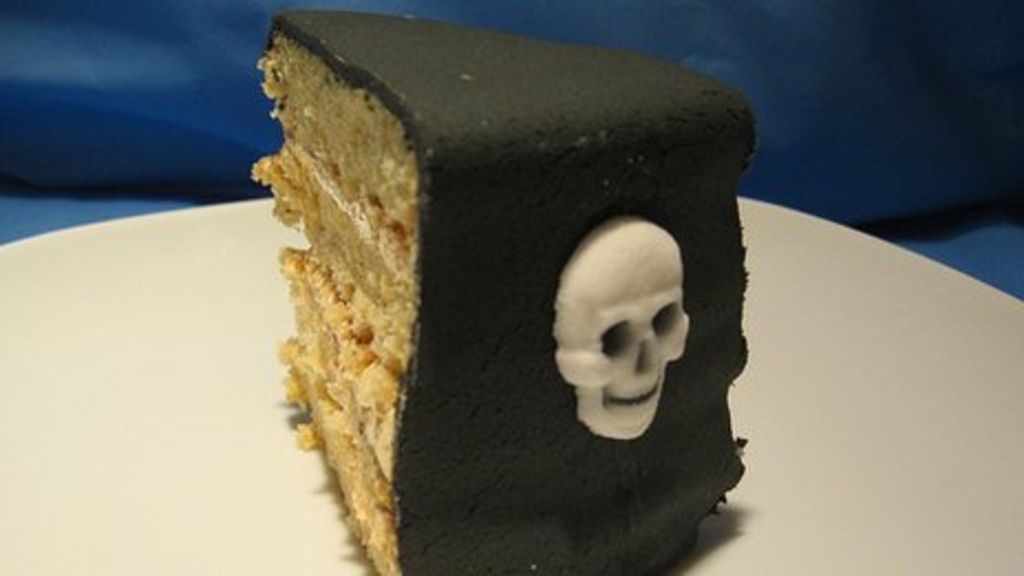
Yes, Cake seems to play a big part, especially cakes with black icing and skulls on them served on plates with skull motifs.
In Manchester, funeral director Hugh O’Brien hosted a death cafe event in Heaton Moor. He said there was “a British reticence about death”. “Everyone seems to be afraid of it,” he went on.
With a finite, in this case a truly finite – market to work in, I’m surprised funeral directors aren’t falling over each other to host these obvious marketing opportunities.
Anyway, the death cafe originator, one Jonathan Underwood from Hackney, is right now, in November 2015, selling shares for a permanent Death Cafe in London.
He thinks his project is the best thing he can do to make a better planet.
Mr Underwood has said there should be no fear about discussing death, and this is his reason: “you don’t get pregnant by talking about sex,” he says, “so why would talking about death make you die?”
I’m sorry old boy, but that is a non-sequitor. You can quite easily feel sexy by talking about sex, and talking about getting pregnant, especially talking positively about it, CAN help a couple have the child they so earnestly want.
In the same way, talking about death, especially talking enthusiatically about it, can hasten it. That’s a basic spiritual principle.
The Church of England’s ‘Grave Talk’ is different, because, as its website says, the Christian faith ‘holds the hope that death is not the end’.
A parish can put on a ‘grave talk’ evening to help people planning or going to a funeral, to have a conversation about death and dying, or to help with grief and loss of a loved one.
For me, that’s a good work, with an emphasis quite different from death cafe.
Let’s face it, we’ve just had an MP trying – and failing, thank God – to bring in an Assisted Dying Bill in this country, there are people going to some ghastly overseas clinic to commit suicide, and a growing suicide cult among young people led to seventy-nine deaths in Bridgend in Wales over just a five-year period.
Teenagers are taking their lives because of bullying, and suicide is the most common cause of death for men under thirty-five in Britain.
Death Cafe protagonists will deny their project has anything to do with promoting suicide. But even if it is just a sales pitch for undertakers, popularising the idea of death, glamorising it with skulls and black icing, won’t exactly help vulnerable teenagers.
Our lives are more than the matter of our death, or anyone else’s. Being obsessed about death, at any level, is simply not healthy for individuals, or society.
In the Bible, Jacob says he is about to be gathered to his fathers. He blesses his children and gives directions for his place of burial. And that’s it.
You see, the overwhelming principle in the Bible is that of life. God told the people of Israel:
Deut 30:19 I call heaven and earth to record this day against you, that I have set before you life and death, blessing and cursing: therefore choose life, that both thou and thy seed may live.
People need life cafes, not death cafes, to be honest. And, thank God, we have quite a few of those. They are often held in a building with a spire on the top, or just in a hall, on a Sunday morning, and quite often they have a cross outside. There’s probably one near you. It’s called a church. Chances are, you’ll find someone inside who knows the author of life, one Jesus Christ. And if you get to know him too, death won’t hold any fear for you at all.
Find out how to join Christian Voice and stand up for the King of kings (clicking on the link below does not commit you to join)

Please note that persons wishing to comment on this story must enter a valid email address. Comments from persons leaving fictitious email addresses will be trashed.





Everybody dies, and I don’t see why the Church of England should have a monopoly of discussing death. Different people prepare for it in their own ways, and if they want to talk about it in a café while eating cake or whatever they prefer, I don’t see whey they shouldn’t do so. To many people it may be helpful, but the emphasis seems to be on making the most of their lives. Somebody said recently that the madmen of Islamic State value life after death more than they do life ! Of course, this was very much the mediæval Christian view too. It would be interesting to see what Mark Jones has to say about that.
Stephen doesn’t actually tell us what is wrong with these café meetings, except to imply that they encourage suicide, and there is absolutely no evidence for this.
The website includes the wording :
“What better way to share questions and experience of life and death, than with others in convivial surroundings. ”
It’s just a bunch of amateur philosophers having a chat, for goodness sake. And the decorations are like Halloween. Skeletons are a bit of a laugh, even in picture books for young children. As one such of my acquaintance once said to me “They’re not really scary, they’re only bones”.
The website goes on :
“munchies from fresh veggies to sweets, including a home baked gluten-free pumpkin pie that one participant described as ‘to die for.’ ”
And no doubt it was low-cholesterol too.
Stephen tells us that in the Bible “Jacob says he is about to be gathered to his fathers. He blesses his children and gives directions for his place of burial. And that’s it.”
Fair enough, we can’t argue that this may very well be a summary of what Jacob did in the very different circumstances in which he lived, but it really doesn’t mean that everybody in 21st century Europe should follow the example of this particular individual. The main element of it is that he wants to be buried in a particular place, and I don’t think most people nowadays care about that. Why should they ? Is there any harm in it if they aren’t bothered ? But they should make a will, and apparently Jacob didn’t ! Maybe he didn’t own any ISAs or a semi-detached freehold property.
The point is, Death Cafe is about death and the Christian Faith is about life.
” to share questions and experience of life and death ”
Surely that applies to both ?
Aren’t Christians interested in heaven, hell, and the plight of dying patients, any more ?
It’s an evangelistic opportunity, in one sense. But Christians really aren’t interested in death as a specific subject. What lies beyond it, yes. But that kind of talk would be regarded as ‘preaching’ at death cafe, and is frowned upon, as I understand it.
Look, at a knitting circle, you have people interested in knitting. At a rugby club you find people absorbed by rugby. At a rambling club, those passionate about walking. Need I say more?
I wonder what would happen if one of the attendees at such a cafe started warning others that they must prepare for death by repenting of their sins and accepting Christ as Lord and Saviour?
I’m afraid they would ignore him, or possibly ask him to leave.