Homosexuality & Trans

Home Homosexuality & Trans Page 15

Your Body Matters

3

By Robin Phillips

Andy Crouch

The dust was hardly able to settle on the same-sex ‘marriage’ debate before activists began preparing for the next set of battles.

It is hard to predict what will come first: will it be calls to legalize polyamory, or perhaps paedophilia (which Wikipedia says is “similar to a heterosexual or homosexual sexual orientation”)?

We can’t say for sure, but Andy Crouch believes that the next battle may hinge on the Christian claim that our bodies matter.

Mr. Crouch’s comments were made in a recent Christianity Today editorial, ‘Sex Without Bodies The church’s response to the LGBT movement must be that matter matters.’

In surveying the ever-growing array of emerging sexualities (lesbian, gay, bisexual, transgender, trans-sexual, queer, questioning, asexual, etc.) Crouch concluded that “There is really only one conviction that can hold this coalition of disparate human experiences together. And it is the irrelevance of bodies—specifically, the irrelevance of biological sexual differentiation in how we use our bodies.”

The irrelevance of what we do with our bodies features in homosexual polemics against monogomy and against sexual exclusiveness, as we showed in our earlier article  ‘Why Gay Marriage is a Public Threat‘. Indeed, advocates of gay ‘marriage’ will frequently downplay the physical aspects of marriage, urging instead that committed relationships are not primarily about becoming one-flesh physically, but are about spiritual and emotional connection. This Gnostic view of allows them to accommodate various models of non-exclusivity. As Crouch observes,

Indeed, sex itself is markedly different for gays and lesbians, research shows. Men in stable, committed gay relationships readily “[make] open arrangements for sex outside the couple,” as a recent New York Times article put it; indeed, more than 40 percent have done so.

Meanwhile, large numbers of women in committed lesbian relationships seem to cease sexual activity altogether over time. These are not just male and female versions of a single simple thing called “homosexuality,” let alone merely “homosexual” versions of a single simple thing called “sexuality”—they are profoundly different human experiences.

Crouch continues and shows that behind the preference for “open” relationships among homosexuals is a fundamental antipathy to the importance of matter. This is in marked contrast to the Christian understanding of the body.

…the created givenness of bodies must give way to the achievement of ascertaining, announcing, and fulfilling one’s own internally discerned desires, with no normative reference to the body one happens to inhabit. It is no accident that as normative sexuality has been redefined, from an essentially exterior reality uniting male and female bodies to an essentially interior reality expressing one’s heart, the charges of bigotry have been heard more fiercely against those who hold the traditional Christian view. How dare we Christians speak against any person’s heart?

Marriage, which has always been “unequal,” yoking together two very different kinds of bodies, must now be “equal,” measured only by the sincerity of one’s love and commitment. To insist on the importance of bodies is to challenge the sovereign self, to suggest that our ethical options are limited by something we did not choose.

There is one other consistent position that Christians can hold, though we will hold it at great social cost, at least for the foreseeable future: that bodies matter. Indeed, that both male and female bodies are of ultimate value and dignity—not a small thing given the continuing denigration of women around the world.

Indeed, that matter matters. For behind the dismissal of bodies is ultimately a gnostic distaste for embodiment in general. To uphold a biblical ethic on marriage is to affirm the sweeping scriptural witness—hardly a matter of a few isolated “thou shalt not” verses—that male and female together image God, that the creation of humanity as male and female is “very good,” and that “it is not good that the man should be alone” (Gen. 2:18, NRSV).


Find out how to join Christian Voice and stand up for the King of kings (clicking on the link below does not commit you to join)

Please note that persons wishing to comment on this story must enter a valid email address. Comments from persons leaving fictitious email addresses will be trashed.

Tesco flout planning law for quick buck

2
Tesco Ilfracombe
Tesco Ilfracombe

A Tesco store in a north Devon seaside town has angered local traders by setting up a marquee selling beach goods without planning permission.

The supermarket giant, which last year sponsored the London ‘Gay Pride’ parade, has set up the tent in the car park of its Ilfracombe store, selling items such as barbecues, buckets and spades and wetsuits, which are normally sold by other local traders.

Tesco said it was “pleased to be offering our customers summer essentials” and said it was “proving to be really popular”.

But it was described as  “immoral” by one shopkeeper, while others said they could not compete with Tesco on prices.

Tesco have applied for retrospective planning permission, but North Devon Council say they can carry on selling goods until permission is either granted or refused.

Local shops have already been hit by Tesco.

A Council spokesman said: “Responsible businesses would be expected to apply for planning consent prior to opening, although it is not illegal for them to open before permission has been granted.”

Local shops have already been hit by Tesco and the store’s illegal foray into beach goods could be the last straw for many.  There seems to be no remedy for the local traders to use planning law to close the marquee in the meantime.

The authority added “any enforcement action should normally be held back while the application is considered”.

By that time summer will be over and it will be too late for the local traders who rely on the seasonal trade in holiday goods.  High Street shopkeeper Gwynn Churchill said: “They haven’t got permission, they have got a big enough store anyway.  It’s sharp practice. Even though it’s legal, morally it can’t be right.”

Morally it wasn’t right to give £30,000 to the 2012 London Gay Pride parade either, but morality is one product which seems to be in short supply at Tesco.

Queen approves ‘Gay Marriage’

The first gay wedding cakes could be baked next summer.
‘Gay weddings’ could take place next summer.

Her Majesty the Queen has given her Royal Assent to the Bill legalising ‘gay marriage’ in England and Wales.

Speaker John Bercow MP told the House of Commons yesterday that Her Majesty had given the Marriage (Same Sex Couples) Bill her approval.  The Bill is now an Act of Parliament.

During Her Coronation on 2nd June 1953, and before she was anointed and crowned, Her Majesty Queen Elizabeth was asked by Archbishop Fisher, inter alia:

‘Will you to the utmost of your power maintain the Laws of God and the true profession of the Gospel?’

And the Queen replied: ‘All this I solemnly promise to do.’

Next the Moderator of the General Assembly of the Church of Scotland presented the Bible to the Queen. Between them, the Archbishop and Moderator said to her:

Orb
‘The whole world is subject to the Power and Empire of Christ our Redeemer’

‘Our gracious Queen: to keep your majesty ever mindful of the Law and the Gospel of God as the Rule for the whole life and government of Christian Princes, we present you with this book, the most valuable thing that this world affords. Here is Wisdom; This is the royal Law; these are the lively oracles of God.’

The Archbishop told Her Majesty when she was given the Orb from the Crown Jewels:

‘Receive this Orb set under the Cross, and remember that the whole world is subject to the Power and Empire of Christ our Redeemer.’

Her Majesty’s Government can no more change the definition of marriage than they can declare that God does not exist.

But they have done so, and as Her Majesty always acts on the advice of her ministers she has, and not for the first time, legislated against her Coronation Oath.

As we saw on Monday, the homosexuals will now be targeting freedom of speech and Christianity itself.  When will the gay hate speech Bill next raise its ugly head?  Who will be the first Christian teacher sacked for refusing to teach that ‘gay shows the way’?  Which will be the first church taken to court for refusing a ‘gay wedding’?  Watch this space.


Find out how to join Christian Voice and stand up for the King of kings (clicking on the link below does not commit you to join)


Please note that persons wishing to comment on this story must enter a valid email address. Comments from persons leaving fictitious email addresses will be trashed.

Pro-Marriage Adtrailer vandalised

gaymnothanks
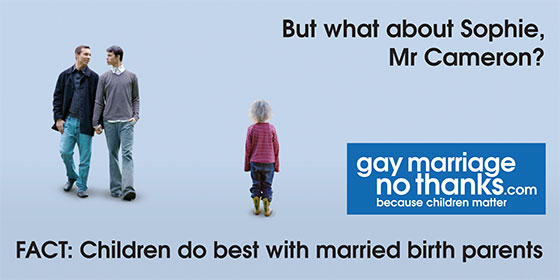
An advertising trailer was vandalised and its driver threatened by homosexual activists for displaying this GayMarriageNoThanks poster.

The progress of a pro-children campaign has stalled after a truck carrying two of its mobile billboards was vandalised and the driver of the van displaying it was threatened on Monday (14th July 2013) in central London. The GayMarriageNoThanks group released billboards aimed at highlighting the fact that children do better with married birth parents.

The group arranged for the poster to be driven around London on an advertising truck yesterday and today. But after the driver received abuse and the truck carrying the billboard was vandalised, the advertising company, Adtrailers Ltd, informed Alan Craig, campaign director for GayMarriageNoThanks, that they were “unable to send out the advertising truck today following yesterday’s campaign day. “Unfortunately the driver out yesterday received threats, the truck was vandalised and there have been several offensive complaints received.” A company representative also informed Mr Craig that people had made personal threats by email and over the phone which were “horrific”, “violent stuff” and “the worst I have known”.

These had caused Adtrailers unilaterally to cancel their contract with GayMarriageNoThanks “to protect their staff”. The violent threats and backlash to the campaign come just prior to the Third Reading of the Government’s Marriage (Same Sex Couples) Bill in the House of Lords today. The billboard campaign attempts to put children back at the heart of marriage in a debate which so far has “been about only the interests of adults,” according to Mr Craig.
The group also delivered a letter to the Prime Minister yesterday in Westminster, enclosing a copy of the New Family Structures Study by US Professor Mark Regnerus. The study, which drew upon randomly-selected sample of nearly 3,000 respondents, show that children are “most apt to succeed well as adults – on multiple counts and across a variety of domains – when they spend their entire childhood with their married mother and father.”

Mr Craig believes the incident with the billboards raises serious concerns in light of the same sex marriage Bill. “These incidents show how free speech is already being shut down before any change in the law on marriage” he said. “The billboard was simply intended to initiate legitimate debate concerning the best environment for raising children. We’re quite convinced that the overwhelming evidence demonstrates children do best with their married birth mother and father. This is a debate which urgently needs to take place. “Vandalism, abuse and threats of physical violence threaten to shut down such democratic debate. Advertising companies and others will no longer be willing to carry ‘controversial’ pro-children and pro-family messages if the safety of their employees is put in jeopardy. “The situation will only get worse with the passage of the same sex marriage bill. What will Mr Cameron do about it? We have been asking him to consider the welfare of our nation’s children. Now we’re also asking him what he will do to ensure freedom of speech for those who, for very good reasons, oppose same sex marriage.” ENDS

Gvt: men can be wives, women, husbands

8
Whatever!
And the British Government has no sense.

Civil servants have overruled the Oxford English Dictionary and hundreds years of common usage effectively abolishing the traditional meaning of the words for spouses, reports the Daily Telegraph.

The newspaper says:

‘The guidance gives the example of some early health and safety legislation drafted in 1963 which includes a range of exemptions for family businesses where the terms husbands and wives will mean people of either gender.

‘“This means that ‘husband’ here will include a man or a woman in a same sex marriage, as well as a man married to a woman,” it says.

‘“In a similar way, ‘wife’ will include a woman married to another woman or a man married to a man.

‘“The result is that this section is to be construed as including both male and female same sex marriage.”

‘Yet it then goes on to say that in future legislation the traditional male-only meaning of husband and female-only understanding of wife could make a comeback – but not in all cases.’

‘“The term ‘husband’ will in future legislation include a man who is married to another man (but not a woman in a marriage with another woman),” it adds, confusingly.

‘“And ‘wife’ will include a woman who is married to another woman (but not a man married to another man) unless specific alternative provision is made.”’

Confused?  Not half as much as they are.


Related stories:

28/06/2013: Supreme Court Decision Winners and Losers

27/06/2013: Supreme Court Gay Marriage Ruling

26/06/2013: Pro-Marriage student arrested in France

21/06/2013: Law Society pushes homosexual propaganda

05/06/2013: How your Peers voted on ‘Gay Marriage’

21/05/2013: Gay Marriage Bill Threatens to Divide Tory Party

18/05/2013: Hammond warns against redefining marriage


Find out how to join Christian Voice and stand up for the King of kings (clicking on the link below does not commit you to join)


Please note that persons wishing to comment on this story must enter a valid email address. Comments from persons leaving fictitious email addresses will be trashed.

Supreme Court Decision Winners and Losers

15

By Robin Phillips

supreme_courtNeither side in the same-sex ‘marriage’ debate could claim that the Supreme Court’s ruling last Wednesday came as a decisive victory. Nevertheless, there were some definite winners and losers. Let’s begin by looking at the losers.

The Losers

Wednesday Was a Bad Day for Christians

Significantly, the Supreme Court did not ‘discover’ a right to gay ‘marriage’ in America’s constitution. Nevertheless, by declaring that it is unconstitutional for the federal government to limit marriage to a relationship between a man and a woman, the Court paved the way for gay marriage to be implemented throughout the states. As more and more states pass laws to change the definition of marriage, the inconsistency will be highlighted. After all, is it really fair for a couple to be ‘married’ in Washington but not married once they cross over the border into Idaho? Faced with this inconsistency, it will probably be only a matter of time before all 50 states begin approving same-sex ‘marriage.’ As this happens, Christians will be the first to suffer.

The reason we know that Christians will suffer is because that is exactly what happened in Canada, the first English-speaking country to legalize gay ‘marriage.’ Since 2005 when Canadians changed their definition of marriage, Christian business owners, florists, caterers, educators and many others have all found themselves prosecuted for their refusal to recognize gay ‘marriages’ or participate in gay weddings. Some of these cases were highlighted by Michael Coren last year in an article for The National Review Online titled, ‘Canadian Crackdown :

Although precise figures about gay marriages in Canada are elusive, there are thought to be fewer than 30,000, after an initial surge of around 10,000 as soon as the law was passed. But if large numbers of gay people failed to take advantage of the law, the law certainly took advantage of its critics. Again, definitive figures are almost impossible to state, but it’s estimated that, in less than five years, there have been between 200 and 300 proceedings — in courts, human-rights commissions, and employment boards — against critics and opponents of same-sex marriage. And this estimate doesn’t take into account the casual dismissals that surely have occurred….

As I write, two Canadian provinces are considering legislation that would likely prevent educators even in private denominational schools from teaching that they disapprove of same-sex marriage, and a senior government minister in Ontario recently announced that if the Roman Catholic Church did not approve of homosexuality or gay marriage, it “would have to change its teaching.” What has become painfully evident is that many of those who brought same-sex marriage to Canada have no respect for freedom of conscience and no intention of tolerating contrary opinion, whether that opinion is shaped by religious or by secular belief.

(For more about the challenges faced by Christians when same-sex ‘marriage’ is legalized, see myth #3 in my article ‘Five Gay Marriage Myths.’)

Wednesday Was a Bad Day for Children

The Supreme Court Ruling did not codify same-sex ‘marriage’, but it did create the legal space for same-sex ‘marriage’ to begin to be mainstreamed in the states. The collateral effect of this cannot be overstated, since it will inevitably help to reinforce the notion that moms and dads are interchangeable. The logic for this spurious notion is already substantially in place. Listen to what Dr. Jennifer Roback Morse said in an article reflecting on her debate with Judith Stacey:

I crossed swords with Judith Stacey…at a debate at Bowling Green State a few years ago. I asked her point blank if she believed men and women were completely interchangeable as parents. In front of that very friendly audience, she said absolutely: the gender of parents doesn’t matter….

Treating same sex unions like marriage amounts to saying that mothers and fathers are interchangeable. It is a coin toss from a child’s point of view, whether they have two moms, two dads, or one of each.

The damage caused by this spurious notion that moms and dads are interchangeable is felt most directly by the children. As Ryan T. Anderson explains,

Social science claiming to show that there are “no differences” in outcomes for children raised in same-sex households does not change this reality. In fact, the most recent, sophisticated studies suggest that prior research is inadequate to support the assertion that it makes “no difference” whether a child was raised by same-sex parents. [See Jason Richwine and Jennifer A. Marshall, “The Regnerus Study: Social Science and New Family Structures Met with Intolerance,” Heritage Foundation Backgrounder No. 2726, October 2, 2012] A survey of 59 of the most prominent studies often cited for this claim shows that they drew primarily from small convenience samples that are not appropriate for generalizations to the whole population. [Loren Marks, “Same-Sex Parenting and Children’s Outcomes: A Closer Examination of the American Psychological Association’s Brief on Lesbian and Gay Parenting,” Social Science Research, Vol. 41, No. 4 (July 2012).]

Meanwhile, recent studies using rigorous methods and robust samples confirm that children do better when raised by a married mother and father. These include the New Family Structures Study by Professor Mark Regnerus at the University of Texas–Austin [See Children from Different Families, http://www.familystructurestudies.com/] and a report based on Census data recently released in the highly respected journal Demography. [Douglas W. Allen, Catherine Pakaluk, and Joseph Price, “Nontraditional Families and Childhood Progress Through School: A Comment on Rosenfeld,” Demography, November 2012.] Recognizing same-sex relationships as marriages would legally abolish that ideal. It would deny the significance of both mothering and fathering to children: that boys and girls tend to benefit from fathers and mothers in different ways. Indeed, the law, public schools, and media would teach that mothers and fathers are fully interchangeable and that thinking otherwise is bigoted.

(For further reading, see my post ‘Gender Matters.’)

Wednesday Was a Bad Day for Friendships

In his Nicomachean Ethics Aristotle showed that laws create norms for citizens which implant certain notions of virtue on their souls. The laws contribute to the formation of how we think and perceive the world around us. Aristotle was right, but the principle he understood works both ways. Bad laws enshrine norms on the public consciousness that reinforce destructive and soul-destroying patterns of thought.

What are the destructive patterns of thoughts created by rulings that create the legal space for same-sex ‘marriage’? We have already seen one, which is that moms and dads are completely interchangeable. Another destructive pattern of thought concerns friendships.

As the logic behind ‘gay marriage’ becomes increasingly accepted, many citizens are increasingly coming to think that marriage is simply an intense emotional bond, with no necessary connection to procreation or child-rearing, and no fixed core other than the consent of two adults who love each other. In fact, both law-makers and homosexual activists have steered away from asserting that the sexual dimension is central to the essence of a same-sex ‘marriage,’ as I showed in my article ‘Gay Marriage Becomes a Joke and ‘Gay Marriage and the Revenge of the Gnostics‘ and in my article ‘Why Gay Marriage is a Public Threat (part 1).

In their book What is Marriage?, Girgis, Anderson and George show that by redefining marriage to mean simply an emotional union of persons, the difference between marriage and friendship becomes purely quantitative rather than qualitative. As Girgis, Anderson and George explain,

Misunderstandings about marriage will also speed our society’s drought of deep friendship, with special harm to the unmarried. The state will have defined marriage mainly by degree or intensity – as offering the most of what makes any relationship valuable: shared emotion and experience./ It will thus become less acceptable to seek (and harder to find) emotional and spiritual intimacy in nonmarital friendships. These will come to be seen not as different from marriage (and thus distinctively appealing), but simply as less. … A critical point here is that marriage and ordinary friendship do not simply offer different degrees of the same type of human good, like two checks written in different amounts. Nor are they simply varieties of the same good, like the enjoyment of a Matisse and the enjoyment of a Van Gogh. Each is its own kind of good, a way of thriving that is different in kind from the other. Hence, while spouses should be friends, what it takes to be a good friend is not just the same as what it takes to be a good spouse.

Wednesday Was a Bad Day for Most Americans

You would be forgiven for thinking that Wednesday’s ruling was welcome to most Americans. That is certainly how the media is portraying it. However, most Americans are actually opposed to changing the definition of marriage. In Ryan T. Anderson’s article ‘On Marriage, Inevitability Is a Choice We Can Reject’, he shares some fascinating facts:

Citizens have gone to the polls to vote about marriage in 35 states. The truth about marriage has prevailed 32 of those 35 times. In only three states have citizens voted to redefine marriage—all in the 2012 election—and in each state the truth about marriage far outperformed the Republican presidential candidate. For example, in liberal Maryland, Mitt Romney received 36 percent of the vote, while marriage received 48 percent.

All this in a campaign in which proponents of redefinition had a 4:1 financial advantage and the backing of national figures: President Obama, Vice President Biden, governors, and a host of business, sports, and entertainment leaders.

Wednesday’s ruling guarantees that the voice of most Americans will continue to be marginalized. Take their ruling on Hollingsworth v. Perry, which was brought to the Supreme Court after California executives refused to enforce a constitutional amendment that voters had enacted to limit marriage to a union between a man and a woman. The governor of California, emboldened by the Supreme Court ruling, has instructed government officials to disregard Proposition 8, thus bypassing the democratic process. This portends a dangerous shift in the balance of power away from representative government, for it gives the executive branch in the states authority to nullify duly enacted laws they do not approve.

Wednesday Was a Bad Day for the Practice of Monogamy

In discussing the differences between heterosexual unions and homosexual unions, Dermot O’Callaghan noted the tendency for homosexual men to downplay the importance of  Monogamy. The notion that “Fidelity is not between your legs but between your ears” (quoted in When Gay People Get Married, p. 95) is a typical position within the homosexual community. Up to now, such ideas have been sequestered to the homosexual community; however, as gay marriage becomes legal in more and more American states, we should expect to see cross-fertilization between homosexual and heterosexual notions of faithfulness under the concept of the new understanding of marriage implicated by the change of law.

Don’t take my word for it that homosexual ‘marriage’ tends towards non-monogamy. Their own writings clearly establish this. Dermot O’Callaghan writes that

A study called The Male Couple  found that “all couples with a relationship lasting more than five years have incorporated some provision for outside sexual activity …”

Another study, Beyond Monogamy, indicates “a positive correlation between longevity and non-monogamy.”  It says, “… non-monogamy isn’t by nature de-stabilizing.  In fact, the results of this study would suggest the opposite – many study couples said non-monogamy enabled them to stay together”.
The agony of non-monogamy amongst gay men surfaces repeatedly in the literature. Other terms include:

      –    Modified Monogamy
      –    Monogamy of the heart

–    Negotiated Non-monogamy etc.

Ryan Anderson has also showed just how mainstream the polemics against monogamy are among the homosexual community:

Andrew Sullivan, who has extolled the “spirituality” of “anonymous sex,” also thinks that the “openness” of same-sex unions could enhance the bonds of husbands and wives:

Same-sex unions often incorporate the virtues of friendship more effectively than traditional marriages; and at times, among gay male relationships, the openness of the contract makes it more likely to survive than many heterosexual bonds.… [T]here is more likely to be greater understanding of the need for extramarital outlets between two men than between a man and a woman.… [S]omething of the gay relationship’s necessary honesty, its flexibility, and its equality could undoubtedly help strengthen and inform many heterosexual bonds.

“Openness” and “flexibility” are Sullivan’s euphemisms for sexual infidelity. Similarly, in a New York Times Magazine profile, gay activist Dan Savage encourages spouses to adopt “a more flexible attitude” about allowing each other to seek sex outside their marriage. The New York Times recently reported on a study finding that exclusivity was not the norm among gay partners: “‘With straight people, it’s called affairs or cheating,’ said Colleen Hoff, the study’s principal investigator, ‘but with gay people it does not have such negative connotations.’”

A piece in The Advocate candidly admits where the logic of redefining marriage to include same-sex relationships leads (and notice what the author thinks of his opponents): “Anti-equality right-wingers have long insisted that allowing gays to marry will destroy the sanctity of “traditional marriage,” and, of course, the logical, liberal party-line response has long been “No, it won’t.” But what if—for once—the sanctimonious crazies are right? Could the gay male tradition of open relationships actually alter marriage as we know it? And would that be such a bad thing?”

The Winners

Wednesday Was a Good Day for Polygamists and Polyamorists

Any reference to polygamy in the public discourse has tended to be dismissed as conservative scare mongering and ‘slippery slope’ speculation. Of course, they say, legalizing same-sex ‘marriage’ won’t open the door to polygamy.

But consider. The Supreme Court kicked the problem of defining marriage into the lap of America’s 50 states, each of which is now tasked with the monumental authority of deciding for themselves what the definition of marriage will be within their borders. But if each and every state must now decide for itself what the meaning of marriage is, then in principle the field is wide open. If it is wrong to exclude homosexuals from getting married, why is it okay to exclude polygamists from getting married, or bisexuals, some of whom must have at least two spouses (one from each gender) in order to be sexually fulfilled?

Significantly, Anne Wilde, one of America’s leading advocates for polygamist rights, commented on the ruling, “I was very glad… The nuclear family, with a dad and a mom and two or three kids, is not the majority anymore.”

Joe Darger, a polygamist in Utah, said, “We’re very happy with it. I think [the court] has taken a step in correcting some inequality, and that’s certainly something that’s going to trickle down and impact us.”

Meanwhile, pro-polygamy journalists are cashing in on the moment to write articles showing that the acceptance of polygamy follows naturally from the same logic that pursued by those advocating same-sex ‘marriage.’ (See Matt Lewis’ article ‘The Case for Polygamy’ and McKay Coppins’s article ‘Polygamists Celebrate Supreme Court’s Marriage Rulings’.)

Already the stage is set for protracted legal battles challenging the constitutionality of America’s anti-polygamy rules. To quote again from Ryan Anderson’s article,

A federal judge in Utah allowed a legal challenge to anti-bigamy laws.  A bill that would allow a child to have three legal parents passed both houses of the California state legislature in 2012 before it was vetoed by the governor, who claimed he wanted “to take more time to consider all of the implications of this change.”  The impetus for the bill was a lesbian same-sex relationship in which one partner was impregnated by a man. The child possessed a biological mother and father, but the law recognized the biological mother and her same-sex spouse, a “presumed mother,” as the child’s parents.

The same holds true of polyamorists, those who want the benefits of polygamy without marital bonds.  Ryan Anderson:

If sexual complementarity is eliminated as an essential characteristic of marriage, then no principle limits civil marriage to monogamous couples….

New York University Professor Judith Stacey has expressed hope that redefining marriage would give marriage “varied, creative, and adaptive contours,” leading some to “question the dyadic limitations of Western marriage and seek…small group marriages.”  In their statement “Beyond Same-Sex Marriage,” more than 300 “LGBT and allied” scholars and advocates call for legally recognizing sexual relationships involving more than two partners.

University of Calgary Professor Elizabeth Brake thinks that justice requires using legal recognition to “denormalize[] heterosexual monogamy as a way of life” and “rectif[y] past discrimination against homosexuals, bisexuals, polygamists, and care networks.” She supports “minimal marriage,” in which “individuals can have legal marital relationships with more than one person, reciprocally or asymmetrically, themselves determining the sex and number of parties, the type of relationship involved, and which rights and responsibilities to exchange with each.”

In 2009, Newsweek reported that the United States already had over 500,000 polyamorous households.[34] The author concluded:

[P]erhaps the practice is more natural than we think: a response to the challenges of monogamous relationships, whose shortcomings…are clear. Everyone in a relationship wrestles at some point with an eternal question: can one person really satisfy every need? Polyamorists think the answer is obvious—and that it’s only a matter of time before the monogamous world sees there’s more than one way to live and love.

A 2012 article in New York Magazine introduced Americans to “throuple,” a new term akin to a “couple,” but with three people whose “throuplehood is more or less a permanent domestic arrangement. The three men work together, raise dogs together, sleep together, miss one another, collect art together, travel together, bring each other glasses of water, and, in general, exemplify a modern, adult relationship. Except that there are three of them.”

Wednesday Was a Good Day for Homosexuals

At the beginning of the court proceedings, lawyer Ted Olson, representing those in favour of same sex marriage, let the cat out of the bag that these cases actually were not about equal rights, but normalization. He said, “marriage…is a matter of status and recognition.” (See my ‘Normalizing Perversion’ and Normalcy Fields and Homosexual Acceptance.’)

Yes, same-sex couples want to get access to the same tax breaks and financial benefits of those in a real marriage, but this tends to be secondary to their more basic goal of changing how we think about homosexual activity. This is also a point that Andrew Sullivan made in his book Virtually Normal: An Argument About Homosexuality. He concludes the book by arguing that changing the definition of marriage to include same-sex couples would have a humanising and traditionalising effect on homosexuality.

This goal of normalization took a giant leap towards being realized on Wednesday when the Supreme Court declared in all seriousness that the federal government has no right to say what it means by marriage in its own laws and programs. This creates the conceptual space for being able to call a same-sex relationship a ‘marriage’, which can only result in homosexual behaviour continuing to be normalized in the minds of the American public.

The sinister side of normalization is that it can only survive if the opposing view—that marriage is a union only of a man and a woman—is delegitimised, even criminalized. The hand-writing is already on the wall that this is what we can expect. To quote again from Ryan Anderson’s article, ‘Marriage: What It Is, Why It Matters, and the Consequences of Redefining It’,

The law and culture will seek to eradicate such views through economic, social, and legal pressure. If marriage is redefined, believing what virtually every human society once believed about marriage—a union of a man and woman ordered to procreation and family life—would be seen increasingly as a malicious prejudice to be driven to the margins of culture. The consequences for religious believers are becoming apparent.

The administrative state may require those who contract with the government, receive governmental monies, or work directly for the state to embrace and promote same-sex marriage even if it violates their religious beliefs. Nondiscrimination law may make even private actors with no legal or financial ties to the government—including businesses and religious organizations—liable to civil suits for refusing to treat same-sex relationships as marriages. Finally, private actors in a culture that is now hostile to traditional views of marriage may discipline, fire, or deny professional certification to those who express support for traditional marriage.

In fact, much of this is already occurring. Heritage Foundation Visiting Fellow Thomas Messner has documented multiple instances in which redefining marriage has already become a nightmare for religious liberty. If marriage is redefined to include same-sex relationships, then those who continue to believe the truth about marriage—that it is by nature a union of a man and a woman—would face three different types of threats to their liberty: the administrative state, nondiscrimination law, and private actors in a culture that is now hostile to traditional views.

After Massachusetts redefined marriage to include same-sex relationships, Catholic Charities of Boston was forced to discontinue its adoption services rather than place children with same-sex couples against its principles. Massachusetts public schools began teaching grade-school students about same-sex marriage, defending their decision because they are “committed to teaching about the world they live in, and in Massachusetts same-sex marriage is legal.” A Massachusetts appellate court ruled that parents have no right to exempt their children from these classes.

The New Mexico Human Rights Commission prosecuted a photographer for declining to photograph a same-sex “commitment ceremony.” Doctors in California were successfully sued for declining to perform an artificial insemination on a woman in a same-sex relationship. Owners of a bed and breakfast in Illinois who declined to rent their facility for a same-sex civil union ceremony and reception were sued for violating the state nondiscrimination law. A Georgia counselor was fired after she referred someone in a same-sex relationship to another counselor. In fact, the Becket Fund for Religious Liberty reports that “over 350 separate state anti-discrimination provisions would likely be triggered by recognition of same-sex marriage.”

Wednesday Was a Good Day for Statists and Totalitarians

In the aftermath of Wednesday’s decision, one important point has been overlooked by nearly everyone. I refer to the fact that the Supreme Court has made clear that without the intervention of government (in this case, the government of each state), there is no pre-political, existential state of affairs that mark certain types of relationships out as being marriage within a state of nature.

Although there are over a thousand references to marriage in federal laws and programs, the Supreme Court has now declared that the federal government cannot actually say what marriage means. The God-like authority to determine what makes a marriage a marriage, and by extension what makes a family a family, is now up to each individual state. But by declaring that each state can determine for itself which collections of individuals constitute a ‘family’, the Court has implied that both marriage and family are little more than legal constructs at best, and gifts from government at worst. In the former case, marriage and family lose their objective fixity; in the latter case, we all become wards of the state.

For consider, if the meaning of marriage did have an objective fixity prior to positive law, then it would make no more sense to let the states define it than it would to let them define what is meant by the colour red in the traffic code.

Properly understood, heterosexual marriage exists in nature and is then recognized by the state on the basis of intrinsic goods attached to it; by contrast, homosexual marriage is an abstract legal entity with no natural or existential existence. Since neither consummation nor biologically-derived intrinsic goods are viable concepts among same-sex couples, it follows that the only way a consensual relationship between two people of the same sex can be upgraded into marriage is if the state steps in and declares that relationship to be a marriage, in much the same way as the state might declare something to be a corporation or some other legal entity.

Once we appreciate this fact, we see that same-sex ‘marriage’ is actually the totalitarian option. Once gay ‘marriage’ is introduced into a state, it undermines the integrity of every family and every marriage in the nation by rearranging the family’s relationship to government. Same-sex marriage would rearrange the relationship between family and state by making our most vital connections merely the result of positive law. For without the mechanisms of the state to confer the status of marriage upon two members of the same sex, there are no acts that organically mark their union out as being a specifically marital one. The existential reality of the relationship, which is usually explained in terms of a commitment of love between two consenting adults, does not itself distinguish that relationship from numerous other sorts of loving relationships that exist in this world. So what is it that sets this type of relationship apart to make it ‘marital’? Again, the answer is that it can only be the state.

But here’s the rub: once we concede that same-sex ‘marriage’ is purely the creation of positive law, then for these ‘marriages’ to be truly equal to heterosexual ones, we would have to acknowledge that EVERY marriage and family comes after political institutions rather than before them. This concedes to the state the power to determine what collections of individuals are a marriage or a family, rather than acknowledging that the state merely recognizes a reality that precedes itself and exists within a state of nature, lat alone as a primary institution of Almighty God.

Ironically, by their refusal to acknowledge that the federal government can actually recognize a specific meaning to the word ‘marriage’, the Supreme Court acted in the most totalitarian way conceivable, for once again it implies that our most vital connections are merely the result of positive law. At first the significance of this is purely symbolic and abstract, but it cannot remain so for long. Eventually, the ubiquitous effects of this rearrangement cannot but be felt at every level of family life.

Consider, when a family sits down at the table to eat together, there is a huge practical difference if they think they are only a family because of bonds created by the state vs. if they think they are a family because of bonds that are natural and pre-political. When a son says, “that’s my Dad” or a man says “that’s my wife”, the meaning is completely different if you think these relationships are purely legal constructs instead of natural, pre-political realities. Canadian Douglas Farrow gave further examples of these ubiquitous effects after that nation legalized same-sex ‘marriage.’ In his article ‘Why Fight Same-Sex Marriage?’ he commented: “Six years ago, when same-sex marriage became law in Canada, the new legislation quietly acknowledged this [that family is nothing more than a legal construct]. In its consequential amendments section, Bill C-38 struck out the language of ‘natural parent,’ ‘blood relationship,’ etc., from all Canadian laws. Wherever they were found, these expressions were replaced with ‘legal parent,’ ‘legal relationship,’ and so forth. That was strictly necessary. ‘Marriage’ was now a legal fiction, a tool of the state, not a natural and pre-political institution recognized and in certain respects (age, consanguinity, consent, exclusivity) regulated by the state.”

(To read more about the totalitarian implications of gay ‘marriage’, see John Milbank’s excellent article, ‘The impossibility of gay marriage and the threat of biopolitical control’ or my article ‘Why Gay Marriage is a Public Threat Part 1.’

Wednesday Was a Good Day for Feminists

Ever since the mid-twentieth century, there has been a very vocal strain of feminists who have been calling for the destruction of marriage. The strange thing is that now scores of public thinkers who were previously opposed to marriage are now singing the praises of ‘gay marriage’ precisely because this is seen as a way to deconstruct the family and redefine marriage into oblivion and meaninglessness.

Throughout the seventies, eighties and nineties it was commonplace for feminists to condemn the matrimonial state. This can be seen in the way Catharine MacKinnon, like other second-wave feminists, have compared sexual intercourse within marriage to rape, saying, “What in the liberal view looks like love and romance looks a lot like hatred and torture to the feminist. Pleasure and eroticism become violation. (Catherine A. MacKinnon, Applications of Feminist Legal Theory to Women’s Lives, Temple University Press, 1996), p. 39.) Elsewhere the Harvard Press author said, “The major distinction between intercourse (normal) and rape (abnormal) is that normal happens so often that one cannot get anyone to see anything wrong with it.” (Catherine A. MacKinnon, quoted by Christina Hoff Sommers, “Hard-Line Feminists Guilty of Ms.-Representation,” Wall Street Journal, November 7, 1991.)

Feminist author and journalist Jill Johnson was equally unbending in her antipathy to marriage. Writing in 1973, she commented that “Until all women are lesbians, there will be no true political revolution.” (Jill Johnson, Lesbian Nation: The Feminist Solution, New York: Simon and Schuster, 1973.) This echoed a whole body of feminist and lesbian literature aimed at discrediting marriage. Here is just a sampling of some of the statements from this corpus:

  • “Like prostitution, marriage is an institution that is extremely oppressive and dangerous for women.” Andrea Dworkin, ‘Feminism: An Agenda’ (Letters from a War Zone, Brooklyn, NY: Lawrence Hill Books, 1993), p. 146.

  •  “Feminism stresses the indistinguishability of prostitution, marriage, and sexual harassment.” Catharine MacKinnon, Feminism Unmodified: Discourses on Life and Law (Harvard University Press, 1987), p. 59.

  •  “We can’t destroy the inequities between men and women until we destroy marriage.” Robin Morgan Sisterhood is Powerful (New York: Random House, 1970), p. 537

  •  “We have to abolish and reform the institution of marriage.” Gloria Steinem, cited in the Saturday Review of Education, March 1973.

  •  “Legal marriage thus enlists state support for conditions conducive to murder and mayhem.” Claudia Card ‘Against Marriage and Motherhood’(Hypatia, vol. 11, no. 3, Summer 1996).

  • “Being a housewife is an illegitimate profession…the choice to serve and be protected and plan towards being a family-maker is a choice that shouldn’t be. The heart of radical feminism is to change that.” Vivian Gornick, The Daily Illini, April 25, 1981.

  • “If women are to effect a significant amelioration in their condition it seems obvious that they must refuse to marry…The plight of mothers is more desperate than that of other women, and the more numerous the children the more hopeless the situation seems to be…Most women…would shrink at the notion of leaving husband and children, but this is precisely the case in which brutally clear rethinking must be undertaken.” Germaine Greer, The Female Eunuch (New York: McGraw-Hill, 1971), pp. 317 & 320.

By now you should get the picture. It isn’t complicated. The narrative is essentially marriage is bad and must be destroyed.

Now fast-forward to the present and what do you find? You find many of these same writers are now agitating for gay marriage. Why is this? Have they suddenly had a major ideological shift to go from anti-marriage to pro-marriage? No. Their agenda is consistent but their tactics have changed. They now realize that little can be achieved on the large scale through explicit calls for the abolition of marriage and therefore they have settled on a new strategy that seeks the same ends while ostensibly placing a high valuation on the institution of marriage. Only in this way can they successfully shift the unconscious normalcy fields in ways consonant with their long-term goals.

This isn’t just speculation on my part. Dozens of public feminist figures (including Gloria Steinem, quoted above, in addition to leading activists, scholars, educators, writers, artists, lawyers, journalists, and community organizers) signed a joint statement in the summer of 2006 entitled, ‘Beyond Same-Sex Marriage: A New Strategic Vision for All Our Families and Relationships.’ This statement argues that those who are advancing same-sex ‘marriage’ have not gone far enough. The statement argues that traditional nuclear families are no longer the norm and that government needs to be more elastic in what it considers to be “legitimate families.” They write, “The struggle for same-sex marriage rights is only one part of a larger effort to strengthen the security and stability of diverse households and families.” How diverse? The Statement suggests that anyone living together should be considered a family, including “Close friends and siblings who live together in long-term, committed, non-conjugal relationships…” It also suggests that “legitimate families” can involve people who don’t live together, including “Queer couples who decide to jointly create and raise a child with another queer person or couple, in two households.”

What is going on here shouldn’t be difficult to grasp. When marriage and family can mean anything, then marriage and family will mean nothing, which is what the radical feminists have wanted all along. Supporting ‘gay marriage’ is simply one stop along the itinerary towards the destruction of the family. Some feminists, such as Masha Gessen, have been candid enough to acknowledge this. (See the video ‘Gay Marriage Activist Reveals Movement’s True Agenda: Destroy Marriage.’) Ryan Anderson reminds us that

Leading LGBT advocates admit that redefining marriage changes its meaning. E. J. Graff celebrates the fact that redefining marriage would change the “institution’s message” so that it would “ever after stand for sexual choice, for cutting the link between sex and diapers.” Enacting same-sex marriage, she argues, “does more than just fit; it announces that marriage has changed shape.” Andrew Sullivan says that marriage has become “primarily a way in which two adults affirm their emotional commitment to one another….

New York University Professor Judith Stacey has expressed hope that redefining marriage would give marriage “varied, creative, and adaptive contours,” leading some to “question the dyadic limitations of Western marriage and seek…small group marriages.” In their statement “Beyond Same-Sex Marriage,” more than 300 “LGBT and allied” scholars and advocates call for legally recognizing sexual relationships involving more than two partners….

Some advocates of redefining marriage embrace the goal of weakening the institution of marriage in these very terms. “[Former President George W.] Bush is correct,” says Victoria Brownworth, “when he states that allowing same-sex couples to marry will weaken the institution of marriage…. It most certainly will do so, and that will make marriage a far better concept than it previously has been.” Professor Ellen Willis celebrates the fact that “conferring the legitimacy of marriage on homosexual relations will introduce an implicit revolt against the institution into its very heart.”

Michelangelo Signorile urges same-sex couples to “demand the right to marry not as a way of adhering to society’s moral codes but rather to debunk a myth and radically alter an archaic institution.” Same-sex couples should “fight for same-sex marriage and its benefits and then, once granted, redefine the institution of marriage completely, because the most subversive action lesbians and gay men can undertake…is to transform the notion of ‘family’ entirely.”

Find out how to join Christian Voice and stand up for the King of kings (clicking on the link below does not commit you to join)

Please note that persons wishing to comment on this story must enter a valid email address. Comments from persons leaving fictitious email addresses will be trashed.

Supreme Court Gay Marriage Ruling

7

By Robin Phillips

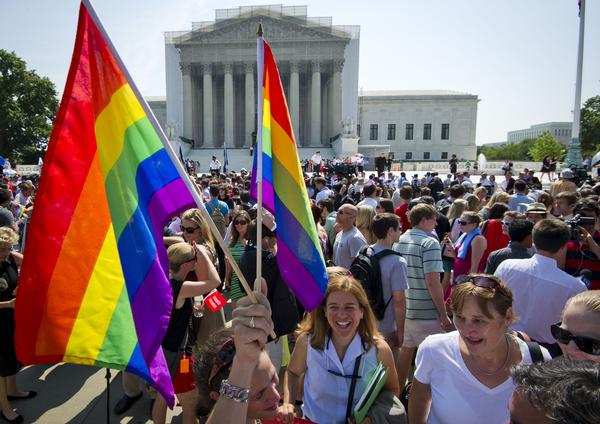
US-JUSTICE-GAY -MARRIAGEYesterday the United States’ Supreme Court declared that the federal government had been violating the Constitution by defining marriage as a union between a man and a woman.

The court also declared that citizens of California who passed a constitutional amendment limiting marriage to a union between a man and a woman did not have legal standing to defend their own law.

Although the two landmark decisions pave the way for marriage to be redefined throughout all of America’s 50 states, the two rulings actually fall short of the high hopes of the homosexual lobby. In particular, they were disappointed that the court declined to declare same-sex ‘marriage’ to be a fundamental right.

In the first case, U.S. v. Windsor, the Court ruled that Section 3 of the federal Defense of Marriage Act (DOMA) violated the Fourteenth Amendment’s equal protection clause (“no state shall … deny to any person within its jurisdiction the equal protection of the laws”) by defining marriage as a male-female union for federal purposes. But the liberal justices who struck down Section 3—Kagan, Sotomayor, Breyer, and Ginsburg—left intact Section 2 of DOMA which prevents states from being forced to recognize same-sex ‘marriages’ performed in other states.

By kicking the matter back to the states, the Court has acknowledged that the federal government has no authority to define “marriage” for purposes of federal law and programs. Although there are thousands of federal laws and programs that make reference to marriage, the federal government has conceded that it does not actually have the authority to say what marriage actually means for the purposes of these laws, and must be content to let the definition be determined by each state.

The second case before the Supreme Court—Hollingsworth v. Perry—concerned California’s controversial Proposition 8, a constitutional amendment that California voters enacted through a referendum but which California’s rulers subsequently refused to enforce. Instead of ruling on the merits of Proposition 8, the Court said that the citizens who passed the constitutional amendment didn’t have standing to defend their own law. What this actually means in practice for California is ambiguous and will be determined only by the passage of time. Once again, this ruling came as a mixed victory for supporters of same-sex ‘marriage’ since the court refused to grant attorney Ted Olsen’s request that the Court ‘discover’ a constitutional right to same-sex marriage that could be imposed across the country.

In their reluctance to offer a decisive pronouncement on the legitimacy of same-sex ‘marriage’, the Supreme Court has essentially kicked the decision back to the states. In so doing, they have virtually guaranteed years of bitter acrimony and debate.

After yesterday’s ruling, 30% of Americans will live in states that recognize same-sex marriage, given the expected addition of California. Twenty-nine states, on the other hand, currently have constitutional amendments defining marriage as a union between a man and a woman.  The real battle is just beginning as both sides line up for a costly state-by-state campaign that could further polarize the American people.

Tomorrow we will run a post looking at the larger spiritual implications of these rulings for the American people and for the world at large.


Find out how to join Christian Voice and stand up for the King of kings (clicking on the link below does not commit you to join)

Please note that persons wishing to comment on this story must enter a valid email address. Comments from persons leaving fictitious email addresses will be trashed.
Law Society pushes homosexual propaganda

LawSocThe Law Society, which represents solicitors in England and Wales, is promoting the London Gay Pride parade and sponsoring a conference looking ‘Beyond Legal Rights’, Christian Voice can reveal.

Last year, the Law Society banned a conference on marriage which had been booked at their HQ in London by Christian Concern.  CC were told just days before the event that it breached “equality and diversity” policies.

The conference speakers held mainstream views that marriage is between a man and a woman. They included academics, the head of a political think tank and a writer for the Telegraph newspaper.

Most reasonable people would take the view that the Law Society should have as much freedom to let their conference rooms to whoever they please as a Christian hotelier should have to decide who can sleep under their roof.  But for Lawyers to allow a booking and then break their contract doesn’t set a very good example to the rest of us.

Christian Concern have now reached an agreement with the Law Society in which the Society agrees that they are entitled to hold their views and can book the premises in future.  But CC point out that this kind of what they call ‘censorship’ is happening before any change in the law on marriage.

What will happen after ‘gay marriage’ is enacted is anyone’s guess, but our guesswork can be helped by the Law Society’s foray into the promotion of sodomites’ rights post ‘gay marriage’.

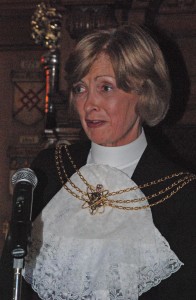
Fiona Woolf in her regalia as an Alderman of the City of London

As well as taking part in the London Gay Pride Parade on 29th June 2013, and despite promising to hold ‘a debate on same-sex marriage’, the Law Society is sponsoring a conference next Thursday under the banner of the ‘InterLaw Diversity Forum’ to ‘secure real equality for LGBT+ people now that a comprehensive legal framework has been achieved’.  ‘Special guest speakers’ are Tim Hailes, MD of JP Morgan and Fiona Woolf, a previous president of the Law Society and diversity advocate who is about to become Lord Mayor of the City of London.

Now they have – or are about to get – legal equality (don’t tell them that the Marriage (Same Sex Couples) Bill now going through Parliament isn’t ‘equal marriage at all) ‘the gays’ want even more.

Dressing up their demands in terms of ‘anti-violence’ and ‘anti-LGBT+ bullying’ (no, we don’t know what the + is for either) ignores the fact that most violence against homosexuals occurs within their own network, and that their anti-bullying programmes encourage bullying.  The real agenda will be about how to shut up those opposed to them and how to push Christians out of public sector jobs.

You heard it here first.


Find out how to join Christian Voice and stand up for the King of kings (clicking on the link below does not commit you to join)


Please note that persons wishing to comment on this story must enter a valid email address. Comments from persons leaving fictitious email addresses will be trashed.

Alan Chambers Goes Back to Egypt

1
Alan Chambers has turned back to Egypt
by Dr. Scott Lively

The headlines in the liberal media are gleefully trumpeting the demise of Exodus International, the leading icon of the ex-”gay” movement. “From ‘pray away the gay’ to acceptance,” chortles the LA Times. But this is not really a story about an organization, but only its leader Alan Chambers and his unfortunate capitulation to the world. I invite you to join me in prayer for him.

Those of us “in the know” have over the past few years watched Alan slowly transform Exodus into his own private fiefdom, while at the same time he slowly gravitated inexorably away from recovery.  By recovery I mean the state of mind which focuses on freedom in Christ from bondage to sin as exemplified by 1 Corinthians 6:9-11: “Or do you not know that the unrighteous will not inherit the kingdom of God?  Do not be deceived; neither fornicators, nor idolaters, nor adulterers, nor effeminate, nor homosexuals, nor thieves, nor the covetous, nor drunkards, nor revilers, nor swindlers, will inherit the kingdom of God.  Such were some of you; but you were washed, but you were sanctified, but you were justified in the name of the Lord Jesus Christ and in the Spirit of our God.”

In anticipation of this sad day many former Exodus member organizations broke away months ago and formed a new organization, the Restored Hope Network.  RHN will carry on the important work of the church in helping homosexuals to recover from same-sex attraction disorder.  I applaud the courage of these men and women to remain true to Scripture in the face of intense hostility and persecution from the “gay” movement and its many powerful allies.  Their ministry will not be made any easier by the triumphal gloating and attacks of their now greatly emboldened detractors.

It was this same relentless grinding hostility that undoubtedly contributed to the fall of Alan Chambers (few can bear it for long, just ask the Boy Scouts), but in addition to this “stick” there was also a “carrot” that led him astray: an insidious form of “gay” theology that misrepresents God’s grace as a license to sin, or at least a license to embrace a personal identity defined by a desire to indulge in homosexual sin.Dr Scott Lively

Don’t get me wrong.  I am a pastor whose theology is deeply rooted in the truth of grace, and I don’t believe that homosexual sin is any greater barrier to salvation than any other sin.  It’s one thing, however, to acknowledge that some heaven-bound Christians may struggle with homosexual desires and even conduct, but an entirely different matter to condone and affirm a homosexual “orientation” as if God intended it to be one’s basis for self-identification.  The former is solidly Biblical, the latter is dangerous heresy.  God did not create people to have no choice in a behavior He condemns as an abomination, and He wants us never to identify with our sin nature but to strive always to overcome it. These are fundamental tenets of Scripture.

The world today mocks the notion that homosexuals can change, but what is truly ridiculous, even by secular standards of logic, is the insistence that a person cannot reorient their sexual nature to comport with their heterosexual physiology. Normalcy is, after all, that with conforms to its design, and all of us, even “homosexuals,” have a heterosexual design. That fact is simply self-evident to anyone with a rational mind. Yet Christians, among whom Alan Chambers still counts himself, are required to hold to an even higher standard of truth: God’s Word. Under that standard, the self-evident truth just mentioned is also the perspective of our Omniscient, Omnipotent Creator God: “Such were some of you.” And, of course, there are many ex-”gays” who know the truth of that verse living among us in victory over their former disorientation, just as there were in the early church.

For many years Exodus International was an organization true to the Bible, adopting as its theme the Hebrew exodus from bondage in Egypt to freedom in the wilderness. In that story the hero is Moses who stayed true to God while the people often grumbled and wanted to go back to Egypt where life in slavery seemed less difficult than their struggles under freedom. Ironically, in the Exodus International story, it is Moses Alan Chambers who has turned back to Egypt, while the people keep pressing on toward the Promised Land. I pray these strugglers will not be overly discouraged by Alan’s failure. After all, here, just as in the Bible story, the true leader wasn’t really Moses, it was and is God. And He never fails.

Being a Gentleman ‘Sexist’, say Feminists

By Robin Phillips

Being a gentlemanNo Longer Politically Correct to be a Gentleman

Chivalry is demeaning towards women and a sign of ‘sexism’ in men, feminist psychologists now claim.

The controversial claims follow a report for the Psychology of Women Quarterly which asserts that there is a cluster of behaviours called ‘benevolent sexism’ which manifests itself in everything from opening doors for girls to men offering to help women choose the right computer. (See Andy Bloxham’s Telegraph article, Chivalry is actually ‘benevolent sexism’, feminists conclude.”)

Playing the part of a gentleman is a particularly insidious form of ‘benevolent sexism’, rooted in warm feelings towards women, the researchers claim. While gentlemanly behaviour might at first appear to be positive towards women, it is actually a form of gender colonialism.

“The warm, fuzzy feelings surrounding benevolent sexism come at a cost,” warned Melanie Tannenbaum in the Scientific American last April, “and that cost is often actual, objective gender equality.”

Social scientists have even claimed that equality is threatened when a man tells a woman that he cannot live without her or when he ‘cherishes’ her.

The radical claims were published in the Psychology of Women Quarterly, the official publication of the Society for the Psychology of Women. The authors of the study, Julia Becker and Janet Swim, warned that “Women endorse sexist beliefs, at least in part, because they do not attend to subtle, aggregate forms of sexism in their personal lives. …women…are the victims of ‘benevolent sexism’.” They warned that sexist attitudes include an “odd…conjunction of what at first seemed inherently incompatible: subjective affection as a form of prejudice…”

Although most women welcome benevolent sexism, social scientists are alerting them to the danger. As the Science Daily reported,

“Benevolent sexism motivates chivalrous acts that many women may welcome, such as a man’s offer to lift heavy boxes or install the new computer. While the path to benevolent sexism may be paved with good intentions, it reinforces the assumption that men possess greater competence than women, whom benevolent sexists view as wonderful, but weak and fragile.”

The report for the Psychology of Women Quarterly drew on the work of social psychologists Dr. Peter Glick and Dr. Susan Fiske who wrote a paper in 1996 which postulated the existence of ambivalent sexism. Ambivalent sexism is a category thought to include both ‘hostile sexism’ (things like rape, wife-beating, etc.) and ‘benevolent sexism’ (things like offering to carry a woman’s luggage, opening doors, etc.). The authors claimed that their research proved that both hostile and benevolent sexism are composed of three subcomponents: paternalism, gender differentiation, and heterosexuality. Both forms of sexism also have origin in men’s desire to dominate women: “[Benevolent sexism is] a subjectively positive orientation of protection, idealization, and affection directed toward women that, like hostile sexism, serves to justify women’s subordinate status to men.”

Glick and Fiske believe that the gender differentiation and heterosexuality that are integral to benevolent sexism emerge in ‘protective paternalism’, intimacy-seeking, male self-disclosure (how sexist to assume a woman will be a sympathetic ear!) and romantic love. As Glick and Fiske write, “the attitudes we define as characterizing benevolent sexism” include “protective attitudes towards women, a reverence for the role of women as wives and mothers, and an idealization of women as romantic love objects.”

Other tell-tale signs of ‘benevolent sexism’ include the belief that “women should be cherished and protected by men”, the belief that “men should sacrifice to provide for women”, or when a man offers to do the driving on a long distance journey (‘protective paternalism’ again). Even saving a woman’s life is offensive, for according to Swim the statement that “in a disaster, women should be saved before men” is sexist.

Being Positive is Being Negative

It is not only males who are being accused of perpetuating ‘benevolent sexism’. If a woman think too highly of her sex, then that is a sign that she too has fallen victim of certain sexist myths. As the Scientific American reported, “women who were exposed to benevolent sexism were more likely to think that there are many advantages to being a woman.” One of the questions used to determine ‘benevolent sexism’ is whether a woman agrees with the statement, ‘there are some things that a woman understands better than a man.’

On the surface, it is strange that any feminist would have a problem with a woman complimenting her own sex. However, given their fixation with ‘gender equality’, the only thing feminists hate more than someone suggested women are inferior to men is for someone to suggest that women are superior to men. The compliment is offensive precisely because the suggestion that women are superior implies that men and women are not the same.

We have seen that the theory of ‘benevolent sexism’ argues that there is a strange juxtaposition between praising women and hating them, that acting positive towards a woman is actually negative; being nice to women is actually not so nice. At first this seems completely bizarre. How can positive feelings towards women be negative? How can it be not quite nice to treat a woman nicely?

The answer to these questions can be found in the pervasive suspicion that if men sacrifice for women or look after them, then this implies women are weak or even (God-forbid) that women are not entirely self-sufficient without men, and visa versa. But classical feminism denies that women need men. By classifying ‘benevolent sexism’ in the same class as ‘hostile sexism’ (rape, wife-beating, etc.), feminist theorists are targeting any kind of mutual dependence and complementarity among the sexes – what Glick and Fiske refer to pejoratively as “complementary gender differentiation.”

These ideas are not limited to fringe feminist academics. If you don’t believe me, try this little experiment. Go into a big city and spend the day looking for acts of chivalry you can do towards women. It could be anything from opening doors for women to helping them on with their coats. You may find that you will have an experience similar to the 55-year-old businessman named Tony whose experience Wendy Shalit chronicled in her book A Return to Modesty.

I was out with my wife and one other woman and when I got the other woman’s coat for her and reached to help her with it, she practically ripped the coat out of my hands, said “Nobody has ever done that for me!” and stomped off and waited, fuming, by the door.”

Such is the topsy-turvy world in which we live, where being nice to women is considered demeaning.

Social Consequences

The irony is that without the concept of gender differentiation, and without a high premium placed on men acting as gentlemen, women are actually vulnerable to the very types of exploitation and abuses to which feminism claims to be the solution.

Glick and Fiske have shown that ‘benevolent sexism’ lurks whenever women are made the objects of men’s adoration, protection, and provision. But don’t we see the results of women not being the recipients of male protection and provision all around us? We do, and it isn’t reassuring. All around us we see the result of a world in which men no longer think they need to protect women. Every day in the news we are reminded what a society looks like where it is no longer cool for a man to be a gentleman.

Not only do we live in a world where a man can claim the moral high ground by repudiating the role of gentleman, but feminists have given us a world in which it is praiseworthy for women not to act as ladies. For let’s not forget that the concept of ‘benevolent sexism’ not only targets men who act as gentlemen, but also women who have a kind of feminine pride, who think of themselves as special, who gravitate towards men who will protect and adore them, and who try to act as ‘ladies.’

When we turn away from the academic theorizing of feminist social scientists to the real world and look at what goes on in the street, it is doubtful that the erosion of female dignity is actually good for women. It isn’t a complicated point that an attractive woman who believes there is a special dignity about being female is more likely to have the inner resources to resist the lucrative pull of the porn industry. A woman who believes that she has a right to male provision and protection merely because she is a woman will be less likely to let herself be victimized by unscrupulous men. A woman who thinks of herself with dignity and who appreciates the advantages of being a woman is going to be more likely to seek out men who will protect and cherish her.

So perhaps ‘benevolent sexism’ isn’t so bad after all. In fact, I’ll go further. Without an appropriate sense of ‘benevolent sexism’, it becomes difficult to rightly assess the tragedy of sexual abuse against women. Let me explain.

Remember that one of the components of ‘benevolent sexism’ is gender differentiation. But without a strong sense of gender differences—what we might call the womanliness of women and the manliness of men—we might legitimately ask whether the violation of female sexuality is really that bad. For some thinkers the answer seems to be no.

For example, the original text of Eve Ensler’s award-winning play, ‘The Vagina Monologues’ venerates rape performed on a 13-year-old girl, who declares, “If it was rape, it was a good rape.” In her book Sex, Art, and American Culture: Essays, Camille Paglia write that if rape “is a totally devastating psychological experience for a woman, then she doesn’t have a proper attitude about sex.” Significantly, Paglia bases this idea on a non-benevolent view of women, saying, if we have the “kind of attitude” that women “are basically nurturing, benevolent people…then of course rape is going to be a total violation of your entire life…” In her own approach, however, a woman being raped is just like a man getting beaten up.

Although these comments should fill us with horror, they are not without a certain feminist logic. If there is no gender differentiation, rape cannot be said to be a crime against one’s womanhood and female dignity, but only a crime against the body. This is because these theories assert that womanhood and female dignity, as something differentiated and complementary to manhood, either do not exist in an ultimate objective sense, or exists as merely the residue of our patriarchal culture. Indeed, when all aspects of our humanity are reduced to gender-neutral categories, then what is left to be called a “woman” has hardly any right to complain that rape is qualitatively different to being beat up, or that prostitution is different than any other type of profession (hence the debates among feminists on whether prostitution should be legalized).

Once gender differentiation is seen to be a species of sexism, then not only is the gentleman seen to be an icon of our sexist past, but the virtuous woman is seen to be an icon of female subordination. This frightening logic has been realized in various movements in which feminists have intentionally appropriated to themselves the language of female hatred. One thinks of Elizabeth Wurtzel book Bitch, or the ‘Slutwalk’ phenomenon which attempted to reclaim the word “slut,” or New York State University’s taxpayer-funded ‘Revolting Behavior’ conference which attempted to reclaim the word “Shameless Hussy”, or the International GoTopless Day which attempts to bring to men sights that at one time would have been restricted to a brothel, or movements like ‘V-Day’ which attempt to reclaim certain slang and offensive terms for the female genitalia. The irony of all these movements are that they sponsored by feminists who, in the name of equality, have embraced themes that used to be the province of misogynist men, while those males who remain gentleman are demonized.

In Defense of Chivalry

Chivalry is unpopular today precisely because it is an emblem of masculinity among the men who practice it and an emblem of femininity in the women who receive it, even as feminine modesty reminds us that there is a difference in how responsible men and women dress. Chivalrous behavior thus presupposes certain things about our humanity. It assumes, for example, that women ought to be treated in a special way because they are women, just as feminine modesty proclaims that women ought to dress in a certain way because they are women. When a man embraces his calling to look after and protect women, or when a woman embraces her obligation to dress modestly, both are proclaiming that there is a fundamental difference between the sexes.

However, in a world where women have been “liberated” to be the same as men, where we are taught that all gender-specific roles (including men showing special honor to women) are oppressive, it is inevitable that strong attack will be leveled against men behaving as gentlemen and women acting as ladies. However, the irony is that by turning female honor and dignity into something dirty, feminism opens women up to new forms of exploitation.

By contrast, being ladies and gentlemen—embracing ‘benevolent sexism’ as something good—acts as a hedge against the sexual reductionism of our society. Good sexual manners—whether it be man offering to carry a women’s heavy suit case or a lady making sure her clothes are not transparent—constantly reaffirms that the raw matter of our world has a certain shape and poetry beyond the brute facts of existence. It also affirms what Glick and Fiske argue is a central tenant of ‘benevolent sexism’ but which might not actually be that bad to recover: the notion that “women are to be loved, cherished, and protected.”


Find out how to join Christian Voice and stand up for the King of kings (clicking on the link below does not commit you to join)

Please note that persons wishing to comment on this story must enter a valid email address. Comments from persons leaving fictitious email addresses will be trashed.
DOJ Employees told to Affirm Homosexuality

Department of Justice

Workers at the United States Department of Justice were sent an email telling them that silence about LGBT issues was no longer enough, and that employees must go out of their way to make homosexuals feel comfortable.

The email, which originated from a group within the Department that calls itself ‘DOJ Pride’, has prompted widespread fears of religious intolerance and viewpoint discrimination at the highest levels of American government.

The anonymous whistle-blower from the Department told the Liberty Counsel law-firm that DOJ employees were emailed the brochure, “LGBT Inclusion at Work: The 7 Habits of Highly Effective Managers.” The brochure was created by DOJ Pride and urges employees to stop using “gender-specific terms like ‘husband’ and ‘wife’”

The brochure also tells DOJ employees to attend LGBT events sponsored by DOJ Pride or by the Department itself, and encourages them to post DOJ Pride stickers in their office.

The most controversial part of the brochure states that “Silence seems like disapproval. There’s still an atmosphere of LGBT issues not being appropriate for the workplace (particularly for transgender people), or that people who bring it up are trying to rock the boat.”

Mat Staver, founder of Liberty Counsel, commented, “Christians are frightened and terrified of losing their jobs. You just can’t keep you head down and do your job. Now you have to become an advocate for the LGBT agenda – and if you don’t – the DOJ will consider that to be intolerant. Under this directive, one cannot be a Christian and a manager at the Department of Justice. How does one who believes in the teachings of Jesus Christ and the Bible display ‘gay pride’ stickers?”

Robin Phillips, spokesman for Christian Voice and author of Saints and Scoundrels, commented that the DOP Proud brochure illustrated the general trajectory of the LGBT movement’s changing goals. “Once the LGBT lobby was content to use the spurious notion of ‘tolerance’ to merely neutralize opposition,” he said. “But recently they have launched a much more ambitious goal, which is the forced affirmation of certain viewpoints and lifestyle choices.”

Further Reading

Find out how to join Christian Voice and stand up for the King of kings (clicking on the link below does not commit you to join)

Please note that persons wishing to comment on this story must enter a valid email address. Comments from persons leaving fictitious email addresses will be trashed.
Privacy and the Paradox of Sexual Freedom

By Robin Phillips

In Hadley Arkes’ book Natural Rights and the Right to Choose, he makes some penetrating observations about American society which apply with equal force to some of the issues Britain is now facing. He writes,

Natural Rights and the Right to choose

In the name of ‘privacy’ and ‘autonomy’, [Americans] have unfolded, since 1965, vast new claims of liberty, all of them bound up in some way with the notion of sexual freedom. In the first steps, there was a liberty, for married couples, but then soon for unmarried persons, to have unregulated access to contraceptives. Next, the claim of privacy was extended into a private right to end a pregnancy, or destroy a child in the womb, at any time in a pregnancy, for virtually any reason. That same claim of privacy was soon extended to the freedom to end the lives of newborns afflicted with Down’s syndrome or spina bifda. After the briefest interval, that same doctrine of personal autonomy was applied to the other end of the scale of age and converted into a claim to assisted suicide.

Ironically, this unfolding scheme of liberation has advanced even while privacy, in other domains, has been progressively crimped and disrespected by the law. Private corporations, private clubs, private households, have found themselves under thicker regulation, and the overhanging threat of lawsuits. The combined effect has been to remove the attribute most prized about privacy: the freedom to arrange one’s own association, or private enclave, according to one’s own, private criteria. But this recession of privacy and freedom seems to count for very little when set against the expansion of rights associated with sexual freedom. The dismantling of restraints on sexuality has evidently been taken as far more liberating, even exhilirating, perhaps because it has been taken as a matter of the most irreducible ‘personal’ freedom. And yet these freedoms, celebrated as pre-eminently ‘personal,’ have required the assistance or intervention of surgeons and counselors, and they have quickly annexed to their cause the demand to have the support of public monies, drawn from tax-payers with the coercions of the law. It must surely count, too, as one of the paradoxes of this new phase in our law that people seem to identify their well-being, not with an obligation to preserve life or go to its rescue, but with the creation of vast new franchises to destroy human life, for wholly private reasons, without the need to offer a justification.

Each step in liberation has been marked, then, by a further detachment of people from the traditional restraints of the law. The corollary, of course, is that, as restraints have been removed, persons once protected by those restraints have been removed from that protection. Vast new  liberties come along with vast new injuries – unless, of course, the victims no longer count. In any event, there is little doubt that these alterations in our law over the past thirty years have been taken as the hallmarks of a new regime of personal freedom; a freedom so vital to those who savor it, that any threat of having it qualified or diminished in any degree is taken as nothing less than an assault on the constitutional order itself.

Find out how to join Christian Voice and stand up for the King of kings (clicking on the link below does not commit you to join)

Please note that persons wishing to comment on this story must enter a valid email address. Comments from persons leaving fictitious email addresses will be trashed.

Boys & girls swop guns & dolls in Scotland

The Swedish arm of Toys R Us is suggesting girls play with guns. Zero Tolerance think this will reduce violence. But only against women.
The Swedish arm of Toys R Us is suggesting girls play with guns. Zero Tolerance think this will reduce violence. But only against women.  Violence against men doesn’t matter.

Nursery children in Scotland are the target of a new campaign that aims to end sexism in pre-schools and prevent future domestic violence by encouraging boys to swap their cars for dolls and little girls to dress up as pirates, says The Times.

The ‘Just Like a Child’ initiative being launched this week by ‘Zero Tolerance’, a charity that claims to ‘fight violence against women’, aims to ‘end gender stereotyping in nurseries’ by giving boys dolls to play with and encouraging girls to play with guns and be ‘strong and tough’.

Jenny Kemp, Zero Tolerance coordinator, writes: “We believe that it is never too early to question what is seen as ‘normal’ or what is traditionally expected of boys and girls in our society. In fact, we believe that doing so from a very young age helps to protect children from the negative consequences of inequality and discrimination as they grow into adults.”

Liz Ely, a ‘development officer’ at Zero Tolerance, said: “From the moment children are born they are told that boys must be strong and tough, and girls are delicate and pretty. These stereotypes have real and lasting consequences. The fact that as a society we tell boys not to express their emotions, and girls that they are not suited to science and maths, sets children on a path to inequality; this inequality lays the foundations for abuse and violence in later life.”

Dr Sarah Morton, a ‘family expert’ and psychologist at the University of Edinburgh, said ‘our research has found a clear link between gender stereotypes and violence against women and children.’

It would be interesting to see that research, and how ‘gender stereotypes’ were quantified, because common sense might lean to the view that it is insecurity rather than some supposed ‘inequality’ which lies at the heart of a desire to lash out, and that by encouraging insecurity in their gender identity this programme will increase the likelihood that these boys and girls will grow up unbalanced and abusive.

The website www.zerotolerance.org.uk says the organisation ‘is a charity working to tackle the causes of men’s violence against women. Too many women in Scotland, and around the world, experience violence from men – most often men they are close to and/or who are in a position of power over them. Men’s violence against women is caused by gender inequality, and it helps this inequality to continue.’

There is so much wrong in that unbalanced statement it is hard to know where to begin. For a start, women’s violence and abuse against men apparently either does not happen or does not matter to ‘Zero Tolerance’. The idea that men are always ‘in a position of power’ over women is laughable. Lastly, where does the idea come from that violence is simply and exclusively ’caused by gender inequality?’ Abuse of any sort is caused by sin, and the roots of it can lie in insecurity, irritation, drunkenness, provocation, mental problems or plain old wickedness. And the fair sex are not immune from any of those.

One strongly gets the impression that there is either an anti-Christian, feminist political agenda behind the approach of ‘Zero Tolerance’ or there are some personal issues becoming rather too public.  Either way, it is not just sad but frankly mendacious to involve children in a social experiment which could leave them trying to work out problems with gender identity later in life.

It would be better and more effective to teach boys that they have a responsibility to protect and care for girls, but of course that would reinforce the very ‘gender stereotype’ that the feministas at Zero Tolerance so detest.


Genesis 2:18 And the LORD God said, It is not good that the man should be alone; I will make him an help meet for him.

Isaiah 3:12 As for my people, children are their oppressors, and women rule over them. O my people, they which lead thee cause thee to err, and destroy the way of thy paths.

1Peter 3:7 Likewise, ye husbands, dwell with them according to knowledge, giving honour unto the wife, as unto the weaker vessel, and as being heirs together of the grace of life; that your prayers be not hindered


Find out how to join Christian Voice and stand up for the King of kings (clicking on the link below does not commit you to join)


Please note that persons wishing to comment on this story must enter a valid email address. Comments from persons leaving fictitious email addresses will be trashed.
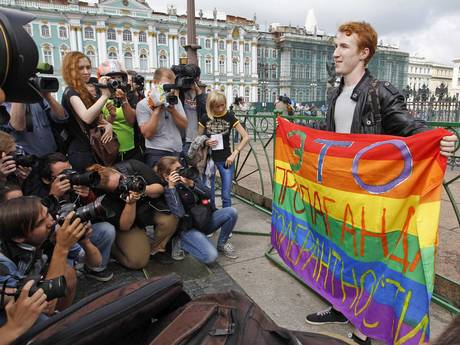
Gay Marriage Bill Threatens to Divide Tory Party

By Robin Phillips

David Cameron is facing a groundswell of opposition that could culminate in him being ousted as leader of the Tory Party.

The Marriage (Same-Sex Couples) Bill cleared its final Commons hurdle today in a vote of 366 to 161, although the victory for Government comes at a costly political price.

More than half of the Tory party voted for one or more amendments that would have protected liberty of conscience, but these amendments were cut down by David Cameron.

The Prime Minister is now facing a rebellion of 130 Tory MPs in a groundswell of opposition that could culminate in him being ousted as the Conservative leader prior to the 2015 general election.

The bill, which seeks to redefine the meaning of marriage, will now move to the House of Lords, which is expected to hold its first debate in July.


‘SOVIET-STYLE PERSECUTION’

The cat was out of the bag that the marriage bill is not about freedom at all after Government rejected three amendments that would have protected liberty of conscience, including one that would have allowed registrars to opt out of conducting gay marriages where another registrar was available and willing.

Former Tory Minister Ann Widdecombe declared that “this Bill is not about liberty and equality but about oppression and state orthodoxy, about Soviet-style persecution in the work place for an opinion given in a private context, about compelling conformity even where conformity is not necessary.”

Many senior Tories are beginning to worry that David Cameron’s pro-Europe and pro-homosexual policies have come at the expense of being able to hold the party together. Secretary of State for Defence, Philip Hammond, echoed the concerns of many senior Tories when he stressed last week that voters are angry.

The infighting was punctuated by a YouGov poll that showed the Conservative Party is at their lowest rating since 2000.

Meanwhile, David Cameron not only faces opposition from his own ranks but also from hundreds of Islamic leaders. Church leaders as well have warned that the Bill could have the effect of isolating young Christians who believe in the traditional definition of marriage.

Find out how to join Christian Voice and stand up for the King of kings (clicking on the link below does not commit you to join)

Please note that persons wishing to comment on this story must enter a valid email address. Comments from persons leaving fictitious email addresses will be trashed.

Hammond warns against redefining marriage

Rt Hon Philip Hammond MP

Secretary of State for Defence, Philip Hammond, has warned of the danger of redefining marriage.

Speaking on BBC’s Question Time, he said there was no great demand in the country for change and criticised the amount of parliamentary time devoted to the issue. “I have just never felt that this is what we should be focusing on,” he told the audience.

“This change does redefine marriage. For millions of people who are married, the meaning of marriage changes.

“There is a real sense of anger among many people who are married that any government thinks it can change the definition of an institution like marriage.

“There was no huge demand for this and we didn’t need to spend a lot of parliamentary time and upset vast numbers of people to do it,” he added.

The comments from such a senior Cabinet colleague will embarrass David Cameron, and encourage Parliamentary opposition to the measure.


Find out how to join Christian Voice and stand up for the King of kings (clicking on the link below does not commit you to join)


French Legalise ‘Gay Marriage’

Francois Hollande has signed the Bill into law
Francois Hollande

France’s president has signed into law a controversial bill making the country the ninth in Europe, and 14th globally, to legalise gay marriage, reports the BBC.

On Friday, the Constitutional Council rejected a challenge by the opposition, clearing the way for Francois Hollande to sign the bill.

The deeply unpopular Hollande said: “I have taken [the decision]; now it is time to respect the law of the Republic.”

The first ‘gay wedding’ could be held 10 days after the bill’s signing.

The Constitutional Council ruled  that same-sex marriage “did not run contrary to any constitutional principles,” and that it did not infringe on “basic rights or liberties or national sovereignty”.

It said the interest of the child would be paramount in adoption cases, cautioning that legalising same-sex adoption would not automatically mean the “right to a child”.

50% of the French electorate oppose adoption of children by homosexuals and the opposition group Manif Pour Tous say that a majority of the electorate oppose Hollande’s flagship measure.

New Zealand legalised ‘gay marriage’ last month.  France is now the 14th country to overturn God’s institution of marriage in which a man joins a woman in a one-flesh union.  Commentators have pointed out that basic anatomy denies the ability to be ‘one flesh’ to two homosexuals, mandating a redefinition of marriage.

France is also the ninth country in Europe to allow same-sex marriage.  The others  are Norway, Sweden, Iceland, Denmark, Belgium, the Netherlands, Portugal and Spain.

South Africa, Canada, Uruguay and Argentina have also changed the definition of marriage.

In January, a protest in Paris against the bill by Manif Pour Tous attracted some 340,000 people according to police – one of the biggest public demonstrations in France in decades. Organisers put the figure at 800,000.

Last month, a youth organiser for Manif Pour Tous, Samuel Lafont, was attacked at Odeon métro station by a homosexual gang. He was stabbed in the back six times, as well as sustaining other injuries. Two persons accompanying him were also hurt.

The following morning there were tweets on Twitter that celebrated what happened. One stated that having no news from Lafont for hours, s/he hoped that Lafont was dead but “not from worry”.
Find out how to join Christian Voice and stand up for the King of kings (clicking on the link below does not commit you to join)


The following morning there were tweets on Twitter that celebrated what happened and wished Lafont dead.  He and his friends are now recovering.

Same-Sex Marriage Debate

1

By Robin Phillips

Sherif Girgis defends real marriage

In our earlier posts ‘Can Ecclesiastical Marriage be Separated from Civil Marriage?‘ and ‘Why Gay Marriage is a Public Threat Part 2‘ I had occasion to quote from the book What is Marriage? by Sherif Girgis, Ryan Anderson and Robert George. This book is probably the most compelling defense of real marriage that is currently available. The website www.whatismarriagebook.com/ gives summaries of the book’s arguments in addition to further resources by the authors.

Last January there was a fascinating debate on C-span in which one of the book’s authors, Sherif Girgis, debated Andrew Koppelman on ‘gay marriage’ before an audience at the Harvard Law School. The entire debate can be watched here. Both thinkers have a background in law and have clearly spend considerable time considering the question from their differing perspectives of legal theory. The debate isn’t easy-going and can get pretty technical, but it is still definitely worth watching if you have a free hour. This was the most civil and rational debate I have ever seen on this topic which is usually charged with emotion.


Find out how to join Christian Voice and stand up for the King of kings (clicking on the link below does not commit you to join)

Please note that persons wishing to comment on this story must enter a valid email address. Comments from persons leaving fictitious email addresses will be trashed.

Niall Ferguson Was Right First Time

19
Niall Ferguson
Niall Ferguson

Scottish historian Niall Ferguson put  a public apology on his website yesterday after suggesting that the spend-your-way-out-of-recession approach of economist John Maynard Keynes was inspired by his homosexuality. (Read the BBC report, ‘Niall Ferguson apology over Keynes remarks.’)

The Harvard professor made the remarks at a conference in California on Thursday after being asked to comment on Mr Keynes’s famous observation that “in the long run we are all dead.” Dr Ferguson suggested that Keynes’ unconcern for future generations was related to being both gay and childless. He reportedly said that “it’s only logical that Keynes would take this selfish worldview because he was an ‘effete’ member of society.”

Ferguson’s remarks raised controversy throughout the internet, and he was quickly condemned for being homophobic, ignorant and even mad.

In his retraction, Dr. Ferguson said, “It is simply false to suggest, as I did, that his approach to economic policy was inspired by any aspect of his personal life. As those who know me and my work are well aware, I detest all prejudice, sexual or otherwise.”

Despite his retraction, Christian Voice believes Dr. Ferguson was right the first time. We have reported on the British economist John Maynard Keynes before, showing how his rejection of the Biblical “sowing and reaping principle” in favour of immediate gratification formed the basis both of his deviant sexual lifestyle and his economic theories. Recognizing the obvious connection between Keynes’ personal life and his economic theory is not a matter of sexual prejudice, but of history.

A paedophile who governed his life by the principle that “in the long run we are all dead”, Keynes was himself the first to suggest that his approach to economic policy was inspired by his immoral life. Keynes wrote, “When the accumulation of wealth is no longer of high social importance, there will be great changes in the code of morals. We shall be able to rid ourselves of many pseudo-moral principles which have hag-ridden us for two hundred years….”

As this quotation suggests, it is simply not possible to disengage Keynes’ economic theories from his worldview – a worldview deeply rooted in the deviance of his personal life. That is why we believe that Niall Ferguson was right the first time.


Find out how to join Christian Voice and stand up for the King of kings (clicking on the link below does not commit you to join)

Please note that persons wishing to comment on this story must enter a valid email address. Comments from persons leaving fictitious email addresses will be trashed.