
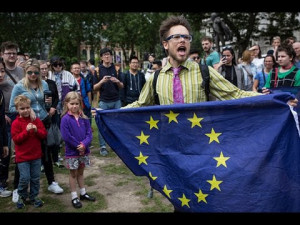
The ‘Remoaners’ are at it again. As part of their anti-Brexit campaign for the UK to stay in the EU, they intend to launch a legal challenge.
This one is not over Article 50 of the Lisbon Treaty but over a certain Article 127.
Confused? Article 127 is the exit clause for the European Economic Area.
The so-called ‘Hard Brexit’ involves leaving the European Union’s Single Market and its Customs Union. A ‘Soft Brexit’ would stay in them, making the vote in June to ‘Leave’ the EU of no consequence.
So just where does the European Economic Area fit in?
OK. Let’s draw it all together.
CUTTING THROUGH THE JARGON
The EU’s own website says: ‘The Single Market refers to the EU as one territory without any internal borders or other regulatory obstacles to the free movement of goods and services. … The European Single Market is one of the EU’s greatest achievements. … The Single Market is at the heart of the European project …’ It also allows the free movement of people, but they are a bit coy about admitting that.
The BBC explains: ‘A customs union is a form of trade agreement between two or more countries. It means they decide not to impose tariffs (taxes on imports) on each other’s goods and agree to impose common external tariffs on goods from countries outside their customs union. Setting common external tariffs is what distinguishes a customs union from a free trade area.’
The European Free Trade Association (EFTA) states: ‘The European Economic Area (EEA) unites the EU Member States and the three EEA EFTA States (Iceland, Liechtenstein, and Norway) into an Internal Market governed by the same basic rules. These rules aim to enable goods, services, capital, and persons to move freely about the EEA in an open and competitive environment, a concept referred to as the four freedoms.’
The UK Government confirms the EEA allows Iceland, Liechtenstein and Norway to be part of the EU’s Single Market. It goes on: ‘Switzerland is neither an EU nor EEA member but is part of the single market – this means Swiss nationals have the same rights to live and work in the UK as other EEA nationals.’
THE UK IS A CONTRACTING PARTY TO THE EEA AGREEMENT
The UK signed the EEA Agreement in Porto on 2nd May 1992 and ratified it on 15th November 1993. It came into force on 1st January 1994. The UK is a ‘contracting party’ to the EEA Agreement.
Article 127 of the EEA Agreement says: ‘Each Contracting Party may withdraw from this Agreement provided it gives at least twelve months’ notice in writing to the other Contracting Parties.
‘Immediately after the notification of the intended withdrawal, the other Contracting Parties shall convene a diplomatic conference in order to envisage the necessary modifications to bring to the Agreement.’
In the face of the legal challenge about to be launched by a pro-single market think tank with no working website called ‘British Influence‘, the Government has maintained that EEA membership ends when the UK leaves the EU. But that is not what the Agreement says. So a bit like the Roundheads in the book ‘1066 and all that‘, the Remoaners in this case are ‘Right but Repulsive’. (The Cavaliers, you will remember, were ‘Wrong but Wromantic’.)
Where does this leave the UK Government? Quite simply, they must just get on with it and bring a short Bill before Parliament to leave the EU and trigger both Article 50 and Article 127. Or they can add all that to the bill they have promised, dubbed the ‘Great Repeal Bill’. which will repeal the European Communities Act 1972.
And if they lose the vote, they will be able to call a General Election and win it.
WE DO NOT NEED TRADE AGREEMENTS TO TRADE
The Bible reminds us that nations do not need trade agreements to trade. Ezekiel 27 is an important chapter which sets down in minute detail the extensive network of ocean-going international trade 2,600 years ago. It was centred around the wicked city of Tyre and included metals from the British Isles:
Ezekiel 27:12 Tarshish was thy merchant by reason of the multitude of all kind of riches; with silver, iron, tin, and lead, they traded in thy fairs.
All trade agreements do is reduce tariffs, which may or may not be of benefit. The EU exports more to the UK than it imports from us, and German car-makers will not want a trade war. The Bible also reminds us that leaders have to trust God and make decisions. First Moses then the Lord told Joshua:
Joshua 1:6 Be strong and of a good courage: for unto this people shalt thou divide for an inheritance the land, which I sware unto their fathers to give them.
In particular, rulers have to take the initiative, set a standard and lead the people:
2Chronicles 20:3 And Jehoshaphat feared, and set himself to seek the LORD, and proclaimed a fast throughout all Judah.
PRAY that Theresa May, David Davis, Boris Johnson and Dr Liam Fox will get on with it and take the UK properly out of the European Union with its pretensions to continue the antichrist project of Babel. View our video:
Find out how to join Christian Voice and stand up for the King of kings (clicking on the link below does not commit you to join)

Please note that persons wishing to comment on this story must enter a valid email address. Comments from persons leaving fictitious email addresses will be trashed.




Thank you for the explanation.
The legal cases are important, in my opinion. Also having a part to play in God’s plan.
I pray that the British vote for Leave (by a narrow margin) will be turn out to be a blessing to the entire community of European peoples, which the UK can obviously never leave.
Although I voted Leave, I would would be delighted to see the UK not invoking Article 50 yet. Instead the UK should remain in the EU for the time being, saying that the UK has decided to leave the EU eventually by popular vote, and will do so, but admitting that it cannot safely do so yet, because Article 50 is not fit for purpose. The mechanism for leaving the EU has to be reformed, to make it possible for member states to leave the EU without risking harming their own economies in the process.
The UK ought to remain in the EU until it has succeeded in reforming the process of leaving the EU, so that other, less wealthy nations than the UK will not be afraid to follow suit. If that becomes government policy, it really will change the face of the European community.
I am happy to accept Stephen as quite an expert on this, though I have my doubts about Ezekiel.
If the campaign was all about the democratically elected British parliament taking back control from Brussels, then it does make sense to allow the British parliament to decide these things, and here is another thing which it needs to decide. Switzerland decides all manner of things by referendum, but that is not our tradition.
If you want expertise (a commendable if rare desire) see Leave HQ and Richard North of the EU Referendum blog. Read “Flexcit”. Our ignorocracy is beginning to discover the things Dr North has been telling them for years. The EU was designed not to be left. It is a trap. It is somewhat like a barbed-wire entanglement. We could tear ourselves free in one bound, and die slowly of the festering wounds thus inflicted. Or we can do it carefully. Meanwhile, the hard Brexiteers will howl “Betrayal” while the remoaners will be trying to wangle things so that we do not leave at all. Those who are actually doing the work will have to resist both. Things have changed since Ezekiel’s time.