
 Over a quarter of young British people do not trust Muslims, according to a poll carried out for BBC’s Newsbeat.
Of the 1,000 young people questioned, 28% said Britain would be better off with fewer Muslims, while 44% said Muslims did not share the same values as the rest of the population.
Some 60% thought the British public had a negative image of Muslims.
Other findings in the Comres survey, conducted in June, include:
* Only three in 10 (29%) think Muslims are doing enough to combat extremism in their communities. Even though 48% of young people agree that Islam is a peaceful religion, more than a quarter (27%) disagree.
* Young people place the blame for Islamophobia in Britain on terror groups abroad (26%), the media (23%) and UK Muslims who have committed acts of terror (21%).
* Young people are divided over whether or not immigration is good for Britain overall. Two-fifths (42%) say it is a good thing but more than a third disagree (35%)
An adviser on anti-Muslim hatred said the findings suggested young people needed to mix more.
Akeela Ahmed, a Muslim from a cross-government ‘working group on anti-Muslim hatred’, said: “These findings indicate that we need to ensure young people are mixing at local levels and that they’re working on projects together so that people can get to know Muslims and vice versa.”
Evidence shows, however, that it is Muslims who do not want to mix. They have formed enclaves in places like Oldham, Bradford, Cardiff, Oxford and Tower Hamlets where non-believers, known as ‘kaffir’, are despised and unwelcome.
A second problem with young people mixing with Muslims is that they could quickly encounter the Muslim practice of ‘taqiyya’ and have their preconceptions hardened.
In brief, ‘taqiyya’ is a culture of lying to protect Islam stemming from advice given by Mohammed himself. It spills over into every normal social encounter with the result that virtually any comment from a Muslim needs to be soundly corroborated before being believed.
Transplanting such a culture into a country whose Christian heritage assumes the truth will always be told and recognises no such loop-hole as ‘Taqiyya’ was always going to be fraught with difficulty.
A third problem is the aggressive manner in which Muslims in Britain practise their religion, with the full face-veil becoming a totem issue.
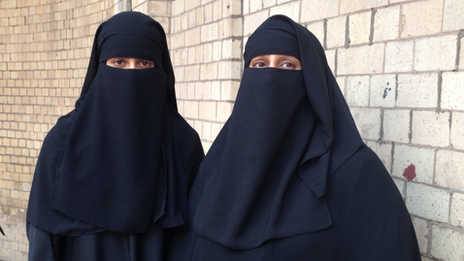
Anisha Patel, a practising Muslim, wears a black full-face veil and according to her comments in the Newsbeat story, claims to have been attacked by two men who pulled off her daughter’s veil.
“The kind of comments, the kind of looks and stares that we’re experiencing at this moment in time is very different to what it was before,” she said.
“They’ve become much more hostile, much more bitter, and much more aggressive in nature. It’s actually got to the stage where I’m beginning to feel that I want to stay in my house.”
She added: “At the end of the day this is a piece of cloth. It can neither harm anyone or do anything to anyone or do anything to anybody. If you’re going to add all the things on to it and say this is a terrorist or whatever they now think we are, it is just ignorance. Absolute ignorance.”
However, a 20-year-old woman who did not want to be named gave Newsbeat some background to her lack of trust of Muslims:
“When you hear about terrorism, more often than not it is Muslims that have carried it out. I just feel they’re all out to do that, they’re all the same.
“If we went to their country we can’t wear shorts and a crop top, yet they come here and cover themselves up. It’s almost like they’re forcing their religion on to us”, she said.
Such comments will dismay members of government working groups, but they indicate a growing depth of feeling at odds with the historic welcome Britain has given to immigrant communities.
However, groups like Huguenots and Jews fleeing religious persecution held similar religious and moral standards as the British, made attempts to assimilate and at the very least did not bring such an ‘in-your-face’ attitude as the recent wave of Muslims have done.
The Muslim population is set to grow in the United Kingdom by further immigration and a degree of natural fecundity spurned by both the Christian and secularist sectors. Muslims will be over-represented in both local and national government and will become more demanding.
Meanwhile, on present trends our culture will become more crass and brutal (as the website Brutal Britain shows) and both the freedom of the Christian faith and the rich Christian Heritage of Britain will be further eroded. It is highly likely that the church will stay within its walls and forget its duty to stand for the truth of the Gospel in the public square as did the prophets of old.
Given all that, it is a good job that Almighty God is in control, but has this country’s rebellion against his laws now outstripped our previous usefulness in spreading the Gospel? Has our national spiritual bank account slipped too far into the red? If so, there could be a rocky road ahead.
Find out how to join Christian Voice and stand up for the King of kings (clicking on the link below does not commit you to join)

Please note that persons wishing to comment on this story must enter a valid email address. Comments from persons leaving fictitious email addresses will be trashed.

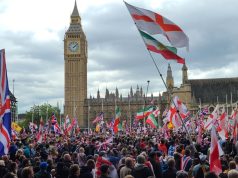
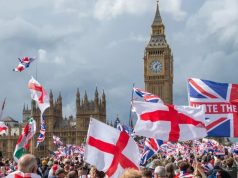




The Church in the UK , with a few exceptions, is trying to be like the society it exists in instead of doing what it was called to do — preach the Gospel of Jesus.
But woe to the UK! From a country that embraced the persecuted Jewish people of Europe and sent out more missionaries than any other country it has become one of the leaders in embracing secularism, atheism, multiculturalism and the advance of a one world government under man.
God says:
Isaiah 60:12 For the nation and kingdom which will not serve you shall perish, And those nations shall be utterly ruined.
Anisha Patel says: “At the end of the day this is a piece of cloth.” Yes, so it is at the end of the day, when she has taken it off to go to bed. But what is important is not the cloth, it is the position of the cloth, covering the face. At the end of the day, and throughout the day, a face is a face, which performs important functions, and people expect to see the face. She does not mention this.
Nor is it really an inherent part of the Muslim religion that women’t faces need to be covered. Where I live, the vast majority of Muslim women do not do it, nor do they wear black. They are brightly coloured with cheerful faces, and are not intimidating at all as a result. Nor incidentally is there an “enclave” , and certainly not an enclave where “unbelievers are unwelcome”, although it is on your list.
The worst experience for me is unexpectedly encountering a black draped woman, apparently at first with no face, in a supermarket aisle. Some of the older ones are really dumpy and shapeless, resembling nothing so much as a sack of coal on wheels. This startles me. I have thought about it, and part of the problem is that at first I don’t know which is the front, so I don’t know which way the object is going to move. They have depersonalised themselves when they do this. It is not my fault if I tend to look on them as objects, they have brought it on themselves, quite deliberately.
Similarly, how are young women dressed like this going to mix with normal teenagers ? What white boy is going to fancy a particular one, and what would be the dreadful consequences if he did ? So the expert’s advice that “young people needed to mix more” is not going to be a lot of use. The whole outfit is designed to discourage mixing.
But this does not apply to Muslim women dressed according to less rigid traditions. What is really needed is for Muslim leaders to convince their followers that the full veil is not necessary, and that black is not necessary. They clearly are not. You only have to look around to see this. If the difference comes from the geographical origin of the group (as it seems to), then what is needed is for some Muslim authorities to establish an appropriate and acceptable Muslim dress for women in Europe, where they are now. This might be on the lines of what European women are allowed to wear in the more liberal Muslim countries, and would not be unreasonable at all.
I would be interested in a survey of young Muslims to see what they thought of their so-called ‘host’ community. Are they kept apart by consent or by obligation? Dop they secretly envy the ‘freedoms’ of the western culture? Or do they see us as decadent and corrupt and so do not want anything to do wqith us? Or do they have the ‘jihad’ mentality that has become the image of so much that Islam has to offer? It is well possible that Muslims feel hoistility from the likes of ourselves and become defensive in the face of this, and so become a victim of pressure from all sides.
Well, here is a summary of surveys done just prior to 2010, showing that young Muslims are far more radical than their parents:
http://my.telegraph.co.uk/danielpycock/danpycock/956/what-do-british-muslims-think-of-the-uk/
Such surveys are useless, because you can’t rely on Muslims to tell the truth, especially when asked questions like these . This is called taqiyya.
Except that taqiyya would present Islam with as a good a face as possible. So the figures can only be worse than actually reported.
A Roman Catholic friend advised me that this view of ‘taqiyya’ is misleading . He likened it more to the situation of Roman Catholics in England in Tudor times, when they could take every necessary step to hide their religion, so that the practice of their “true” religion could continue relatively unhindered, rather than die out.
A glance at Wikipedia confirms this .
“ a legal dispensation whereby a believing individual can deny his faith or commit otherwise illegal or blasphemous acts while they are at risk of significant persecution” (this would be “legal “ and “illegal” according to their own religious law).
I am already aware of other sensible rules like this in Islam, for example, you don’t need to fast during Ramadan if you are ill, or to pray or carry out other duties in totally unreasonable circumstances.
The risk of significant persecution does not apply to most social encounters in Britain. Moreover, taqiyya is much more practised by Shias than by Sunnis, and the majority of Muslims in Britain (as in most countries) are Sunnis.
Your Roman Catholic friend and Wikipedia may not be as reliable as you want to believe. The uncomfortable fact is that the word of Muslims, both Shia and Sunni, should always be corroborated before being accepted. Whether the dissimulation stems from Taqiyya or some other cultural norm may be a matter for discussion but does not alter the sad reality.
How do we corroborate it , if normally acceptable sources like Wikipedia are not reliable in such matters ? Where did you go to yourself to establish this uncomfortable fact ?
It’s borne out by numerous examples. The Somali Ambassador flatly denying that hostages during the Nairobi siege were allowed to leave if they could prove they were Muslims. The electoral fraudsters in Birmingham in 2005 who told lie after laughable lie. I could go on. It is also borne out by experience.
So you say the word of Muslims, both Shia and Sunni, should always be corroborated before being accepted. But how can we corroborate it on questions such as what constitutes acceptable taqiyya ?
To be fair to Muslims in general, there are numerous examples of non-Muslim criminals and diplomats and indeed politicians telling lots of lies.
But Muslims are over-represented in our prisons. And when they demand a mosque inside the prison, it isn’t to reform each other so they can go straight, as those brought up in a Christian tradition might imagine. It’s simply to learn the pillars of Islam and Quran.
‘In order to submit to God, and to be at peace with fellow beings, a Muslim has to perform certain duties to God and to fellow-beings. The duties to God are: Prayer (salaat), Fasting (saum) and Pilgrimage to Mecca (hajj).
‘The duty to fellow beings is to spend one’s resources, time, energy, money, etc. for the welfare of others; in particular, to give a part of one’s wealth to help those in need (known as giving zakaat, a charity-tax).’
But you can still do all that while being a drug-dealer, an extortioner, a pimp, or whatever other racket the criminal world comes up with.
And please don’t argue that logically from ‘the welfare of others’ it should not be like that. It is like that. Islam is not a faith where repentance, the indwelling of the Holy Spirit, turning from the flesh, etc etc, as in Christianity, have any place. You do the stuff and you are a good Muslim. End of story.
However, groups like Huguenots and Jews fleeing religious persecution held similar religious and moral standards as the British, made attempts to assimilate and at the very least did not bring such an ‘in-your-face’ attitude as the recent wave of Muslims have done.
Stephen, it is not often that I agree with you, but I am proud that Britain has always offered a safe haven for those seeking shelter from religious persecution. The Jews, Huguenots, and more recently the Hindu’s expelled from Idi Amin’s regime in Uganda, have made a valid contribution to our society. But this influx of muslims has me concerned for the very future of our nation.
They have made it clear they do not wish to integrate. Our politicians bend over backward to accommodate their every whim, the media is even afraid to mention the words Islam, or muslim, when reporting atrocities. I envisage a bleak future.
What would you suggest be done?
Another difference which has just occurred to me is that these Muslims are not actually fleeing religious persecution .They all come from Muslim countries.
Learning in prison that they must go on a pilgrimage to Mecca isn’t going to be very helpful. although when they get out of prison I suppose it might encourage them not to go back until they have acquired enough money for the pilgrimage and been on it.
If it is OK to commit crimes so as to give part of the proceeds to others, how is it that Shariya law treats criminals so harshly ? Does a thief get his hand cut off if he intended to give the loot to others as zakaat ?
A Muslim only has to make the Haaj once in a lifetime.
A thief will only have his hand cut off in a country which enacts sharia.
You will generally find that poor thieves have that punishment. Rich ones can pay a sum of money instead – or bribe the judge.
You make it sound as though Muslims are thoroughly dishonest and corrupt.
I saw a woman in the middle of a shopping centre today sitting on a chair having her eyebrows plucked for the sake of beauty. She was wearing a niqab mask, and was very careful to keep her nose and the rest of the lower part of her face covered from the public gaze. Of course, this resulted in far more people looking at her than would otherwise have been the case.
I think Stephen is really right. He has really thought this through and knows the more about religion than anyone else. Good work Stephen, another contribution the mass of human knowledge. Good old Stephen…
Steady on, Ben.