
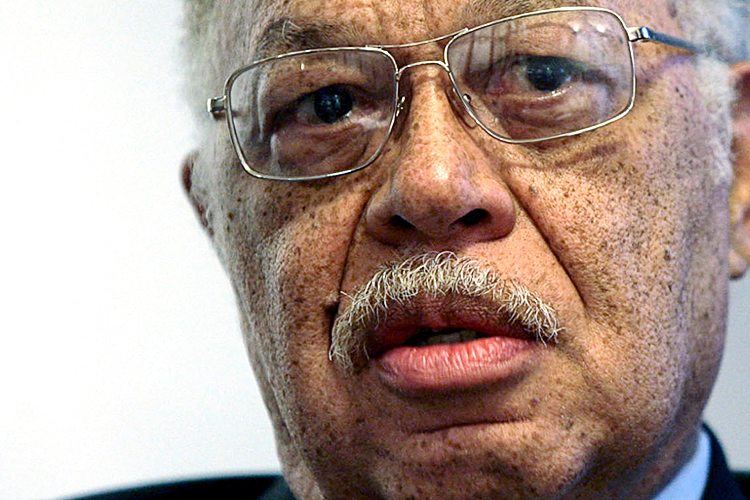
Earlier this month, long-time abortion provider, Kermit Gosnell, was sentenced to life imprisonment on multiple counts of first degree murder and a string of lesser charges. The verdict was issued after it emerged that his Philadelphia based ‘Woman’s Medical Society’ had snipped the spinal cords of hundreds of babies born alive.
Gosnell’s preferred method for performing late-term abortions was to induce delivery and then kill the baby after birth by cutting the spinal cord at the back of the neck. Testimony given to the jury showed that this process of snipping occurred hundreds of times to bring about the demise of a breathing and moving baby. The babies would be thrown away, while their feet would be stored in jars.
The jury heard that sometimes a baby would be left for a while before being killed, and would only stop crying once Gosnell performed his barbaric procedure. One baby was born in a toilet and made what appeared to be frantic efforts to swim moving before an employee grabbed it and cut its neck with surgical scissors. Some of the babies who were snipped would not die immediately and testimony includes accounts of babies screeching in agony.
The pro-abortion machine was as quick as the pro-life lobby to condemn Gosnell’s atrocities, not wanting their abortion-rights movement to be tainted by association with this mass murderer. At the same time, however, we shouldn’t let this obscure the fact that the abortion-rights industry has had a record of ambivalence when it comes to the question of infanticide.
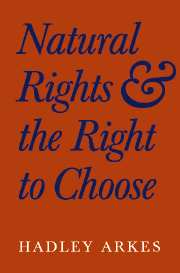
At least, that is what Hadley Arkes suggests in his fascinating book Natural Rights and the Right to Choose. Arkes shows that the idea of protecting babies born alive has been highly controversial within the ranks of abortion-rights activists.
One of the things that made me interested in reading Natural Rights and the Right to Choose is that Arkes was one of the architects of an important piece of American legislation protecting babies who survive an abortion, known as the Born-Alive Infants Protection Act of 2002. This bill was put together after revelations surfaced that hospitals in America were routinely performing what was known as “live birth abortion.”
There are numerous harrowing accounts of “live birth abortions” practiced at conventional hospitals. In some of these procedures the baby is killed with surgical scissors, while in other hospitals the baby is literally thrown in the trash or a cot to die of dehydration in a process that has sometimes lingered on for an entire day. Jill Stanek, a former nurse at a major Chicago hospital, has described witnessing babies being born alive after failed abortions and being brought to a “soiled utility room” and left to die. “My experience was that they [the babies] survive as short as a few minutes, to once, almost as long as an eight hour shift.”
Mary Ellen Douglas, National Organizer for Campaign Life Coalition, has reported that “Babies were found struggling for life in a basin and nurses were told to leave them alone because they were aborted.”
Official statistics from Canada show that between 2000 and 2009 at least 491 babies died after surviving abortions following a live birth.
Arkes explains that the Born-Alive Infants Protection Bill was not merely a response to the proliferation of live-birth abortions. Arkes was also concerned that much of the reasoning that judges were adopting to defend “partial-birth abortions” entailed accepting premises that also logically entailed infanticide. Indeed, it was coming to be accepted by judges and legal scholars that the right to an abortion means the right to an effective abortion, even if the baby survives the first attempt and is accidentally born. If the right to abortion entailed the right to a dead child, then it is only a triviality which side of the birth canal that child happened to be on. This was exactly the issue that emerged in the landmark cace of Floyd v. Anders in 1977. Arkes explains the significance of this case:
A male child had survived an abortion, and a surgery, for 20 days after an abortion, and the question was posed as to whether there had been an obligation to preserve the life of that child. The answer, tendered by Judge Clement Haynsworth, was no: As Haynsworth “explained,” the mother had decided on abortion, and therefore, “the fetus in this case was not a person whose life state law could protect.” Ordinarily, a child born alive is protected under the laws of a state, but now we had a new constitutional right, a right to abortion, and that new right worked its effects simply by shifting the labels: That child born alive was not a child, or a person, protected by the laws of homicide. That new being was merely a ‘fetus,’ marked for termination. In effect, the right to abortion was interpreted as the right to an “effective abortion” or a dead child.

It was to address atrocities such as these that Arkes pioneered the Born-Alive bill. But in his book Arkes is candid that he also had a more subversive aim. He hoped that the Born-Alive Infants Protection Bill would plant premises in people’s minds that could serve as the most modest of first steps towards questioning the very principles on which abortion rights were based. If the law could recognize that the value and humanity of a baby who survived an abortion does not depend on the feelings of the mother, then it might be reasonable to ask why the value and humanity of the same child, only minutes earlier, can be thrown into question with such ease.
During Arkes’ decade long battle to get the Born-Alive Infants Protection Bill introduced and finally passed, it met with vigorous opposition from House Democrats and the abortion-rights machine. “The most ‘modest first step’ of all was the proposal simply to preserve the life of the child who survived the abortion” Arkes reflected. “As simple as it was, the proposal had a political bite, because the proponents of abortion could not admit even the smallest step that acknowledged the human standing of the child.”
On 20 July, 2000, The National Abortion Rights Action League came out with a forceful press release opposing the bill, claiming it represented “yet another anti-choice assault” that “would inappropriately inject prosecutors and lawmakers into the medical decision-making process.” It further accused the bill of “seeking to ascribe rights to foetuses ‘at any stage of development,’ therefore directly contradicting one of Roe’s basic tenants.”
Since the “stage of development” referred to in the bill was the stage after birth, NARAL’s opposition suggested that there was a principled connection between the logic of abortion-rights and infanticide. As Hadley Arkes wrote, commenting on NARAL’s incredible admission, “The fact that the child had emerged from the womb apparently made no difference for its standing: It was still a fetus. And it would be a fetus presumably, as long as it was marked for abortion. It would never attain the name of ‘child’ or person. All of that quite fit the premises and the lens with which NARAL looked out on the world.”
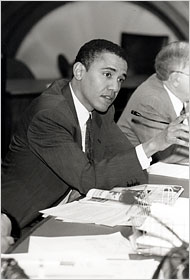
The National Abortion Rights Action League had many supporters in Congress, and one of them was state senator, Barack Obama, who used his position as a committee chairman to kill the same bill in Illinois.
Despite widespread opposition, the Born-Alive Infants Protection Act finally passed in August 2002 thanks to two developments. The first development was that Congressman Jerry Nadler (D, N.Y.) realized that the Democrats would embarrass themselves if they insisted too hard on extending “choice” to the killing of children already born. (Interestingly, Obama continued to oppose the bill even after NARAL and most of the Democrats withdrew their opposition.) The second development was the addition of a “neutrality clause” explicitly stating that the bill expressed no judgment, in either direction, about the legal status of a human prior to live birth.
The enactment of the Born-Alive Infants Protection Act over a decade ago has not silenced the debate about the personhood of children who survive abortions in America. Indeed, one of the things that emerged during the trial of Hermit Gosnell was just how ambivalent mainstream abortion rights activists have been towards the issue of infanticide.
Now in one sense this should come as no surprise. From the very beginning of the abortion rights movement, judges justified their decision in Roe v. Wade on the grounds that the court was not in a position to resolve the difficult question of when human life begins. But once we concede that we are not in a position to know when human life begins, then the mandatory protection of infants who are already born begins to look merely arbitrary.
This logic has not been lost on the pro-choice lobby. In March of this year a Planned Parenthood lobbyist was asked by a member of the Florida House Civil Justice Subcommittee whether an abortionist should be required to try to save the life of a baby who survived an abortion. The abortion-rights lobbyist, Alisa Lapolt Snow, replied, “We believe that any decision that’s made should be left up to the woman, her family, and the physician.” Think about that for a moment: the concept of ‘choice’, once only applicable to whether or not to kill the child in the womb, is now being extended to a baby struggling for life on a doctor’s table!
This problem is not limited to America. In the UK, 66 abortions a year are botched and the baby is born alive, according to an official report by the Confidential Enquiry into Maternal and Child Health, commissioned by the Government. Once born no medical help is offered.
In April this year, an undercover investigator attended a teaching session where a 10-year Planned Parenthood adviser explained what to do if a woman were to deliver her baby at home between the stages in a two-day abortion. She should just “flush it” and said that any surviving baby would die once it was submerged in a toxic solution inside a jar. (See also, ‘Abortion Doctor: I Would Leave Babies to Die Born Alive After Abortion.’)
Last year a paper in the Journal of Medical Ethics, entitled ‘After-birth abortion: why should the baby live?’, argues that “both fetuses and newborns do not have the same moral status as actual persons…” The authors of this paper, Alberto Giubilini of the University of Milan and Francesca Minerva of Melbourne University, state in the article’s abstract:
By showing that (1) both fetuses and newborns do not have the same moral status as actual persons, (2) the fact that both are potential persons is morally irrelevant and (3) adoption is not always in the best interest of actual people, the authors argue that what we call ‘after-birth abortion’ (killing a newborn) should be permissible in all the cases where abortion is, including cases where the newborn is not disabled.
The argument in the main body of the essay used abortion-rights arguments to try to prove that live-birth abortions can be justified for the same reason as conventional abortions. As the authors write, “A serious philosophical problem arises when the same conditions that would have justified abortion become known after birth.” What are these conditions? Earlier in the paper the authors had specified: “a child can itself be an unbearable burden for the psychological health of the woman or for her already existing children…” The essay went on to argue that “In such cases, we need to assess facts in order to decide whether the same arguments that apply to killing a human fetus can also be consistently applied to killing a newborn human.”
In cases where a newborn is found to be disabled, the authors believe the issue is fairly straight-forward because of the detrimental economic impact the child would have on society:
“Nonetheless, to bring up such children might be an unbearable burden on the family and on society as a whole, when the state economically provides for their care. On these grounds, the fact that a fetus has the potential to become a person who will have an (at least) acceptable life is no reason for prohibiting abortion. Therefore, we argue that, when circumstances occur after birth such that they would have justified abortion, what we call after-birth abortion should be permissible.”
But even in cases where the newborn is not disabled, they suggest that after-birth abortion should be acceptable on the same principle as conventional abortions:
“…we claim that killing a newborn could be ethically permissible in all the circumstances where abortion would be…. The moral status of an infant is equivalent to that of a fetus in the sense that both lack those properties that justify the attribution of a right to life to an individual. …the same reasons which justify abortion should also justify the killing of the potential person when it is at the stage of a newborn.”
How old does a baby have to be before we can attribute human personhood to him or her? The authors of the article are reluctant to give a threshold and admit “it is hard to exactly determine when a subject starts or ceases to be a person.”
Shrinking back from the attribution of personhood is not limited to philosophical journals. Arkes quotes a revealing interchange that occurred on the floor of the Senate between Pennsylvania’s Rick Santorum and Barbara Boxer of California when debating a bill to ban partial-birth abortions. Mr Santorum asked Mrs Boxer when was the first moment a child came under the protection of the laws regarding human life. Boxer replied, “I think when you bring your baby home…”
Why is there such reluctance to acknowledge that a child born alive is a person with value? We have attempted to address some possible answers to this question in our follow-up post, ‘Abortion and the Problem of Personhood.’
Further Resources
Find out how to join Christian Voice and stand up for the King of kings (clicking on the link below does not commit you to join)

Please note that persons wishing to comment on this story must enter a valid email address. Comments from persons leaving fictitious email addresses will be trashed.








[…] « Live-Birth Abortions and the Politics of Choice […]
[…] Live-Birth Abortions and the Politics of Choice […]