
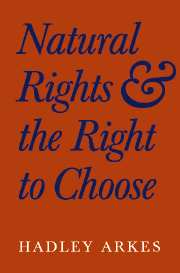
 Our earlier post, ‘Live-birth Abortions and the Politics of Choice‘ ended by asking why there has been such reluctance among abortion defenders to acknowledge that a child who survives an abortion is a human person of value.
Hadley Arkes’ book Natural Rights and the Right to Choose offers some possible answers to this question. Mr Arkes suggests that part of the problem has been a move away from natural rights towards an exclusive reliance on positive law. The concept of natural rights recognized that those laws which are posited must be based on more fundamental first principles of ethics. There are certain moral absolutes that are prior to, and the basis of, the laws which are posited.
Beginning around 1965 natural rights began to be questioned in American benches and law schools and was gradually replaced by what is known as ‘legal positivism.’ Arkes traces this process and shows how Positivism “usually goes hand in hand with the expression of a deep scepticism about the sources of law. The Positivist is more likely to register a profound doubt that there are moral truths, holding steady from one place to another. In our own time, there has been more of an inclination to say that there are merely ‘opinions’ or right and wrong, which will always be ‘relative’ to the feelings of the person who holds them, or to the opinions that are dominant in any place.”
The rejection of natural rights entailed by legal positivism feeds on a type of ‘soft’ relativism that eschews the casting of moral judgements, especially judgements which might affect policy. However, all policy is essentially moral, whether we recognize it or not, and it is inescapable that the public will absorb the moral principles implicit in the laws. As Arkes writes,
“As the public absorbs the understandings of rights and wrongs contained in the laws, the character of the public becomes shaped, for better or worse…. Law there must needs be, and the men and women who shape the laws must be, perforce, teachers of morality, even when they profess to teach that there is no morality. In fact, we have discovered in our own time that judges and political men are never more rigid and moralistic in their teaching as when they are ridiculing moral judgment and professing to free people from the tyranny of moral truths.”
Arkes shows that this move away from natural rights toward relativistic notions of positive law has followed the trajectory of thinking on abortion rights. Before the “right to an abortion” can have any plausibility, it is necessary to first deny that a baby in a womb is a human person in any meaningful sense, let alone that it possesses a human ‘nature.’ Thus it has become routine for defenders of abortion to maintain, in all seriousness, that they really do not know what it is a pregnant woman is carrying in her womb.
For example, in issuing a verdict for Planned Parenthood v. Doyle in 1998, Judge Richard Posner announced that partial-birth abortion is simply a removal of tissue comparative to cosmetic surgery.
Or again, in striking down the laws against partial-birth abortion in Planned Parenthood v. Casey in 1992, Judge Barry explained that the law forbidding this barbaric procedure had been addressing a mirage since, in reality, there was no child to be born, and no ‘delivery’ of a baby since “a woman seeking an abortion is plainly not seeking to give birth.” Thus, the difference between delivering a human and not delivering a human depends on the intention of the woman. This introduces an element of radical subjectivity into our understanding of human life. Since the answer to question “What is a human being?” depends on a value judgement, each one of us must be left to determine the answer to this question for ourselves. The difference between an actual human life and a potential human life becomes a matter of personal opinion. Thus we have the bizarre situation of American judges pronouncing that “at the heart of liberty is the right to define one’s own concept of existence, of meaning, of the universe, and of the mystery of human life.” (Planned Parenthood v. Casey)
But this logic, once accepted, spills outside the immediate confines of the debate about abortion, and has entailed a more general denial that there is such a thing as a shared human ‘nature’ that we can know and agree upon. To truly experience liberty, the ruling of Planned Parenthood v. Casey seemed to suggest, each person must be free to decide for him or herself what constitutes a human life. In this way, the ‘right’ to an abortion can only be sustained by denying the foundation of natural rights and positing a new concept of rights evacuated of moral substance.
A result of relativizing the definition of human life is that there is great difficulty when it comes to speaking meaningfully about man. As Arkes explains:
“The judges in our own day, profess to be far less certain about the meaning of ‘nature’ and ‘man.’ …they are more disposed to leave to the ‘political process’ the power to resolve that question of what constitutes a person or a human life… Since there is no ‘objective’ standard of what constitutes a human being, the decision will be left in the hand then of people with political power. And when they flex their power, in reach a judgment, that judgment will be tested by no standard of right or wrong apart from power itself.
“As the judges advance in their work, at the end of the century and the beginning of a new millennium, they have removed from our law any fixed notion of what constitutes a ‘man’ or a human being.
The problem, of course, is that if there is no nature common to man, then there can be no ‘human’ rights springing from that nature. If there is no objective ‘nature’ that human beings can be said to share in common, then there can be no settled moral truths that arise from that nature. In this way, we have accepted premises that, step by step, have talked ourselves out of the grounds of our own rights:
“If we can arbitrarily alter the definition of a ‘man’ as it suits our convenience, if nature provides no definition of a human being that we are obliged to respect, then – as we shall see – we remove the distinct ground of our claim to ‘natural rights.’ But if we do that, if we remove ‘natural rights,’ we would convert all rights into rights of ‘positive law.’ With that subtle shift, we would have removed, in effect, the very logic and substance of rights. For what we call ‘rights’ then are simply the things declared to be right by the opinion that is dominant in any place. In that event, the ‘rights’ enacted into law are merely the rights that a majority is willing to confer. But what the majority may confer, the majority may also remove when it no longer strikes the majority as right or convenient.”
Enter Gosnell. In one sense he is the prime example of someone defining reality for himself in the way urged by the judgement of Planned Parenthood v. Casey (“at the heart of liberty is the right to define one’s own concept of existence, of meaning, of the universe, and of the mystery of human life.”) Even though the murder of newborns was routine in the clinic, Gosnell never thought of himself as a murderer. In an article for the Washington Post, Melinda Henneberger said that “Gosnell himself seemed confused, when he was charged with so many counts of murder, as to how that could be. Because even at that point, he didn’t appear to see the children he’s accused of beheading as people.”
Gosnell is being treated as an anomaly, but if Arkes is to be believed, he is only the tip of the iceberg.
“People had to talk themselves into the notion that these beings, conceived by homo sapiens, carried in the wombs of women, were not really human beings—or at least not quite yet. This shift in labelling was not exactly easy to do if one had even a rudimentary knowledge of biology. And it was especially improbably in the light of what modern embryology was able to teach about the human embryo. But the powers of rationalization have been such that even people holding degrees from expensive colleges have been willing to affect, in public, that they have no firm knowledge of what is in a woman’s womb. …for the sake of making us all more suggestible to a new right to abortion, the judges had to begin teaching a novel doctrine: that the taking of human life was not as portentous a thing as we used to think, because we are no longer as sure as we were in the past in our sense of what a human being is.”
Further Resources
Find out how to join Christian Voice and stand up for the King of kings (clicking on the link below does not commit you to join)

Please note that persons wishing to comment on this story must enter a valid email address. Comments from persons leaving fictitious email addresses will be trashed.





[…] Abortion and the Problem of Personhood » […]
[…] Abortion and the Problem of Personhood […]