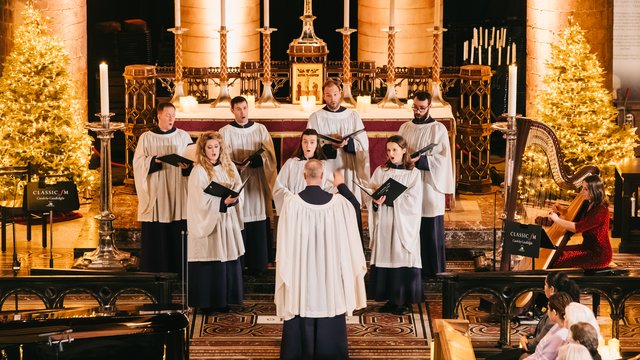
The Church of England has advised clergy to alter traditional Christmas carols to avoid “causing unnecessary offence,” according to the Telegraph.
Beloved hymns such as O Come, O Come, Emmanuel and Lo, He Comes With Clouds Descending- have been flagged for their supposedly “problematic” language, with clergy urged to use phrasing that “minimises” tension or confusion.
The Church’s identity crisis
The Church of England’s decision to alter beloved Christmas carols reflects a deep and troubling identity crisis. What was once a cornerstone of tradition and faith has now become an institution seemingly terrified of its own message. This latest directive, urging clergy to revise Advent hymns exemplifies a desperate attempt to placate an imagined audience that might take issue with core Christian beliefs.
It’s as if the Church is trying to market itself to a demographic that neither believes in its teachings nor respects its traditions. This absurdity calls to mind the analogy of a vegan walking into a butcher shop demanding changes to its product. The Church, instead of standing firm in its convictions, bends over backwards to accommodate every potential grievance. In doing so, it risks alienating the very people it is supposed to serve – those who come seeking faith, not a watered-down version of it.
By attempting to neutralise language about Christ’s divinity and the exclusivity of salvation, the Church is abandoning its foundational tenets. What message does this send to worshippers? That the Church itself doubts its teachings? Such an approach is not inclusive; it is self-destructive. The result is an institution so diluted that it struggles to offer anything meaningful to believers or non-believers alike.
A pattern of decline

This is not an isolated incident. Earlier this year, reports surfaced of a Church of England branch in Shipley transforming its services into professional wrestling events
to attract more congregants. Not long before that, the Church explored dropping the term “church” altogether to seem more accessible. These gimmicks, while perhaps well-intentioned, reveal a troubling trend: the Church of England is willing to sacrifice its identity in the futile hope of gaining popularity.
Such strategies betray a lack of confidence in the power of its own message. Instead of drawing people in with the strength of its traditions and the transformative message of the Gospel, the Church is resorting to marketing stunts and linguistic contortions. What’s next? Turning services into entertainment hubs complete with pub-style refreshments? These decisions are a far cry from the steadfast faith that has guided the Church for centuries.
The collapse in attendance and belief is not a failure of tradition but a failure of conviction. By apologising for its core tenets and pandering to societal trends, the Church alienates believers and disheartens clergy. Instead of inspiring faith, it fosters disillusionment. The Church’s inability to stand firm is not just a crisis for the institution; it reflects a broader cultural drift away from meaning and certainty.
Ask us to come and speak at your church →
The business analogy that hits too close to home
If the Church of England were a business, it would have gone bankrupt long ago. No successful enterprise undermines its own product to such an extent. Imagine a restaurant apologising for the quality of its food every time a customer orders. That is essentially what the Church is doing: diluting its message while simultaneously signalling shame about its own beliefs. This approach does not attract new followers; it drives them away.
The Church’s attempt to operate like a modern business – editing carols to avoid “offence” and adopting flashy, unorthodox practices like wrestling services – only underscores its desperation. Yet, businesses thrive because they offer something distinct and of value. The Church once had this in its faith and traditions, but in abandoning those, it has rendered itself indistinct. What’s left to offer when even the Church seems uncertain about its purpose?
The collapse of church attendance is a direct result of this lack of conviction. People aren’t seeking spiritual fulfilment elsewhere; they’re giving up entirely. And why wouldn’t they? If the Church itself seems unsure of its teachings, why should anyone else take them seriously? The Church’s role is not to cater to every cultural whim but to provide a stable anchor in a sea of change.
The tragic loss of conviction

The Church of England’s latest move – editing Christmas carols to avoid offending hypothetical sensitivities – is more than just a misguided attempt at relevance; it’s a tragic loss of conviction. A religious institution that cannot stand by its beliefs has little hope of inspiring faith. This failure of courage is not just damaging to the Church but to society as a whole, as it signals a retreat from moral and spiritual leadership.
The Church has historically been a source of strength, guiding communities through challenges and offering a message of hope and redemption. But today, it seems more focused on avoiding controversy than proclaiming truth. This shift is not only unappealing to potential worshippers but deeply disheartening to those who still hold onto their faith. The Church risks becoming a relic of the past, not because of its traditions but because of its abandonment of them.
If the Church of England truly wishes to regain relevance, it must stop apologizing for its beliefs and rediscover the courage of its convictions. Faith is not about pandering to the crowd; it’s about standing firm in the face of opposition. Without this resolve, the Church will continue its decline, leaving behind a legacy not of spiritual guidance but of squandered potential.
Related Story
Church of England spending “excessively” on politicised roles →
Scots protect abortion as churches close →
Read and pray
READ: John 4:24;Romans 14:1; Acts 20:28; James 1:27; Colo 1:28-29; Eph. 5:27; 1 John 2:15-17
.
PRAY: Pray for the Church of England.
Pray for the UK.
Pray for our leaders to lead in wisdom and the fear of God.
Let us know what YOU think in the comments below.
Support us!
We appreciate your support; it enables our research and helps us inform your prayers.
So click below to support Christian Voice and stand up for the King of kings
Or fill in the form below to keep in touch:
Click on the social media links below to share this post:</span