
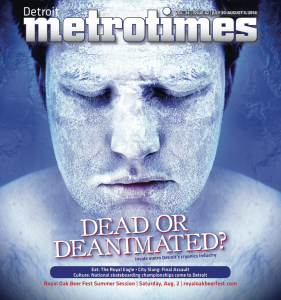
 A teenager has won the right for her mother to freeze her body in the hope that she may be brought back to life.
The court made the ruling in October, before the girl, 14, died from a rare form of cancer. Her father had opposed the application. Going further, he has accused the firm concerned, the Cryonics Institute, based in Michigan USA, of ‘selling false hope’.
He told the Independent: ‘I believe they are selling false hope to those who are frightened of dying – taking advantage of vulnerable people.
‘When I asked if there was even a one in a million chance of my daughter being brought back to life, they could not say there was.
‘I think it would be doubly impossible to both bring her back from the dead and cure her cancer, and companies should not hold out some false hope.’
THE ETHICS OF CRYONICS
The story, reported here by the BBC, has opened up debate on the practice and ethics of ‘cryonics’, the freezing of people with the intention of future resuscitation when and if the technology becomes available. (Cryonics is not to be confused with cryogenics, the study of extremely low temperatures. Even the BBC got them muddled up.)
So does cryonics work, and what would be a Christian view of it? Is it ethical, and if not, why not?
Cryonics is not mentioned in the Bible – obviously. But wisdom certainly is. God has given us common sense and analytical minds. If we lack wisdom, we can pray for it. Moreover, fraud and theft are mentioned quite a few times and that might be useful to us here.
Before we approach the ethics of it, what are the problems with cryonics both in the present and in the future?
PRACTICAL PROBLEMS IN THE FUTURE
In the future, we are assuming not only that scientists will be able and willing to thaw people successfully but that doctors will also be able to revive what was, at the point of freezing, a dead person. Something killed him. It will still be there.
David H. Gorski is an American surgical oncologist, Professor of surgery at Wayne State University School of Medicine. He points out that anyone being revived centuries from now would hardly know how to function (even Adam Adamant had problems, and he had only been frozen for sixty-five years). But crucially, there is the ‘question of whether some future society and scientists would even want to revivify a bunch of decades- or centuries-old bodies. They might want to do a few to prove it could be done, but after that each succeeding body would just be another burden. Sooner or later, the scientific interest would wane, as would the desire to devote resources to it.’

PRACTICAL PROBLEMS IN THE PRESENT
In the present, the advocates and customers for cryonics are placing too much faith in the freezing process. Frozen food manufacturers can freeze peas, beans, spinach, broccoli, even baby carrots, but try freezing raw potatoes or courgettes. All you will end up with on thawing them out is a mush.
That is because the ice crystals break down the vegetable’s cell walls. The Library of Congress writes about Clarence Birdsey’s invention of the quick-freezing process: ‘Before quick-freezing came along, foods were frozen at a fairly slow rate. This caused large ice crystals to form, which ruptured the cell membranes of the food. When the food was defrosted, the ice crystals melted and water would leak out, taking with it the food’s flavor and texture.’
WATER IN THE BODY
The cryonics companies say they will remove the customer’s blood and replace it with a sort of anti-freeze, but the freezing of blood is the least of their problems.
The human body is 60% to 65% water. The average weight of a human being around the globe is around ten stone. That’s 140 lbs.
So that person’s water content is more or less ninety pounds. Two thirds of it, sixty pounds, is intracellular, one third, like the blood, is extracellular. Your 8 pints of blood weigh ten pounds, just 11% percent of your total water.
It’s the intracellular water which will do the main damage, reducing the body’s cells to thawed-potato-like mush.
Put simply, you cannot freeze a human body fast enough. No-one has even frozen and revived the smallest of mammals. Small roundworms (nematodes) and some insects can survive freezing but that’s about it.
DYING HEART AND BRAIN CELLS
And that is even before we look at what happens at death. Professor Gorski writes:
‘Within minutes, the heart muscle cells, deprived of oxygen-rich blood, start really dying … and the more of them that die, the less the chance of getting the heart started again. … The problem of the dead heart, however, is minor compared to the problem of the dead brain. The brain is highly metabolically active and is thus exquisitely sensitive to interruptions in blood flow. As soon as the blood flow stops from a cardiac arrest, the brain starts losing cells, and it only takes a few minutes before severe and permanent brain damage occurs that rapidly progresses to brain death; i.e., the death of the neurons controlling the “higher’ functions.’
Over a year ago, in June 2015, the Daily Mail reported a study under the typically dramatic headline ‘Memories can survive cryonic preservation‘. But the study was on the aforementioned nematode worms. A more realistic view comes from the President of the Cryonics Institute, Dennis Kowalski. Describing cryonics as ‘a roll of the dice’, he said he did not believe memories would necessarily survive after the brain had been frozen for decades. He said patients could awake as “clones” of themselves, with no sense of their former lives, and he added he only had a ’50-50′ belief that people enclosed in the freezing chambers would ever be revived.
RABBIT BRAIN THAWED OUT – PIG AWAITED
Will the technology ever arise to bring dead heart and brain cells back to life? And if it does, what will have happened to the memories, thoughts, impulses and daily body functioning which the brain controls? Even the heart has ‘brain’ cells. People are paying to freeze their bodies. Who will cough up the money to get their non-working heart and brain and their thawed-out squashy, pulpy body working again?
In February 2016, scientists froze and thawed out the brain of a rabbit. The team, led by Massachusetts Institute of Technology graduate Robert McIntyre, filled the vascular system of the rabbit brain with chemicals that prevent decay and allow it to be cooled to -211 degrees Fahrenheit. When thawed, the brain was found to have all of its synapses, cell membranes, and intracellular structures intact.
The problems with the experiment, although described as a ‘success’, are that the rabbit died of something, and even if the brain looks intact, there is no way of seeing whether it would power a real live rabbit and retain memories and functionality. The team were said at the time to be awaiting the thawing out of a pig brain, whose size is closer to that of a human being. And what about all the other organs? Research costs money.
CRYONICS IS A BUSINESS
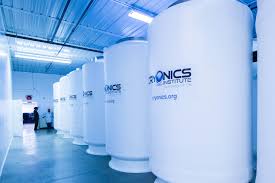
Remember, the cryonics companies want sales. The ‘Cryonics Institute‘, despite its ‘.org’ website address, is a business, albeit one claimed to be non-profit with only two paid employees, according to the Daily Telegraph. But even as a non-profit, it still has an emotional idea to defend and an empire to build. The Cryonics Institute even plays with language, not liking to call people ‘dead’ They are instead ‘deanimated’, to give the marketing-friendly impression they might at some future date be ‘reanimated’.
The firm invites potential customers to ‘imagine a world free of disease, death and aging.’ They go on:
‘At the Cryonics Institute, we believe that day is inevitably coming and cryonics is presently (sic – US usage) our best chance of getting there. Our mission is to extend human lifespans by preserving the body using existing cryogenic technologies – with the goal of revival by future science…
‘We provide long-term storage and security for members at our cryonics facility in Clinton Township, MI. We specialize in full-body cryo-preservation of humans and pets, DNA & tissue storage as well as cryonics outreach and public education about the cutting edge science we are engaged in. Members are afforded the opportunity to be preserved at cryogenic temperatures in hopes that future medical technology may be able to someday revive and restore them to full health.’
Another company, Alcor Life Extension Foundation, claimed in August this year to have frozen 148 ‘patients’. One of its founders, Fred Chamberlain, together with his father and mother, are among them. His wife Linda claims the company ‘is providing a realistic service that gives hope’.
HOPE OR WISHFUL THINKING?
But the ‘hope ‘of Alcor is just wishful thinking. There is no evidence that any dead person will ever be brought back to life and plenty of common sense and scientific reasoning against it.
Ethically, the companies are promoting a scam to the gullible. And that is fraudulent. It is theft. David Gorski says:
‘Perhaps what’s the worst about this is that people spend incredible amounts of money, which could be used to make their lives now better or be passed on to their heirs, chasing immortality. Cryonics is not, as its advocates say, an “ongoing medical trial”. Rather, those who choose to freeze themselves are more akin to the ancient Pharaohs, who spent enormous resources constructing elaborate tombs, so that they will one day rise from the grave and live again. Instead, they are found thousands of years later and end up in museums around the world.’
Cryonics is appealing to a human desire to live forever. The desire is good, indeed God-given. Nevertheless, there is only way to achieve it, and squandering your children’s inheritance on a false hope is not it.
REAL HOPE
The Christian life to come is not Alcor’s ‘might happen if you’re lucky’ type of hope. It rests on the promises of God Almighty. By Jesus Christ, says Paul:
Romans 5:2 … we have access by faith into this grace wherein we stand, and rejoice in hope of the glory of God.
The customers of the cryonics companies are chasing immortality, but they will have as much success as the pharaohs. Everlasting life is found only in Jesus:
John 3:16 For God so loved the world, that he gave his only begotten Son, that whosoever believeth in him should not perish, but have everlasting life.
As to being brought back to life, resurrection is surer than resuscitation. Jesus brought Lazurus back to life, but he did it to make the point to his sister Martha that by believing in him, she would live forever in the resurrection:
John 11:24 Martha saith unto him, I know that he (Lazarus) shall rise again in the resurrection at the last day. 25 Jesus said unto her, I am the resurrection, and the life: he that believeth in me, though he were dead, yet shall he live:
A BETTER PLACE
One final thought. When a Christian dies, we very often say ‘he (or she) is in a better place now’. If they are in a better place, why do we sometimes struggle, often in prayer, often with medicine, to keep them here? The only reason the Apostle Paul wanted to hang around in this life was to continue preaching the Gospel of Christ and the Kingdom of Heaven:
Philippians 1:21 For to me to live is Christ, and to die is gain. 22 But if I live in the flesh, this is the fruit of my labour: yet what I shall choose I know not. 23 For I am in a strait betwixt two, having a desire to depart, and to be with Christ; which is far better: 24 Nevertheless to abide in the flesh is more needful for you.
Let us fix our hopes of eternal life on Jesus and on nothing and nobody else. And if the subject of cryonics comes up in conversation, the material here might just provide you with some arguments against it.
Find out how to join Christian Voice and stand up for the King of kings (clicking on the link below does not commit you to join)

Please note that persons wishing to comment on this story must enter a valid email address. Comments from persons leaving fictitious email addresses will be trashed.








This may not be strictly relevant, but I was involved many years ago in research into freezing 4d ice-cream “bricks” cryogenically at a well-known ice-cream factory, by spraying them (when still soft) with liquid nitrogen. (The standard method is to put the soft ice-cream bricks into a deep-freeze to freeze there).
We found that the outside froze very hard, leaving the inside very soft (although they had to be stored in the deep freeze, and this evened out in time, as if they had been there all the time). This would have been OK, except that when one of them went astray and got in the way of the packing machinery, instead of being squashed, it behaved more like —– a brick ! This kept putting the packing machinery out of adjustment, if not actually breaking bits of it. I don’t think it was my fault that the experiment was abandoned.
Whether or not bodies are going to be frozen by spraying with liquid nitrogen, they are much bigger than 4d ice-cream bricks (the same size as choc ices still are, which then cost 6d). They are certain to start off much colder on the outside than on the inside. So you will get very roughly treated muscles, which perhaps doesn’t matter very much, but the delicate heart, kidneys, liver etc will stay soft and unfrozen for ages. The hope of them recovering after (again slowly) thawing again centuries from now seems thin. And of course, if the patient died of a faulty heart, it will be a defrosted faulty heart which he will be resurrected with. I really don’t fancy his chances.
It should be easier to freeze kidneys which are detached from the body, and a useful thing to do, if they might be needed for a future transplant. But nobody has ever succeeded in doing this, nor are they anywhere near doing it. You couldn’t do it in situ deep inside the body ! This is not even to consider the brain, which is much more complicated.
Semen, ova, and various individual cells can be frozen, but this is not so easy as it sounds. Water cannot be left inside, so in a sense they are not really frozen, as there is no ice. Presumably (although I haven’t heard the word used in a medical context) they are freeze-dried, like the prawns or chicken in Vesta meals, and these bigger more complex morsels never really become quite like normal dead prawns or chicken for the purpose of eating. They are freeze-dried (the chicken in small pieces) by manipulating the pressure as well as the temperature so that the water content turns straight into water vapour without ever becoming ice.
How you would ever be able to freeze-dry a whole human body complete with its organs I have no idea; nor are you going to reconstitute it by warming it with some water in a saucepan, I’m afraid.
If you have your dog frozen, why would anybody in 2316 pay to have him defrosted, when they could just get a new dog ?
Unfortunately, someone is going to have the same thought about defrosting the elderly people, even if they have paid in advance to have it done. If it was possible, would you really want some frail Georgian Greens who died of cholera cluttering up your house ? Yuk.
They might disagree with you too.
The Bible says there is an Appointment we all must keep.
Hmm, yes, Vesta meals: “In ancient Roman religion, the Di Penates or Penates (/pᵻˈneɪtiːz/; Latin: dī penātēs [ˈdiː ˈpɛ.naːteːs]) were among the dii familiares, or household deities, invoked most often in domestic rituals. When the family had a meal, they threw a bit into the fire on the hearth for the Penates.[1] They were thus associated with Vesta, the Lares, and the Genius of the paterfamilias in the “little universe” of the domus.[“. (I can use Wikipedia too, Rox). It says “When the family had a meal, they threw a bit into the fire”. I remember Vesta meals from many moons ago, but I don’t think I ever knowingly ate one: I strongly suspect that “throwing them into the fire” was mostly what they were fit for.
I actually have some scientific qualifications in this field, and have personally worked in the ice-cream factory in Gloucester and at the Vesta meals factory in Ashford, Kent, so I don’t need Wikipedia for this. An interesting titbit which I don’t think you will find in Wikipedia is that the carrots (imported already dried in small pieces) used to come from Nazareth ! So you have probably consumed Nazarene carrots, just think of that ! [ If not in Vesta meals, in dried soups which came out of the same factory under a different brand name, and very suitable for bachelors. ]. The onions, descried as “kibbled” (look it up if in doubt) came from Egypt.
You don’t have to remember them from many moons ago ! Some of them are still available in the shops, including my favourite, which was the beef chow mein. Try Tescos.
The ice-cream factory was Walls, so I can’t wait for Mark Jones to copy bits out of Wikipedia about building walls.
Or about bachelors, perhaps confirmed bachelors .
Or Batchelors?
I couldn’t possibly confirm this.
http://www.dailymail.co.uk/video/sciencetech/video-1052781/DEMO-VIDEO-Freeze-drying-corpses-burial-pellets.html
This unmissable video shows (with animated diagrams) what happens if you spray liquid nitrogen on a dead body, just like the ice-cream bricks actually, and then freeze-dry it. The purpose here is to obtain something green and convenient to bury. There is no suggestion whatever of reconstituting it by just adding water !
There is a form of freeze-drying which is quite familiar. When washing freezes on a clothes-line, it may be found to be dry afterwards, without going through a period of being wet again after thawing,
Lets suppose, Rox, that one could indeed preserve the body in some kind of usable state. What happens to the soul? Would you say such a thing exists? I would suggest that the person has already gone to the appointment we all must keep (“It is given to man to live once, then the Judgement”) at the time of orginial death, ie before freezing. This raises the question of what defines death. Lazarus, in the Bible, and many others since, (there are many testimonies of this, “some of whom are still alive”, including a friend of mine) were/have been raised back to life (in this world) after the body has died, but they were raised by GOD (or so they would say (ask them?)). Can some “doctor”/scientist “raise” a frozen body back to life? I suppose there’s only one way to find out: I personally am sceptical of their chances.
Then there’s the question of cloning: as far as I know, no HUMAN has (yet?) been cloned, although animals have been. Is there a unique human “soul” that cannot be replicated in two human bodies as would seem to be necessary in human cloning? Would there be one person, so to speak, in two separate bodies? At what point is a soul, if indeed such a thing exits, “made”? Conception? In a test tube? There is no “conception” with cloning (?). If human cloning became possible, would this pose a problem for people of faith? It would seem to be capable of raising interesting theological/philosophical issues. If it does happen one day, (it will certainly be attempted), although according to google it hasn’t been done yet: “to date, no human clone has ever been born”, for which a human mother’s body is still required, I think I am right in saying.
Then again, Jesus spoke of a second birth, being “born again”, without which “it is impossible to see the Kingdom of God”. https://gotquestions.org/born-again.html. This site has many interesting, good (imo) articles answering common questions about Christianity, you might like to check it out. If you would like to be my facebook or other type of friend, that would be good (for me, at least!). Of course, you may feel that you don’t want to engage any further with this fool/idiot, thats ok too.
If I may chip in, whether one speaks of a ‘soul’ or the ‘spirit’ of man, you have brought in an important theological question, Mark. God knows all things from the beginning, so would not be unprepared for someone rising from the dead, be it the young man at Nain in Luke 7:11ff, Lazarus in John 11, or someone else who was raised to life. Maybe the spirit leaves and returns.
I have taken the view, and Rox agrees from his experience, as so do most scientists, that cryonics is a scam, mainly because you firstly cannot die without some damage having occurred and that you cannot freeze a human body without further damage.
Let it be firmly understood that I am not in favour of this procedure ever being successful, except for organs which might be transplanted into otherwise healthy and reasonably youthful people (like myself).
You have a valid point even about personality. As far as I’m concerned, the personality is encoded in cells in the brain, and when they become diseased or die the personality changes drastically and is eventually extinguished. That’s what happened to my mother anyway, and to other people’s mothers. You would never get it back after defrosting somebody. As I understood it, the soul, however, is supposed to be a separate spirit which routinely leaves the body on death. I don’t think you’re going to get that back either.
If a soul is created at conception, then identical twins would have to share a soul (or have identical souls, anyway). Do Siamese twins have Siamese souls which have to be separated during a separating operation ? I wouldn’t like to say. (Something like this happens in the Dark Materials trilogy, when children are cruelly separated from their “dæmons”, which are visible souls in the shape of appropriate animals, in the fictional world of the books. That would happen if only one of the Siamese twins kept the entire soul, cruelly leaving the sibling without one !).
Thank you for the kind thought, Mark, but I don’t do Facebook or Twitter. It’s too dangerous.
I suspect that it is feasible to cool down the body of a dying person, slowing down his metabolism for a few hours or days, including the progress of any terminal disease, whilst (for example) awaiting for a donated organ to arrive, for life-saving transplant. Freezing an already dead human body, in the hope of resurrecting it decades or centuries later, if a cure is found for whatever killed the owner, is a whole different ethical kettle of fish.
Agreed. Stephen is right in everything he says (!), but the major point is that even if you achieve no damage, nobody has the faintest idea how to bring back to life the defrosted dead body. It isn’t just a question of curing the illness (which is hard enough, if the heart or the liver was no longer working). The person you froze had died of the illness. The person you defrost will still be dead.
People who die are usually not declared dead until they are brain dead and if they are brain dead freezing them will not miraculously make their brain alive and better again. Cryonic freezing is a 21st century scam and those responsible for conning thes gullible people should be locked up for fraud. I wonder what will become of all these frozen people when the company goes bust and calls in the receivers, as will inevitably happen in the not to distant future.
re Peter: ” I wonder what will become of all these frozen people when the company goes bust and calls in the receivers, as will inevitably happen in the not to distant future.”
Probably end up in Vesta Chicken/Beef Chow Mein, Peter, after all they did something similar with Romanian horsemeat.
Rox, I don’t agree that twins would have the same soul, eg the sperm doesn’t fertilise the same egg, or the egg splits, or something. At what point is the soul created? Is having the spirit given by God the same thing/process? Also sorry to hear about your mother.
Re Stephen, yes, agree that only God gives life (spirit), and cryogenically frozen bodies must suffer SOME damage, if nothing else.
It was YOU who wrote :
” At what point is a soul, if indeed such a thing exits, ‘made’ ? Conception? ”
I didn’t actually agree with you, I merely took it from there :
“IF a soul is created at conception, then…”
Non-identical twins, who can be two boys or two girls, are just brothers or sisters made from two different fertilised eggs. But IDENTICAL twins develop from ONE egg which splits into two. If you think about it, you will see that the egg must have been fertilised before it split, otherwise the father-given part of the baby’s genetics would be no more identical than two ordinary sisters (or two ordinary brothers). Therefore, if the soul was given at the time the egg was fertilised, the soul will have to split too, presumably, but science has never proved that this happens as far as I know.
The “they” who made AND MAKE Vesta meals was in no way the same “they” involved with horsemeat. I think Christian Voice needs to make that clear, for legal reasons. But there is nothing wrong with eating horse (or donkey) meat provided it has gone through proper inspection at the slaughterhouse and is still fit for human consumption (properly stored, like any other meat) . Donkey is common in Italian salami (at least, in Italy).
In some parts of Italy, where there is a shortage of space for burial underground, dead bodies are stored in what look very much like left-luggage lockers (some 2 metres deep), but I suppose they throw away the key, I do wonder what is going on inside these lockers, and what will happen to them eventually. There are lots of them in Genoa, for example. I will send Stephen photographs of this to prove it !
Hi Rox
re facebook/twitter, I do farcebook but that’s enough for me. Re twitter, I think the clue is in the name, particularly the first 4 letters, but that may be just me. I dare say it could be arranged for you to have my email address or even telephone number (I’m not out to “convert” you), its entirely up to you, no pressure whatsoever.
My choice of words was somewhat clumsy. I wasn’t meaning to suggest that Vesta were or are involved with putting horsemeat, Romanian or otherwise, (or donkey) in their meals.
I hope Vesta’s Legal Department will be happy with that.
Mind you, I would have thought that Vesta’s Legal Department would be far too busy dealing with innumerable complaints of food poisoning to worry about allegations of horsemeat in their products, but perhaps I’m wrong.
Still, I have retracted my original comment, better to be safe than sorry I suppose.
[…] https://www.christianvoice.org.uk/index.php/a-surer-hope-than-cryonics/ […]