Academic and author, Dr Sophie Coulombeau, suggests that women who adopt their husband’s surname are losing their identity.
In an article for BBC’s news magazine, Dr Sophie Coulombeau, raised the question of why a woman would want to share her husband’s last name.
In a well-researched historical surveyof female name-changing, Coulombeau suggested that a woman’s very identity as a person hinges on not adopting the surname of her husband, as if changing one’s name is tantamount to becoming a different person.
The novelist and Professor of English at Cardiff observed that “For me, to adopt the surname of my partner and relinquish my own would profoundly affect how I think about my own identity.”
Later she added that “To abandon my surname and take that of my partner would mean abandoning Sophie Coulombeau, along with all the errors, achievements and resonances she created over thirty years.”
Dr. Coulombeau is not alone. Writing in the Guardianlast year, Jill Filipovic suggested that adopting a husband’s surname is equivalent to allowing one’s identity to be obliterated, “subsuming your own identity into our husband’s.”
These ideas are achieving resonance with numerous women in the younger generation. In 2009, only 70% of womensaid they thought wives should adopt their husband’s surname.
Meanwhile, some are going to the opposite pole to suggest that a man should take his wife’s surname. Some couples are solving the problem by making up a brand new surname.
It is hard not to have some sympathy for the concerns various women have raised in the debate about name-changing. On the surface at least, there does seem to be something unfair in a tradition that insists a woman must change her name while a man is never expected to change his. Of greater concern to many women is the fact that name-changing might imply that a wife is simply an adjunct of her husband with no identity of her own. Others are concerned that this custom is simply a residual hang-over from our culture’s “patriarchal’ past – a past in which women allegedly had no rights and could be abused without consequences.
In this article I will attempt to interact with these concerns and to put forward some reasons why the custom of name-changing is worth preserving. But before getting into that, it may be helpful to explore some of the ideological origins of behind the current rejection of female name-changing.
Feminism and the Rise of Gender Equality
Despite the pervasive influence of feminism, most women still want to adopt the surname of their husband.
The growing move for women to keep their maiden names is directly tied to the rise of feminism, particularly feminist teaching about sexual equality.
Throughout the last hundred years, feminists have managed to convince the general public that equality of worth runs parallel to equality of role, with the consequence that in order for men and women to enjoy equal value, there must be sameness of function. Accordingly, feminism has left modern society without the categories for distinguishing diversities to be celebrated from inequalities to be lamented. In theory at least, all inequalities are viewed in a pejorative light. Thus, throughout the 20th century, there was pressure from feminists to remove all vestiges of gender differentiation from as many political and social areas as possible.
Despite their gains, feminists find it irksome that most women still choose to adopt their husband’s sunames. For a woman to adopt her husband’s name strikes at the heart of the utopia of gender neutrality towards which modern feminism strives. Consequently, feminists have fixated on this issue as part of their larger ambition to eradicate all gender distinctions from society.
The uneasiness about name-changing is understandable, since it is an emblem of a view of marriage that modern feminism rejects.
Feminism and the Changing Face of Marriage
In the older understanding, marriage had an institutional groundingthat was bigger than the couple, and which implicitly situated each marriage within an entire context of laws, taboos, traditions and expectations. The sense of marriage as an institution larger than the individuals involved was embodied in the practice of having the couple recite marriage vows that were given to them by the society, as well as in the tradition of a wife adopting the name of her husband’s family. Under this scheme of things, it is not up to any individual to define what marriage means; rather, marriage defines us.
In the revisionist understanding of marriage, it is the individual who defines her marriage and what it ultimately means to her.
By contrast, in the modern understanding of marriage championed by feminism, each woman should be able to define for herself what marriage means. This is one of the reasons it is becoming widespread for a couple to invent their own marriage vows. Customs and practices for marriage that are received (even when we do not understand the rationale behind them) are viewed as a limitation to the right we all have to define our own existence for ourselves. As such, whatever makes a woman feel more fulfilled, whether it is keeping her maiden name or adopting the surname of her husband, is legitimate. It is the individual who defines her marriage and what it ultimately means to her.
The causalities in this revisionist understanding of marriage are legion, and affect everything from our willingness to accept same-sex ‘marriage’ to our society’s approach to no-fault divorce. It also means that the custom of a woman accepting her husband’s name is viewed as little more than an anachronistic relic that has survived well beyond its years from our “patriarchal” past. In this regard it is significant that Coulombeau explicitly situated the debate about female name-changing within the larger context of the same revisionism that has rejected gender normativity:
And we might well ask, in the wake of last year’s Marriage (Same Sex Couples) Act, whether a custom that depends on a gender-normative idea of marriage – a woman automatically sacrificing her name to take that of a man – is starting to look more outdated than ever.
Guardian journalist, Jill Filipovic, has also drawn a connection between wives keeping their maiden name and the revisionist innovations of same-sex “marriage.”
An Attack on Christian Tradition
In her BBC article on the subject, Dr Sophie Coulombeau acknowledges the Christian origin to the tradition of a wife taking the name of her husband’s family, noting how around the turn of the 15th century, the English appropriated the French doctrine of coverture “based on scriptural ideas, which focused not on the husband’s power over his wife but on the unity that marriage gave them.” Coulombeau continued:
The English custom of designating a married woman by her husband’s surname dignified those who had previously occupied the status of vassals.
“In the words of the English jurist Henry de Bracton, they became ‘a single person, because they are one flesh and one blood’. As this idea gained ground, so did the clerical habit of designating a married woman by her husband’s surname.The married woman had formerly been a vassal with no surname at all, but now, in theory, she came to share the surname of her husband as a symbol of their legal and spiritual unity.”
This is significant, because it shows that far from being demeaning, the practice of a wife adopting her husband’s surname was dignifying, lifting her above the status of a vassal and giving her legal and spiritual unity with her husband.
This practice actually goes further back than the 15th century, as the Genesis narrative records Adam naming his wife Eve. The notion is also consistent with Biblical teaching regarding the headship of the husband. Though Christian cultures have not always practiced this custom, the idea itself is consonant with Biblical teaching.
Name-Changing and Female Identity
Even those who do not share our Christian convictions have good reasons to be concerned by the growing practice of married women preserving their maiden names. This is because the assumption behind keeping the maiden name is often rooted in the dangerous idea that a woman’s identity is precariously fragile, hinging only on what she is called. Sophie Coulombeau implies as much when she writesthat “Introducing myself as ‘Sophie Hardiman’ would mean that saying ‘I do’ had fundamentally changed the answer to the question ‘Who am I?’” Coulombeau goes on to quote followers of Lucy Stone, whose slogan in the 1920s was “My name is my identity and must not be lost.”
Does Jill Filipovic really believe a woman’s identity is fragile enough to be undermined by adopting her husband’s surname?
This echoes concerns articulated by Jill Filipovic in her Guardian article ‘Why should married women change their names? Let men change theirs.’ Filipovic wrote that adopting the name of a husband “lessens the belief that our existence is valuable unto itself, and that as individuals we are already whole. It disassociates us from ourselves…Jill Filipovic is my name and my identity. Jill Smith is a different person.”
Do these feminists really want us to think that female identity is so precarious, and that the billions of women throughout history who chose to adopt the name of their husband’s family thereby ceased to be less than themselves, that their personhood was sublimated to that of their husbands?
Having said that, there is a kernel of truth to the fears these feminists are articulating. Marriage makes us whole (if we were “already whole” before marriage, then there would be no reason to get marriage in the first place?), but it also involves change, sacrificing who we were in a dynamic process of becoming, of continual renegotiation of self in relation to the other. This is as true for a husband as it is for a wife. A woman changing her name is a visible sign of this dynamic process, but there are just as many ways (if not more) that marriage requires husbands to negotiate a new understanding of self in the mutual interplay of sacrifice and new life that forms the mystery of marriage. In the past, the feminists who found this loathsome – believing, with Filipovic, that “we are already whole” – attacked marriage itself and urged women to remain single. They recognized, not without warrant, that marriage is antithetical to the principles of individual self-assertion that form the bedrock of so much feminist ideology.
Part of the problem arises from thinking of marriage as a zero-sum game where the sacrifices and adjustments made for the sake of the other are correlative to loss of self. But in reality marriage is governed by the spiritual logic where the more we give the more fully we become ourselves. This applies as much to the sacrifices a husband has to make as it does to a women sacrificing her maiden name for that of her husband.
Name-Changing and Government Intrusion
Although I maintain there are good reasons for a wife taking her husband’s name, I do not believe any woman should be forced to do this against her will. However, a day may come in the not so distant future when women will be deprived of this choice and forced to keep their maiden names.
I have read (but have not verified it for myself) that in parts of Canada it is now actually illegalfor a woman to change her surname to that of her husband; the government forces her to keep her maiden name. Strange as this seems, it is a natural corollary to the notion that requiring women to change their name somehow implies that women are inferior. If the time-honoured practice really does treat women as inferior, then how is it not a species of the type of abuse that is usually forbidden in law? By asking questions like this we see that the arguments feminists are now making could be setting us on a trajectory that can only culminate in women being preventing from taking the name of their husband’s family.
The government may have its own reasons for wanting to abolish the custom I have been defending. Recognizable and traceable family structures (whether in the form of clans, tribes or extended networks of kinship) have historically proved to be one of the main hedges against the aspirations of powerful warlords and kings. Although this is less the case in the modern world, the strength of the family still functions as a significant barrier to the unrestrained power of the state. But it is hard to preserve these family structures when there is irregularity in how names are passed down. With everyone choosing their own surname, with some couples jointly taking on the wife’s surname, with other couples inventing a new surname, and with children having to decide whether to adopt their mother’s surname or their father’s surname (a choice that may be different to that of their siblings), we will increasingly have to lean towards the state to help clarify the boundary markers of each family.
It is significant in this regard that many who are agitating for women to keep their maiden name are appealing to a notion of family based on legal rather than natural bonds. For example, Filipovic writes that an alternative to the traditional family is to “embrace a modern vision of family where individuals form social and legal bonds out of love and loyalty, instead of defining family as a group coalesced under one male figurehead and a singular name.” This continues the trajectory of gay marriage where the boundaries of what constitute a family are becoming purely a legal fiction.
It is tempting to say that the consequence of each woman making her own choice extends no further than her own family. However, if the concerns I have registered are legitimate, then that is an overly naive and simplistic view. Without wanting to over-dramatize things, what is at stake is the future of the family itself.
Find out how to join Christian Voice and stand up for the King of kings (clicking on the link below does not commit you to join)
Please note that persons wishing to comment on this story must enter a valid email address. Comments from persons leaving fictitious email addresses will be trashed.
It is the case that in the Canadian province of Quebec, women have been prevented by law from taking their husband’s surname, since as far back as the mid-1980s, I believe.
Another attack on traditional values: these people think that marriage is servitude anyway don’t they, I doubt if they really want get married in any case!
What sane man would want to marry these haridans, the first time they get upset they’ll walk off taking most of one’s wealth anyway!
Well, I wouldn’t mind marrying Sophie Coulombeau. Does haridan mean “A member of a hereditary Hindu group of the lowest social and ritual status”. A very traditional value ! It seems unlikely that she is one of those, but I would still marry her, despite the age differenc .
Rox, I think you will find Sophie is spoken for. A potty-mouthed individual called Rich Hardiman appears to be setting up home with her: https://twitter.com/welprich
Speaking as a sane man (doctor-certified!) planning on marrying one of these harridans, I might be able to answer your question.
She’s smart, she’s funny, she’s kind. She very seldom stoops to calling perfect strangers names over the internet if they happen to disagree with her (and on the occasions she can’t help herself she’s careful to check the spelling).
She makes me happy, and I believe that she’ll make an excellent lifelong partner for me. Together, with one another’s support, I believe we’ll be able to achieve much more than we could singly in all aspects of our lives. I think she’ll make a wonderful, nurturing mother when the time comes for us to have kids. I suppose you could say that I’m planning to marry her because I love her!
We don’t always agree on everything (although we’re in perfect sync on this issue), but when we do disagree we can have a discussion based on mutual respect, which is something I really value. I’m happy to let you know that despite a couple of arguments here and there she’s not walked off, and I remain in possession of all the wealth I’ve managed to put together (although I might move the sock from under the floorboard, based on your advice).
Knowing that we’re making a lasting commitment to each other, although we’re not religious, helps us through any disagreements – the family unit we’re building together has strong foundations & we’re both looking forward to affirming that together in front of our family and friends on our wedding day, regardless of what we then sign in the register.
And of course, if Sophie Coulombeau does marry you (upon which hearty congratulations would be seriously in order), she can quite properly be both Dr Sophie Coulombeau and Mrs Hardiman. She would lose neither her identity nor her achievements on taking your name socially and keeping hers professionally. Many women do it that way.
No need to apologise to me, but I’ll pass the apology on to Sophie for you… 🙂
Stephen – you’re absolutely right that a lot of women choose this option, and more power to their arms. It’s a valid choice, just like opting to change names, although it’s not for us. Personally I think it should be a matter of choice for the woman concerned (with counsel from those close to her, obviously), but I don’t have a fight to pick with those who disagree with me.
I guess the point I was trying to make, and I’ll admit to doing it a bit impishly, was that just because we’re not religious or traditional doesn’t mean that we can’t sustain a loving relationship. People on both sides of the faith divide (or the political divide, or various other divides) seem depressingly apt to forget that those who disagree with them are humans too. Take Mark for example – I’m sure he’s not a bad man, he just forgot that S was more than an opinion & happened to be in the right place at the right time for me to lay into. Another day, another topic, he’d have been in a position to do exactly the same to me…
Anyway chaps, I’m off to cook dinner. Good evening.
Don’t worry, old boy, lots of chaps cook dinner. Bon appetit.
I always thought she looked like a good bet, and I seem to be right. Sounds like an excellent choice. But who would want to be called Sophie Hardiman, anyway ? She really doesn’t look like a hardy man.
There once was a beautiful harridan,
Who was wooed by a love-seeking Hardiman.
Her complexion aglow,
It didn’t fit, so,
They decided she’d better stay Coulombeau.
[This is not quite the traditional structure for a limerick, which seems kind of appropriate …]
This is all a matter of fashion, and it’s really quite unimportant. In the 1950s, a minority of English people were still referring to married women with their husband’s CHRISTIAN name as well as his surname, for example Mrs Luke Reynolds instead of Mrs Helen Reynolds. I can remember my own mother being criticised by her older sister for not doing this, which according to the sister was “correct”.
Then there is a practical issue for some people, including my own daughter as it happens. Supposing that Dr Coulombeau’s husband is not Mr Hardiman but Dr Hardiman. This would make them Dr & Dr Hardiman, so then which is which ? Even if he isn’t, Mr & Dr Hardiman seems a little strange. People should be allowed to choose, especially if they have a distinctive name like Sophie Coulombeau. It doesn’t seem to do anybody any harm to allow some choice.
A minority of people have always chosen surnames contrary to the normal system, for example Oliver Cromwell was descended from Thomas Cromwell’s married SISTER. The present queen would not normally have the surname Windsor. If Oliver Cromwell can do it, why can’t Sophie Coulombeau do it ? Because she’s a woman ?
Yes, and it’s a convention not entirely shared in Spain, Iceland, Italy, or Slavonic countries either .
As I understand it, the use of surnames arose in England (and presumably in most of Europe) only in the Middle Ages. Some countries were slower than others to adopt it, for example Wales, where English-style surnames were forced onto people for administrative convenience. As so many people there ended up with “Jones”, they have famously re-adopted the mediaeval usage of identifying by current profession, e.g. Jones the Post, Jones the Baker.
Christian folk have Christian names, and it is notable now how we are taught to refer to Bishop John , Father Andrew (this in the Church of England), with surnames seldom used.
It is quite difficult to see the formula Christian Name + Surname promoted in the Bible.
I have never come across any female doctor who describes herself like you recommend.
Yet another attack on our social structure and a good way to cause confusion…this all links in with the modern notion of ‘choosing your identity’, ‘being an individual’. Whatever your background, you can just cast it off and ‘be you’.
Surely Isaiah chapter 62 explains why it is absolutely the right thing for a bride to take the groom’s name if marriage is accepted as being typical of Christ and His church.
‘…thou shalt be called by a new name, which the mouth of the LORD shall name.’ verse 2
Good to know…that womens’ status elevated from vassal by taking husband’s last name.
Wishing we could include modifiers to the word “feminist”…I am a feminist in the sense that my mom (paid $.50/hour in the early 1950s for her work on photographs) was then barred from joining the male only Union. Her male boss made big money from the base wage women doing the actual work. My dad’s heavy load of supporting 5 kids could have been reduced had my mom been able to use her considerable art skills to earn a man’s wage.
Remembering my embarrassment when a prominent and good Chicago church left out certain verses when reading aloud proverbs 31 on the good woman/wife…you guessed it…the verses where she earned money. Noting that her husband and family were happy…and the whole household of this (probably mature) woman functioned well…
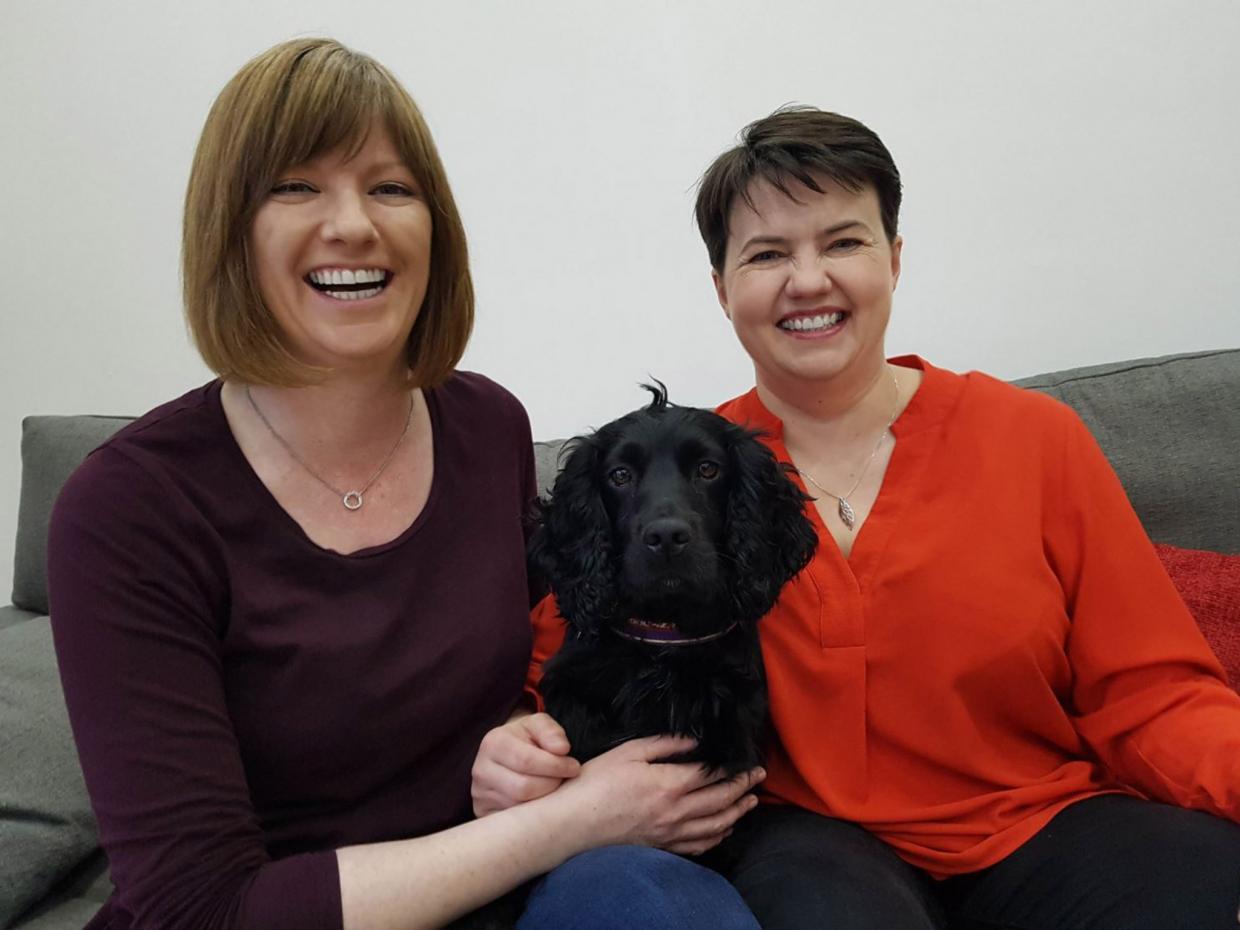
Ruth Davidson, the leader of the Scottish Conservative Party, is 13 weeks pregnant with her first child.
'Parents to be'
You can just about trust the...







It is the case that in the Canadian province of Quebec, women have been prevented by law from taking their husband’s surname, since as far back as the mid-1980s, I believe.
This is true, since 1981.
There have been challenges, the last we can find dates from 2007:
http://www.canada.com/windsorstar/news/story.html?id=72ddc06b-4660-4b92-8b92-3a26ae24b377
And a judge in a legal case allowed a ridiculous hypenation in 2012:
http://coolopolis.blogspot.co.uk/2012/09/quebec-judge-opens-door-to-allowing.html
No jurisdiction anywhere else in the world has followed Quebec’s absurd dictate.
Another attack on traditional values: these people think that marriage is servitude anyway don’t they, I doubt if they really want get married in any case!
What sane man would want to marry these haridans, the first time they get upset they’ll walk off taking most of one’s wealth anyway!
Well, I wouldn’t mind marrying Sophie Coulombeau. Does haridan mean “A member of a hereditary Hindu group of the lowest social and ritual status”. A very traditional value ! It seems unlikely that she is one of those, but I would still marry her, despite the age differenc .
Be careful what you wish for!
Rox, I think you will find Sophie is spoken for. A potty-mouthed individual called Rich Hardiman appears to be setting up home with her: https://twitter.com/welprich
Speaking as a sane man (doctor-certified!) planning on marrying one of these harridans, I might be able to answer your question.
She’s smart, she’s funny, she’s kind. She very seldom stoops to calling perfect strangers names over the internet if they happen to disagree with her (and on the occasions she can’t help herself she’s careful to check the spelling).
She makes me happy, and I believe that she’ll make an excellent lifelong partner for me. Together, with one another’s support, I believe we’ll be able to achieve much more than we could singly in all aspects of our lives. I think she’ll make a wonderful, nurturing mother when the time comes for us to have kids. I suppose you could say that I’m planning to marry her because I love her!
We don’t always agree on everything (although we’re in perfect sync on this issue), but when we do disagree we can have a discussion based on mutual respect, which is something I really value. I’m happy to let you know that despite a couple of arguments here and there she’s not walked off, and I remain in possession of all the wealth I’ve managed to put together (although I might move the sock from under the floorboard, based on your advice).
Knowing that we’re making a lasting commitment to each other, although we’re not religious, helps us through any disagreements – the family unit we’re building together has strong foundations & we’re both looking forward to affirming that together in front of our family and friends on our wedding day, regardless of what we then sign in the register.
Hopefully that answers your question, good buddy.
Your dear lady doesn’t sound like a harridan to me …
And of course, if Sophie Coulombeau does marry you (upon which hearty congratulations would be seriously in order), she can quite properly be both Dr Sophie Coulombeau and Mrs Hardiman. She would lose neither her identity nor her achievements on taking your name socially and keeping hers professionally. Many women do it that way.
Well, Mr Hardiman, I suppose apologies are called for on my behalf. I suppose I did speak rashly without concern for the facts.
I wish you and Ms Columbeau a long and happy marriage, and best wishes to you and your future family.
Hi Mark,
No need to apologise to me, but I’ll pass the apology on to Sophie for you… 🙂
Stephen – you’re absolutely right that a lot of women choose this option, and more power to their arms. It’s a valid choice, just like opting to change names, although it’s not for us. Personally I think it should be a matter of choice for the woman concerned (with counsel from those close to her, obviously), but I don’t have a fight to pick with those who disagree with me.
I guess the point I was trying to make, and I’ll admit to doing it a bit impishly, was that just because we’re not religious or traditional doesn’t mean that we can’t sustain a loving relationship. People on both sides of the faith divide (or the political divide, or various other divides) seem depressingly apt to forget that those who disagree with them are humans too. Take Mark for example – I’m sure he’s not a bad man, he just forgot that S was more than an opinion & happened to be in the right place at the right time for me to lay into. Another day, another topic, he’d have been in a position to do exactly the same to me…
Anyway chaps, I’m off to cook dinner. Good evening.
Don’t worry, old boy, lots of chaps cook dinner. Bon appetit.
I always thought she looked like a good bet, and I seem to be right. Sounds like an excellent choice. But who would want to be called Sophie Hardiman, anyway ? She really doesn’t look like a hardy man.
There once was a beautiful harridan,
Who was wooed by a love-seeking Hardiman.
Her complexion aglow,
It didn’t fit, so,
They decided she’d better stay Coulombeau.
[This is not quite the traditional structure for a limerick, which seems kind of appropriate …]
This is all a matter of fashion, and it’s really quite unimportant. In the 1950s, a minority of English people were still referring to married women with their husband’s CHRISTIAN name as well as his surname, for example Mrs Luke Reynolds instead of Mrs Helen Reynolds. I can remember my own mother being criticised by her older sister for not doing this, which according to the sister was “correct”.
Then there is a practical issue for some people, including my own daughter as it happens. Supposing that Dr Coulombeau’s husband is not Mr Hardiman but Dr Hardiman. This would make them Dr & Dr Hardiman, so then which is which ? Even if he isn’t, Mr & Dr Hardiman seems a little strange. People should be allowed to choose, especially if they have a distinctive name like Sophie Coulombeau. It doesn’t seem to do anybody any harm to allow some choice.
A minority of people have always chosen surnames contrary to the normal system, for example Oliver Cromwell was descended from Thomas Cromwell’s married SISTER. The present queen would not normally have the surname Windsor. If Oliver Cromwell can do it, why can’t Sophie Coulombeau do it ? Because she’s a woman ?
No, the Sophie would be Dr Sophie Coulombeau, Mrs Hardiman.
In this jurisdiction, people can choose whatever name they want, so long as it is not part of a fraud.
So we are here talking about a convention, and showing that it is based upon a Christian understanding of what marriage is all about.
Yes, and it’s a convention not entirely shared in Spain, Iceland, Italy, or Slavonic countries either .
As I understand it, the use of surnames arose in England (and presumably in most of Europe) only in the Middle Ages. Some countries were slower than others to adopt it, for example Wales, where English-style surnames were forced onto people for administrative convenience. As so many people there ended up with “Jones”, they have famously re-adopted the mediaeval usage of identifying by current profession, e.g. Jones the Post, Jones the Baker.
Christian folk have Christian names, and it is notable now how we are taught to refer to Bishop John , Father Andrew (this in the Church of England), with surnames seldom used.
It is quite difficult to see the formula Christian Name + Surname promoted in the Bible.
I have never come across any female doctor who describes herself like you recommend.
Yet another attack on our social structure and a good way to cause confusion…this all links in with the modern notion of ‘choosing your identity’, ‘being an individual’. Whatever your background, you can just cast it off and ‘be you’.
Surely Isaiah chapter 62 explains why it is absolutely the right thing for a bride to take the groom’s name if marriage is accepted as being typical of Christ and His church.
‘…thou shalt be called by a new name, which the mouth of the LORD shall name.’ verse 2
Read your informative article with interest.
Good to know…that womens’ status elevated from vassal by taking husband’s last name.
Wishing we could include modifiers to the word “feminist”…I am a feminist in the sense that my mom (paid $.50/hour in the early 1950s for her work on photographs) was then barred from joining the male only Union. Her male boss made big money from the base wage women doing the actual work. My dad’s heavy load of supporting 5 kids could have been reduced had my mom been able to use her considerable art skills to earn a man’s wage.
Remembering my embarrassment when a prominent and good Chicago church left out certain verses when reading aloud proverbs 31 on the good woman/wife…you guessed it…the verses where she earned money. Noting that her husband and family were happy…and the whole household of this (probably mature) woman functioned well…
[…] Surname Controversy and the Future of the Family […]
[…] Because women have stopped taking men’s surnames This is obviously a steaming pile of crap. […]