
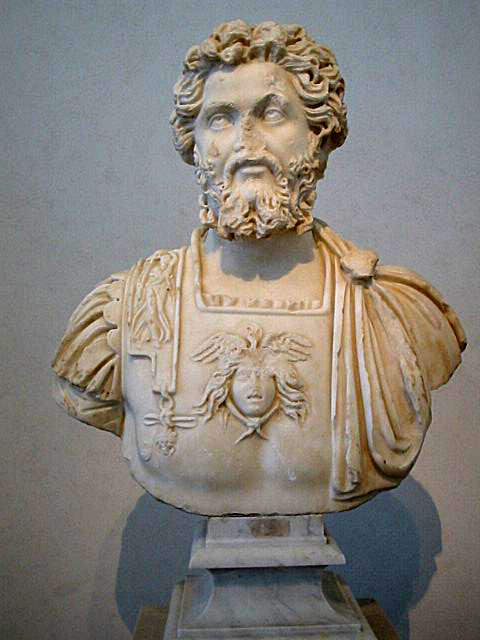
Persecution Under Severus
The date is 202 and the Roman emperor, Septimius Severus, has just enacted a law prohibiting the spread of Christianity and Judaism throughout the Roman empire.
Alarmed by the steady growth of Christianity (which may have been as much as 40% per decade throughout the second century), Emperor Septimius hopes his decree will contain the Christian threat and strengthen his kingdom.
Persecution was nothing new to Christians in the early third century. But this was the first time there was a universal decree forbidding conversion. If someone was discovered to have become a Christian, the choice offered by the emperor was simple. One could either curse Jesus and make an offering to the Roman gods or be executed.
“Many martyrs are daily burned, confined, or beheaded, before our eyes,” observed Clement of Alexandria, describing conditions during the “terrible reign” of Severus.
One particularly moving story from this period concerns the martyrdom of the young mother, Perpetua.
Under House Arrest
Perpetua was a noblewoman living in Carthage at the beginning of the 3rd century. Although it was unusual for women of that time to be educated, Perpetua was able to read and write. Indeed, she has left us an account of the events leading up to her martyrdom. Hers is the earliest known document written by a Christian woman.
In 203, when Perpetua was around twenty-one years old, she was preparing for baptism along with four other converts from Carthage. They also included a young woman named Felicity, who was eight months pregnant.
When the Roman authorities in Carthage learned of the conversions, Perpetua and her companions were taken to a dwelling. There they were put under house arrest.
Though under intense pressure from her pagan father to renounce the Christian faith, and still nursing her newborn son, Perpetua was determined to remain faithful to Christ.
From House Arrest to Jail
It soon became clear that the company were to be moved to an actual jail. Because of that, the local church authorities allowed them to be baptized ahead of their formal training. They received the sacrament of holy baptism and the Eucharist. Then the five converts prayed for strength to endure to the very end. One can only imagine Perpetua’s agony when the day finally arrived and she was sent to prison. Her baby, utterly dependent on his mother for sustenance, was stripped from her arms.
A Roman prison was a foul place and this was no exception. The five converts were put in a windowless cellar, where there was no means of escape from the hot stifling air.
Despite the dismal and unsanitary conditions of the dark cell, Perpetua’s worst torment was the thought of her child left helpless without her. However, two church deacons bribed the jailer to move them to a better part of the prison. It was here that Perpetua received a visit from her Christian mother. She brought her grandson, now faint with hunger, to be suckled. For the remainder of her time in jail, Perpetua was allowed to keep the child with her. Because she was a woman of high birth, she was also allowed to keep a diary.
“I am a Christian”
When the day of the trial finally arrived, the prisoners were brought before a tribunal, where Perpetua’s father was also waiting. Appealing to her love for him and her child, the elderly man tried in vain to persaude his daughter renounce her beliefs. Hilarian the procurator urged her similarly, saying, “Spare your father’s grey hairs. Spare the infancy of the boy. Make sacrifice for the Emperors’ prosperity.”
Perpetua answered simply, “I am a Christian.” This left Hilarian with no choice but to pass sentence. Perpetua, along with the others, was condemned to be killed in the stadium for the amusement of the crowds. Even at this point it was not too late for them to go free if they would simply agree to renounce Christ.
Martyrdom of Perpetua
Thus it was that on March 7, 203, Perpetua and the other converts were marched to the Carthaginian amphitheatre amid jeering crowds. Perpetua and Felicity were stripped naked and made to put on a net before entering the arena. A mad heifer had been prepared for the purpose of kicking, knocking and trampling the netted girls to death.

However, when they were brought into the arena, even the callous Romans shuddered to see the tender girls. A contemorary account says milk was still dripping from Perpetua’s breasts. Consequently, Perpetua and Felicity were recalled and given robes with which to clothe themselves.
Even after being attacked by the cow, Perpetua did not die, but courageously stood up. Though covered in blood, she helped Felicity to her feet. Then she turned to her Christian friends in the audience. She encouraged them and urged them to stand firm in the faith and to love one another.
A swordsman was appointed with the task of completing what the cow had started. The man was a novice, so instead of piercing Perpetua right through, the blade accidently hit her collar bone. She shrieked but did not die.
Unafraid of death, the bleeding Perpetua picked up the blade and set it upon her own neck, in order that the swordsman might finish the job.
Why Were the Christians Persecuted?
So why were gentle Christians like Perpetua seen as such a hazard to Rome? Why did the emperor Severus believe that Christianity threatened the very being of his empire?
This question is especially puzzling when we realize that Rome tolerated all manner of different religious movements. In the city of Rome, for example, there was an array of various mystery cults. These were imported from all over the empire, but especially from the East. They offered their votaries privileged access to certain divinities but – and this is crucial – they did not dictate how life should be lived in the public world. It is this last point which helps to explain why Christianity was so different. Like the new age movements of today, the mystery cults occupied themselves entirely with one’s interior spirituality.
Over and above the vast array of mystery cults available to Romans stood the religion of the State. In contrast to the mystery cults, the imperial religion was public, structuring the lives of loyal Roman citizens.
The main feature of the imperial religion was not emperor worship, as is often imagined. It is true that many of the Julio-Claudian emperors claimed to be sons of a god, with some of them even claiming divine honors for themselves. However, this emerged out of, and did not form the basis of, the imperial religion. The latter revolved around loyalty to the empire. Such loyalty involved more than merely paying taxes and defending one’s country. It involved bringing all of public life, thought and allegiance into subjection to the priorities of the state.
Rome’s Religion – Public and Political
The Roman state offered a vision of the good life and peace for its citizens. It brought together previously warring pluralities. Moreover, the Roman state offered a sense of eschatological progress. Above all it provided a framework of meaning to answer the question “how should we live?” In short, the commitment that Rome demanded of its citizens was so complete that it can only be adequately described in religious terms. This was despite the fact that many votaries of the state would not have considered themselves Rome-worshipers.
Unlike the mystery religions, which were private and personal, the religion demanded by Rome was public and political. As Stephen Perks observed in his book Common-Law Wives and Concubines:
“The Eastern cults that were popular in ancient Rome, such as the cults of Mithras and Isis, did not structure the lives of their adherents – at least not if they were good Roman citizens. What structured the lives of the Romans was the religion of Rome, which was a political religion.”
Against this backdrop it is not hard to see why Christianity threatened the imperial credo while the mystery cults did not. The Christians, like the Caesars, applied the language of evangelion (“gospel” or “glad tidings”) to their movement. Like Rome, the Christians taught that they held the answer for bringing justice, order and peace to the world. (See Luke 2:13-14; John 14:27). Christianity, like the Romans, claimed that a single man had rightful dominion over the whole earth (See Matt. 28:18-19). Christianity, like the imperial religion, offered a sense of community to previously warring pluralities (See Gal. 3:28). Furthermore, Christianity, like the religion of Rome, was intent on evangelizing the world.
The Good News is bad news for Caesar
But whereas the Caesars sought to Romanise the world through brutality, force and bloodshed, the Christians sought to evangelize the world through love, self-giving, and sacrifice. The glad tidings of Jesus was therefore bad news for Caesar, since it proclaimed there was another way to transform the world superior to Caesar’s way. It announced that God had called out a people whose vocation was to work for peace and justice on Jesus’ terms, not Caesar’s.

Had Christianity been merely one more mystery cult, offering its followers a new kind of spiritual experience, the Romans would have taken little or no notice of individuals like Perpetua. It was precisely because the totalising claims of Christ’s lordship competed at the level of the public imperial religion that Christianity could not be ignored.
Gospel is transforming nations
As Peter Leithart has observed in his book, Against Christianity, in the early church we do not find an essentially private gospel only secondarily applied to the public sphere, as if the public implications of the gospel were a second story built on the private ground floor. Rather, the Gospel is the announcement that a new creation has burst in upon the old order, transforming, not just individuals, but nations.
Even when the early Christians submitted to the ruling authorities, there was an implicit challenge. In writing to the Romans, Paul made clear that the reason Christians were to submit to the civil magistrates is because they have been placed there by the higher authority of God (See Romans 13:1). Though the Caesars liked to think of themselves as autonomous and subject to no one, Christians proclaimed that earthly rulers are God’s ministers, responsible for carrying out His business here on earth (cf Rom. 13:2-7). The idea that Caesar’s authority was derivative rather than ultimate was nothing less than fighting talk.
Personal Challenge
This helps us to understand why simply claiming the name of Christ was seen by Emperor Severus as being a subversive act. It also presents a challenge to us. We live in an age when there is mounting pressure to keep religion as a personal, private experience detached from the outward realm of public life. By coincidence, much modern Christianity resembles a 1st century mystery religion. It offers a new type of religious experience but makes little or no demands in the public square.
It is against such pressures that the witness of Perpetua still challenges us. Her martyrdom should convict us for accepting watered-down versions of the Gospel that may be devotionally inspiring but make no demands on our public life.
Perpetua challenges us to be a challenge to today’s Caesar. Her courage to stand firm for Jesus against the entire Imperial system inspires us to play our part against the ungodly political systems of our day.
The above article first appeared in Christian Voice’s June 2010 newsletter. Those who join Christian voice receive our monthly newsletter. More information about joining are given below: