
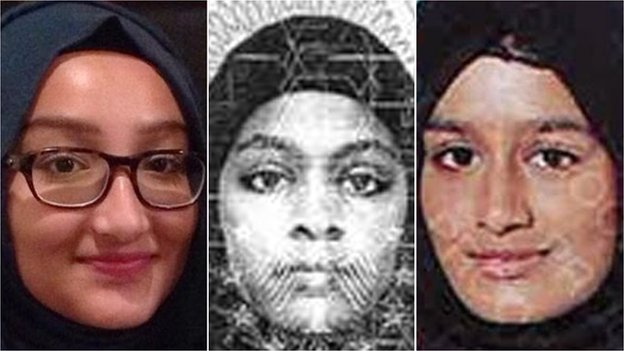
The rise of ‘Islamic State’, as they call themselves, continues to concern the kind of non-practising, secularised Muslims you find at the BBC.
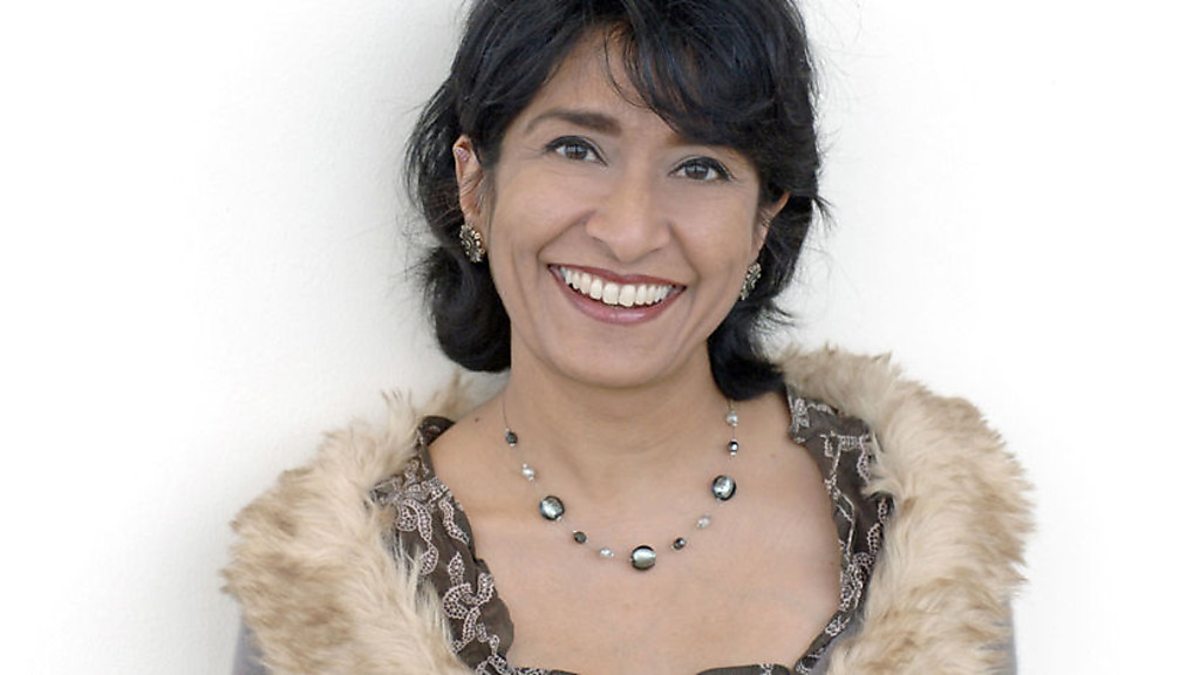
Razia Iqbal, a journalist employed by BBC News, wrote on the BBC website last week about the London schoolgirls Kadiza Sultana, Amira Abase and Shamima Begum absconding to Islamic State in Syria.
The girls were radicalised by Aqsa Mahmood. She flew to Syria to marry an IS fighter last year. In addition she was known to MI5.
But a Twitter conversation between Aqsa Mahmood and Shamima Begum appears not to have been followed up. Muslims have complained the three girls were failed by our security services.
PROMISING FUTURE
Razia Iqbal writes: ‘Their names are important to me, because they focus my mind on them as individuals, as young girls, with a promising future ahead of them, with friends, siblings and parents.’
They had ‘a promising future ahead of them’. Which begs several questions: What other kind of promising future is there than the sort which lies ahead of you? And exactly what were Kadiza, Amira and Shamima going to do? Go to university perhaps? Become secularised there? Or radicalised? Become BBC journalists? Get married? Travel to San Francisco? Does Razia know?
She went on: ‘A troubling and growing sisterhood is being cultivated – it appears an estimated 200 to 300 European Muslim girls have made the same journey as Kadiza, Shamima and Amira. Why? What for? The term jihadi bride is particularly egregious, but there is some truth to it.’
So by ‘promising future’ Razia meant anything but going to join a seemingly romantic band of outlaws and bearing their children.
ISLAMIC STATE NEEDS WOMEN
And of course, Islamic State does need women to build its legitimacy. At the moment the ‘State’ part of its title is aspirational. Women can bear children to its fighters. These are portrayed by IS in ways appealing to young girls. This article on the BBC website. has described the young men as ‘eye candy’.
Ms Iqbal concluded:
‘The only counter-narrative that might appeal to potential further recruits, is if girls such as Kadiza, Sultana, Shamima Begum and Amira Abase find a way of getting back to their lives in London, and tell the truth about how un-Islamic IS is; how unromantic it is to be part of a murderous cult and how unappealing it is to give up on your self, and your individuality.’
So in what way or ways is Islamic State ‘un-Islamic?’ Razia Iqbal fails to tell us. Perhaps for her it is the emphasis, to put it mildly, on grabbing land and killing whoever does not share their particular Islamic beliefs. But the Quran includes, according to one estimate, some 109 verses mandating open-ended violence against unbelievers. The Muslm holy book strongly advocates ‘liberating’ towns from the ‘oppression’ of non-Muslim rule.
THE QURAN MANDATES FIGHTING AND WAR
For example: Surah 2:191. And slay them wherever ye catch them, and turn them out from where they have turned you out; … 216. Fighting is prescribed for you, and ye dislike it. But it is possible that ye dislike a thing which is good for you, and that ye love a thing which is bad for you. But Allah knoweth, and ye know not.
Surah 4:74. Let those fight in the cause of Allah Who sell the life of this world for the hereafter. To him who fighteth in the cause of Allah,- whether he is slain or gets victory. Soon shall We give him a reward of great (value). 75. And why should ye not fight in the cause of Allah and of those who, being weak, are ill-treated (and oppressed)? Men, women, and children, whose cry is: “Our Lord! Rescue us from this town, whose people are oppressors. And raise for us from thee one who will protect; and raise for us from thee one who will help!” 76. Those who believe fight in the cause of Allah, and those who reject Faith Fight in the cause of Evil. So fight ye against the friends of Satan. Feeble indeed is the cunning of Satan.
Surah 5:33. The punishment of those who wage war against Allah and His Messenger, and strive with might and main for mischief through the land is: execution, or crucifixion, or the cutting off of hands and feet from opposite sides, or exile from the land. That is their disgrace in this world, and a heavy punishment is theirs in the Hereafter;
ISLAMIC STATE FOLLOWING QURAN
Islamic State seems to be following most of that. They are also following in the footsteps of the founder of their faith. The ancient world knew Mohammed for his rampaging, looting and raping. There are a few verses of peace in the Quran, so it is possible to be Muslim and peaceful. But it is much easier and more faithful to the Quran to be Muslim and warlike.
Indeed, the only sure route to paradise for a Muslim is to be killed in the way of jihad. This doctrine gives jihadists – and by extension their wives and families – great status in Islam.
It is true that Christian martyrs are held in high esteem in the true faith. However, they have to be standing for Christ, not waging war. Moreover, every Christian will be with him in paradise. That means everyone who confesses that Jesus Christ has died for his sins. No ifs, no buts. And Allah won’t be there. As the Apostle Peter told the Jews in Jerusalem:
Acts 2:21 … whosoever shall call on the name of the Lord (that’s Jesus) shall be saved.
Watch our short YouTube video ‘Is Allah Almighty God‘
THE EXAMPLE OF MOHAMMED
Mohammed is set up as an example for Muslims to follow. The ‘Hadith’, which are stories accepted among Muslims about Mohammed’s life, record this episode:
“When Muhammad saw Hamzah he said, ‘If Allah gives me victory over the Quraysh at any time, I shall mutilate thirty of their men!’ When the Muslims saw the rage of the Prophet they said, ‘By Allah, if we are victorious over them, we shall mutilate them in a way which no Arab has ever mutilated anybody.” (Al-Tabari, vol. 7, p. 133; cf. Ibn Ishaq 387) The Quraysh were Mohammed’s own tribe who claimed to be descended from Abraham’s son Ishmael and who ruled Mecca.)
So whether or not Islamic State is ‘romantic’, and that will lie in the eye of the beholder, it certainly is Islamic. One can understand that Razia would want to tell her BBC bosses and readers the opposite. That is what they want to hear, but it doesn’t make it any less of a lie.
As to becoming a ‘jihadi bride’, it is much more Islamic for a young woman to become the wife of a Muslim jihadist and bear his children than to pursue ‘self and individuality’:
The Muslim website kilafah.com says: ‘The role of the Muslim woman is clearly defined and outlined in Islam. In short her primary role is with the upbringing of her children and in being a dutiful wife. She is encouraged to carry out all the duties she takes up with devotion and enthusiasm.’
RAZIA IS UN-ISLAMIC
One thing we do know is that Razia Iqbal is un-Islamic. Her mode of dress let alone the lack of any head covering are in stark contrast to the modest Muslim attire of Kadiza, Amira and Shamima. One top of that, she actually married an unbeliever, a ‘kaffir’, fellow BBC World Service journalist George Arney, from whom she is now sadly separated.
Razia might make it into a Wikipedia list of Muslims in entertainment and the media, but there is very little for a real practising Muslim to identify with or respect in her.
Was one point of the article to reach out to girls about to be radicalised into absconding to join Islamic State and stop them? The stark truth is that it will fail. A fifty-something westernised pseudo-Muslim like Razia Iqbal has nothing in common with girls like Kadiza, Amira and Shamima and nothing to say to them.
It is going to be down to MI5 to stop potential jihadi brides after all.





Many people identify as Christians while living quite secular lives. It’s the same with Muslims. I think it’s good to encourage people to reach their full potential and I don’t think it is helpful to say that a woman is not a real Muslim because she doesn’t wear the veil. That is the kind of statement i would expect from Islamic State. The world would be considerably safer with more Muslims like Razia Iqbal and fewer like the followers of Islamic State.
Well, yes, of course, but my point is merely that we cannot expect young practising Muslim girls to take any notice of a secularised Muslim like Razia.
I largely agree with Michael Glass, not for the first time I think, but I also agree with a lot of what Stephen has written in his article above.
Most important is his justification of the idea that Islamic State really is authentic Islam. I’m afraid there is little mileage in the argument, so common with politicians, that true Islam is nothing like that at all.
One tends to think of the Koran as the equivalent of the Bible, but in fact there is a sort of trilogy (called the “Sunnnah”) of Muslim scriptures —- the variously spelt Koran, the variously spelt Hadith, and the Sirat Rasul Allah (The Life of the Messenger of Allah, or The Life of Muhammad, variously spelt). This almost always comes in the version compiled by Ibn Ishaq in the 8th century AD, and in English, almost always in the translation by A. Guillaume, ©1955 Oxford University Press, and published by them ! (They also do a lot of bibles). Although this is 800 pages long, it is better to grapple with it rather than to read a concise version compiled by a Muslim or Christian editor, who may well have his own point of view to peddle !
In many ways it is the Sirat resembles the Bible most, because it has more narrative, and is more or less chronological, which the Koran and the Hadith emphatically are not. It actually starts with facts about history and religion before Mohammed (a sort of Mohammedan old testament) , and once he appears, there are infancy stories, on many of which Ishaq casts doubt with phrases such as “It is alleged in popular stories (and only God knows the truth)”. The Christian equivalent never made it into the Canon at all, though some are familiar from mediaeval carols.
The preaching of Mohammed is fairly unobjectionable while he still lives in Meca, and the pleasanter verses of the Koran (not all at the beginning of the book !) date from this time. Things get tougher after he moves to Medina with most of his followers from Mecca (the date when the Muslim calendar starts, too).
Now, this period in Medina is where I do strongly agree with Stephen. There is fierce fighting with other tribes, not least with the non-Muslim elements of Mohammed’s own tribe, the Quraysh, who remained the most powerful tribe in Mecca and custodians of the Ka’aba . There is also fighting with other Arab tribes and with Jewish tribes, the various alliances coming and going as convenient. There is a LOT of beheading, and a LOT of booty is taken. Many raids are undertaken entirely for the sake of booty, and spectacular bloodshed, and the acquisition of women. Mohammad is always inspired by Allah to rule that this is OK. I have long realised that the young men of Islamic State see themselves as re-enacting these events. But you should certainly read it for yourself and form your own opinion.
Things differ nowadays in that a lot the fighting is with unco-operative Muslims, as well as with what Christians and other complete infidel can be found. But no doubt they are not proper Muslims. In Mohammad’s day, his religion was intimately bound up with the existing religion of Mecca and beyond (for example, pilgrimages to the Ka’ba were already very similar, and Allah was already an important god of the Quraysh, but one of several; the Quraysh were proud of being directly descended from our “Abraham”, etc ). It is not unusual for one religion to evolve quite gradually from another (Christianity from Judaism, Methodism from Anglicanism) even without the leader realising quite what he has done, and bitter religious wars can ensue between the resulting sects (notably Catholics and Protestants).
All this, however, was at a time when in Europe Vikings were running around with battleaxes, and many centuries before Mary Tudor thought it was fine to burn Anglican bishops. For the Tudors, beheading was a soft option, a luxury punishment reserved for aristocrats. It is very reasonable to expect modern moderate Muslims to behave more reasonably, and to pay attention to the more peaceful aspects of Mohammed’s life and teachings. Jews do not nowadays spend their lives battling with Canaanites in the most vicious and gruesome ways detailed in their scriptures (although this can ring a bell sometimes).
Any teenager who is doing well at secondary school might be said to have a “promising future ahead of them”, without the need to question specifically what this is. In the 1930s, it often meant working in an office rather than a coal-mine or factory, perhaps in the office of the same mine or factory as one’s friends. In the 1950s and 60s, it often meant going to university, followed by a career in teaching, or in a technology related to a science subject, or with luck a good job in some other sphere (but middle-class families were much better at understanding and finding these). In later years, it was more likely to mean university, but with quite an uncertain result afterwards, sometimes not amounting to a lot more than might have been achieved without the university in the past (for example, rising through the ranks in a bank). There is no knowing what these three girls might have done, but no reason why they should not have followed many Muslims into the media (not forgetting the numbers of them who seem to be producers etc at the BBC). Nobody can say whether or not they would be secularised, travel to the USA, and/or get married, and it makes very little difference. As Michael Glass says, there are plenty of everyday moderate Muslims doing ordinary jobs, and these vary according to their ability, luck and talent, like for the rest of us. I suspect that neither Stephen nor Robin live in circumstances where they actually come in contact with them very much . Actually, many of the brighter ones seem to be opticians or pharmacists, in my experience, not at all a bad choice. And they run restaurants, almost celebrity status for a white man of the right class.
So I think that Razia Iqbal just means that it would be a waste of their good fortune so far, and their success in Western education, to end up no more than an extremist Muslim’s wife in the Middle East, just because of a teenage romantic whim (not unlike if a talented white girl ran away with the gypsies, really) .
Those who are keen to read the Koran, much the easiest Muslim book to obtain (and often free), might like to have this simple guide on how to read it. The Penguin Classics translation of 1956 is actually printed in a special order which the translator (N.J. Dawood) strongly thought was most helpful, and all I have done is list the chapters in his order. So it starts at chapter 1 as usual, but then leaps to 99 and to some other chapters which are of a sort of Genesis nature, before getting on with the story and teaching of Mohammed.
The famous beginning of his mission where Gabriel says to him “Recite” (i.e. Read) and “Recite ! Your Lord is the most Bountiful One, who by the pen taught man what he did not know” (etc), is chapter 96, followed by chapter 97: “We revealed the Koran on the night of Qadr” etc. These may seem oddly placed here in 16th and 17th place rather than following 1, “In the name of Allah, the compassionate, the merciful” etc. However, they are very obviously better here than placed 96th and 97th out of 114 chapters altogether ! The normal Koran tends generally to place the shorter and the earlier chapters towards the end (including, of course, most of those which Dawood places before 96). Some translations in the conventional order do confirm which chapter is very early, early, later, or very late, etc. Traditionally, this is wisdom which the Imam imparts to you only as he feels appropriate.
Every chapter has a name (or nickname, really), but I have only included those which seemed to me most likely to be useful or meaningful. Please note that I would not recommend Dawood’s translation. It is a matter of taste, but other translations are usually more versified and readable. However, I do recommend printing out this order and using it as a bookmark to read your preferred translation in this order .
Koran rearranged in a more logical order
1; 99; 82; 81; 76; 55; 71 (Noah); 100; 113; 114; 95; 93; 92; 89; 94;
96 (Blood clots); 97; 102; 103; 104; 107; 108; 101; 98; 91; 88; 90; 87; 19 (Mary);
86; 12(Joseph); 85; 84; 83; 80; 79; 78; 77; 75; 74; 70; 73; 69; 68; 10 (Jonah); 67;
28 (The Story); 27; 64; 63; 18 (The Cave); 14 (Abraham); 62; 61; 57; 56;
54; 53; 52 (The Mountain); 51; 50; 47 (Mohammed); 46; 45; 11 (Houd); 13;
44; 43; 42; 41; 40; 37; 36; 35; 34; 32; 31; 30 (The Greeks); 29; 26; 25; 24; 23; 20;
17 (The Night Journey); 15; 7 (The Heights); 105; 106; 111; 112; 72 (The Jinn);
60; 59; 58; 49;48; 39; 38; 33 (The Confederate Tribes); 21 (The Prophets);
16 (The Bee); 8 (The Spoils); 9 (Repentance); 2 (The Cow); 4 (Women);
65 (Divorce); 5 (The Table); 109 (The Unbelievers); 110; 22 (Pilgrimage);
3 (The Imrans); 6; 66 .
Good luck !
You’ll need it. It isn’t actually worth the effort.
I wouldn’t say it is worth the effort to read all the Koran, nor all the Life, and certainly not all the Hadith, but it is interesting to have it available so that you can check what it actually says about the virgins available in paradise, for example (choose an edition with a good index). In the end, and with no knowledge of accuracy, I prefer for readability the 1904 translation by Muhammad Marmaduke Pickthall, revised 2010 and © Islamic Dawah Centre International, Birmingham (not to be confused with the IPCI Birmingham Koran). You may have to make a “donation” for IDCI, whereas IPCI is free. But IDCI’s revised Marmaduke has a very good index (although described as “brief”) and a paragraph of notes on each chapter, including its probable date. For example, he says that many authorities (but not him) would place 5 (The Table) last of all.
So here is the truth of the famous virgins :
55:53. Which is it of the favours of your Lord that you deny ?
54 Reclining upon couches lined with silk brocade, the fruit of both the gardens near to hand
55 Which is it of the favours of your Lord that you deny ?
56 In it are those of modest gaze, whom neither man nor jinn will have touched before them,
57 Which is it of the favours of your Lord that you deny ?
58 In beauty like the jacinth and the coral-stone.
59 Which is it of the favours of your Lord that you deny ?
60 Is the reward for goodness anything but goodness ?
61 Which is it of the favours of your Lord that you deny ?
Interesting that they don’t have bags over their heads. “Modest gaze” is sufficicient.
There are probably further descriptions of this situation which I haven’t found .
4.57 comes close to the “dying in battle to get them” element.
“And for those who believe and do good works, We shall make them enter Gardens underneath which rivers flow — to dwell in them forever; there for them are pure companions — and we shall make them enter plenteous shade.”
In the Middle East, water and shade seem to be valued almost as highly as sex ! Fountains are promised as well as the companions and the rivers.
I have found via Wiki that the Life, trans Guillaume, is obtainable as a free download, which I can confirm consists of (as it were) double-spread photocopies of the same OUP book which I bought for about £12.
http://ia600503.us.archive.org/3/items/IbnIshaq-SiratRasulAllah-translatorA.Guillaume/IbnIshaq-SiratRasulAllah.zip
The most reliable hadith (I am told) are the Bukhari version, available as 9 free downloads (or as one summary, a much bigger download than each of the 9) :
http://www.kalamullah.com/sahih-bukhari.html
“Know thine enemy !” Sun Tzu (and I always thought it was from the Bible !)