
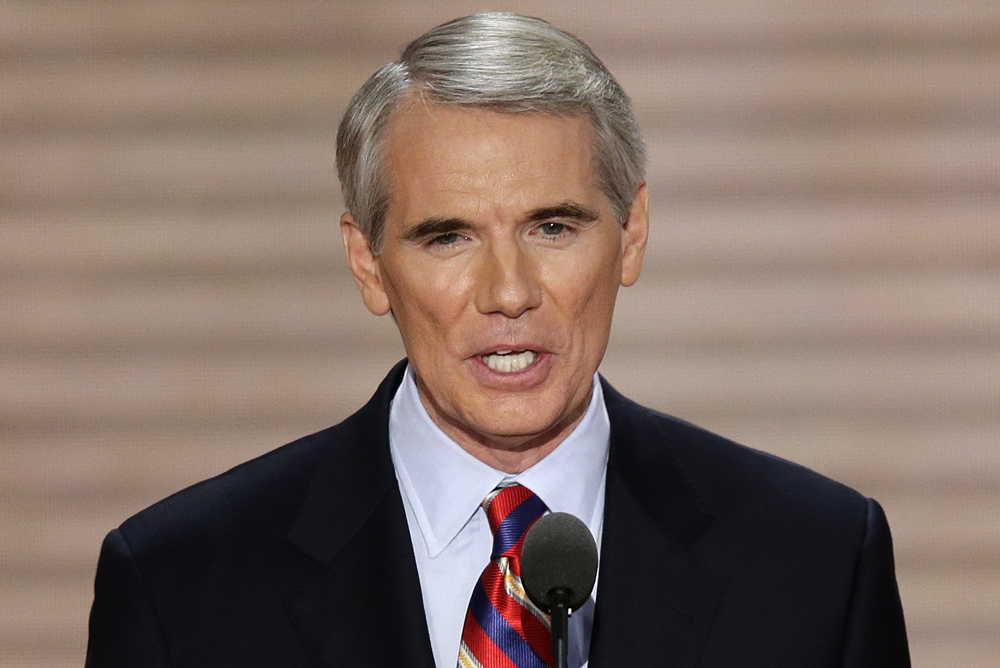
Rob Portman sent shock waves through America’s Republican Party last week by announcing that he was publicly changing his position on same-sex marriage.
The high-profile GOP senator from Ohio was previously an opponent of the gay rights movement and one of the co-sponsors of the Defense of Marriage Act (DOMA), a law supporting traditional marriage which Portman now believes to be unconstitutional.
In an interview with CNN, Portman explained that his U-turn came as a result of his 21-year old son, Will, revealing to his parents two years ago that he had embraced homosexuality. “I’ve had a change of heart based on a personal experience” Portman told CNN.
Portman, a Christian, appealed to the Bible when trying to justify his change: “Ultimately, it came down to the Bible’s overarching themes of love and compassion and my belief that we are all children of God.”
Senator Portman’s announcement comes just ahead of the Supreme Court having to decide on the constitutionality of DOMA, which was signed into law by President Clinton in the 1990s to protect the rights of states to recognize marriage as a union between one man and one woman. Portman said he chose to reveal his new position now in anticipation of having to talk to the media about DOMA later this month.
Portman never explained what new information he now possesses to justify changing his beliefs about what the Constitution says. Instead, he has appealed almost exclusively to personal and emotional factors.
The Republican Party has traditionally stood firm on family values, but analysts anticipate this will be changing in the days ahead as the Party’s demographic shifts to younger voters who support same-sex marriage. As a leading voice in the Republican Party for the past four decades, Portman’s U-turn represents this growing shift to the left.
Former presidential candidate Jon Huntsman, Florida Rep, Ileana Ros-Lehtinen, and party donor Foster Friess, are only some of the influential Republican voices in favour of changing the definition of marriage.
Constitutional Implications
The question of gay marriage has raised a host of deeper issues concerning the interpretation of the Constitution. Specifically, the Supreme Court must now decide whether it is unconstitutional for the federal government to protect states wishing to restrict marriage to a union between one man and one woman. If the Supreme Court “discovers” something in the Constitution that contradicts DOMA, then they will overturn it.
DOMA was originally written to prevent any single state being forced to recognize same-sex marriages, on the assumption that a marriage conducted in one state must be recognized by all the other states. However, nine states have simply ignored DOMA, so that we have the absurd situation that a couple can be “married” while in the state of Washington and “not married” as soon as they cross over the border into Idaho.
As the Supreme Court prepares to consider the constitutionality of DOMA, the underlying problem parallels an issue that arose last year in the debates surrounding the constitutionality of Obamacare. The four liberal Supreme Court justices claimed that the individual mandate in the Affordable Care Act should be upheld as part of Congress’ power to regulate interstate commerce delegated to it in the Constitution. Critics pointed out that if the federal government could force people to buy health insurance as part of commerce regulation, then in principle it might also be able to force people to buy vegetables or certain cars as part of this same authority. In a similar way, it needs to now be pointed out that if the constitution allows the federal government the authority to force states to recognize same-sex unions in the legal definition of marriage, then in principle the constitution also allows the federal government authority to force states to accept such things as polygamy, polyandry or incest in the definition of marriage.
Gay Marriage Myths
One hopes Rob Portman is considering the above implications, although it seems that his opposition of DOMA is more personal than rational. One can certainly be sympathetic to Portman’s evolving views, since he made clear that his U-turn arose out of a wish to show love and support to his son. However, if one looks closely at the types of statements Portman is now making, it emerges that a lot more is going on than simply a father’s unconditional love for his son. What is going on is that Portman has fallen prey to some of the myths that have been circulating about same-sex marriage which I hope to address in a future Christian Voice newsletter. In particular, he seems to have fallen for
- the myth that marriage is fundamentally a voluntary union of persons in a committed relationship;
- the myth that gay ‘marriage’ legislation will ‘remove the ban’ on same-sex couples getting marriage;
- the myth that gay ‘marriage’ is the most tolerant option;
- the myth that gay ‘marriage’ will bring greater equality;
- the myth that gay ‘marriage’ will not undermine the traditional family
.
.
Find out how to join Christian Voice and stand up for the King of kings (clicking on the link below does not commit you to join)

Please note that persons wishing to comment on this story must enter a valid email address. Comments from persons leaving fictitious email addresses will be trashed.