
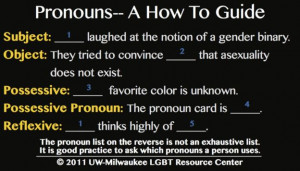
 A Student body is urging the use of ‘gender neutral pronouns’ at Oxford University, reports the Oxford Mail.
The National Union of Students is apparently behind the move, which will see ‘he’ and ‘she’ replaced with the silly gender-neutral ‘ze’.
But the ‘ze’ pronoun will only be used if the person requests it. It is unlikely to be preferred by ‘transgender’ students, if there are any, since these are determined to use the sex-specific pronoun of their gender of choice.
Indeed, deliberately using the wrong pronoun for a transgender person is an offence under Oxford’s behaviour code, the newspaper has said.
Instead, ‘ze’ will be used by those who decide they are neither male nor female. Those who are genuinely neither male nor female, or possess conflicting sexual organs, are know as ‘intersex’.
This condition is rare, but it afflicts the South African runner Caster Semenya, who has decided to identify, and run, as a woman despite having internal testes. There is at present no ‘ze’ gender classification at the Olympics. Athletes are male, or female.
Christian Voice was first with ‘Gender Neutral Pronouns’
Christian Voice first reported on this matter two months ago, so Oxford University and the Oxford Mail are somewhat behind the times. In an article in our October Newsletter, ‘Brighton Bell’ wrote:
‘At the University of Sussex in Brighton, students from the school of History, Art History, and Philosophy were sent an email with regards to pronouns. More precisely, the use of ‘gender neutral’ and ‘gender non-binary’ pronouns.
‘The email states that it has come to the attention of the university that a number of students don’t wish to be referred to by ‘traditional’ pronouns such as he or she, but instead prefer gender neutral pronouns such as they and their.
‘It goes on to say that students should notify the university if they wish to be addressed by such pronouns by their lecturers or fellow students. It may be tempting to put this down to an isolated incident at a radical university, but as we shall see in this article, this issue has become increasingly widespread.
‘Before looking at how widespread the debate over the use of pronouns is, let us first consider how the issue came to be in the first place.
MASCULINITY IS ‘TOXIC’
‘The ‘traditional’ view that there are two genders is going out of fashion among today’s young people. Especially in academic circles, people are taught to accept that gender is not a binary. Instead of there being two genders, an endless number of genders exist. Many students today are taught that gender is not an immutable characteristic, but instead merely a social construct. The term for this is the ‘gender non-binary’. People identify as new ‘non-binary genders’ which most outside the hallowed halls have never heard of before.
‘Feminists have for a long time been seeking to blur the lines between male and female, especially with reference to attacking masculinity. Masculinity is denounced as ‘toxic’, and feminists argue that men who act like men are expected to act are wrong to do so. Changing gender from a binary of male and female to a spectrum in which one can choose from a menu of options is one way in which to attack maleness. If you can convince people, and especially men, not to identify with the gender they were born with, it will lead to a decline in masculinity.
‘Effectively, feminists seek to make the heterosexual male a dying breed, as it were.
400 GENDER OPTIONS
‘So, just how many new genders are there? According to a recent count on the website Tumblr, which is the home of the online feminist, there are over 400 gender options now to choose from. From the more popular ‘genderqueer’ and ‘genderfluid’, to far more obscure options, all are to be accepted without question, unless one wishes to be called ‘transphobic’ or ‘transmisogynist’.
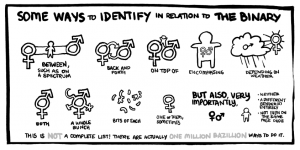
‘These options aren’t mutually exclusive either, so one can choose to identify with more than one of these new ‘genders’. Let’s take a look at a couple of these new ‘genders’ to see just how ridiculous they are (the definitions are from ‘Tumblr’):
‘Abimegender: “A gender which is profound, deep, and infinite”.
‘Genderflora: “A gender that blooms and evolves depending on the weather and atmosphere; similar to genderfluid but more plant-like”.
‘Polygender: “Identifying as multiple genders; may be static or fluid”.
‘In addition to the above terms, a word has even been invented for normal people who identify with the gender they were born with – cisgender. Society is said to be ‘cisnormative’, meaning that those who identify with trans and non-binary genders are an oppressed group.
‘It’s interesting to note how proponents of the gender non-binary see gender as a fluid, social construct one can choose whilst simultaneously seeing sexuality as immutable and unchangeable; something one is born with and cannot choose.
BLURRING LINE BETWEEN MALE AND FEMALE
‘Universities across the UK and America are now accepting the new gender theory as if it were proven fact. This has resulted in an increasing number of students identifying with a gender other than male or female. It has also raised the issue of by which pronouns they would like to be addressed. In addition to gender neutral pronouns such as ‘they, them, and their’, completely new pronouns are now also being made up to protect these poor students’ feelings. For example, the pronouns ‘ze, zie, and xe’ are just three of the many sets of pronouns one can now choose as an identity. The more that the gender binary can be deconstructed in these ways, the more the lines will blur between male and female.
‘How widespread is the issue of pronouns? It’s difficult to know just how many universities are implementing new policies on them, but there are certainly a number of examples of universities doing just that. This certainly isn’t an issue confined to the University of Sussex.
CHOOSE YOUR OWN PRONOUNS
‘For example, the University of Michigan in the USA have recently implemented a new policy to allow students to choose their own preferred pronouns. These pronouns must be respected by professors and fellow students on threat of disciplinary action. In a rather amusing twist, one student who found the policy to be ridiculous decided to change his pronoun to ‘his majesty’ in an effort to highlight just how insane the policy is.
‘At American University in Washington DC, students in an induction session were asked to introduce themselves by their name and preferred pronouns.
‘Meanwhile, at the University of Vermont, students are allowed to change their pronouns on the university’s computer system, having the choice between ‘he’, ‘she’, ‘they’, and ‘ze’, along with ‘name only’ if they wish to have no pronoun at all.
‘PUTTING PRONOUNS ON THE CARDS’
‘Back home here in the UK, our very own National Union of Students seems to have a serious problem with the use of pronouns. Last year, the NUS LGBT committee submitted a motion to the NUS women’s conference called ‘putting pronouns on the cards’. The motion complained that as current name badges used at conferences only state the person’s name and educational institute they attend. That was discriminatory as non-binary students then have to also write their pronouns on these badges so they are addressed correctly. Apparently, having to write a pronoun on a name badge can make one feel ‘uncomfortable, othered, or outed as trans’. The solution the NUS women’s conference came to is that all students will now be asked their preferred pronouns when registering for conference. These pronouns will then be printed on all name badges.
‘Interestingly, the NUS women’s conference also declares that it is open to “all who self-define as women, including those with complex gender identities which include ‘woman’, and those who experience oppression as women.”
‘BORN IN THE WRONG SPECIES’ IS NEXT
‘As you can see, the issue of gender is now at the forefront of what is going on in the academic world, and is a new battleground which must be fought. We cannot allow for traditional genders and gender roles to be eroded further in the name of ‘progress’ or political correctness. First it was sexuality, now it’s gender. What next? A ‘trans-species’ movement? Sadly, that is an idea also starting to gain some momentum. A number of people now not only believe they were born with the wrong gender, but they were also born in the wrong species.
‘Of course, all this ignores the clear words of scripture:
‘Genesis 1:27 So God created man in his own image, in the image of God he created him; male and female he created them.
‘1Corinthians 14:33a: God is not the author of confusion.
‘Indeed, God is not the author of confusion, and he created a binary of genders which are not social constructs. They are ordained by God himself. So the confusion of genders and blurring of gender lines has not come from God but from the world. It is a corrupting influence on today’s youth and society as a whole. Along with the blurring of gender lines comes an increase in experimenting with different sexuality, and the ever growing embrace of homosexuality as an acceptable, alternative lifestyle.
‘PRAY for Christian young people at university. It takes courage to oppose the militants and faith to persevere. Pastors and parents should be aware of this issue in order to be able to pray with and support our young people.’
Find out how to join Christian Voice and stand up for the King of kings (clicking on the link below does not commit you to join)

Please note that persons wishing to comment on this story must enter a valid email address. Comments from persons leaving fictitious email addresses will be trashed.







All this feminism etc (and it is questionable whether feminists are really pro-women or just anti-male) has come in a civilisation that hasn’t needed traditional male strengths, such as physically defending it in a time of war, for many years. I suspect the feminists etc will turn pretty quickly to the traditional males when they need to be defended against physical attack (although many seem to prefer being raped by migrants, eg in Germany, Sweden and elsewhere). The question is whether males will feel they want to defend feminists, having been the subjects of vitriolic verbal abuse and scorn by these women for many years, or indeed whether the modern male, at least the version that modern males are encouraged to be, could punch his way out of a wet paper bag.
On the subject of personal pronouns, my personal preference is for “Sir”.
I once observed an apparently male burglar at work in the dark, and reported this to the police. After I had been interviewed, the police wanted me to sign a statement of what I was supposed to have said. This included that I had seen “them”, and “they” had been in a particular place. I protested, because I had not said that , and there was only one burglar, not two. My statement had become very misleading in the hands of the police. N.B. You don’t have to sign what the police write out for you, and you can write your own in advance, not a bad idea.
I was asked how I could be sure it was a man not a woman. Well, it looked more like a man to me (like you might think you saw a cat rather than a dog or a fox in the dark), but it was true I had not done any anatomical or genetic testing. What I was sure of was that there was one of them, not two, and I thought that was more important. It goes without saying that I could not give any more details of his appearance than I had described, e.g. exactly what shape was under the coat, or what the colour of the hair was
The pronoun “their” in English could refer to either sex (unlike in French, where ils and elles are different). But it is plural. I think there is a place for a non-specific singular third person pronoun too (as well as “one”, which doesn’t usually fit). This would be used, if I had my, way, when the sex was genuinely unknown, for example, “When the student has finished, he/she must put down his/her pen and leave the room immediately”.
“I saw a dark figure and he/she moved towards the house across the road” (but that could be “it”).
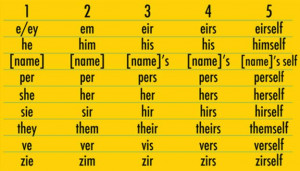
Elaborating a little on the Milaukee table, I think I would go for:
Per (subject), perm (object), pers (any possessive word) . Also perself.
So “Per came along the road, and I saw perm go into the house. In pers sack was an object which I do not think was pers”.
Sensible, no problem.
There is no need for a new plural or anything else.
When you say ” ‘transgender’ students, if there are any”, yes, how many of these people are there supposed to be around ? It really can’t be that many for all this to have justified so much fuss as it has done, especially in the USA.
Actually, although “per” obviously comes from “person”, I don’t like it on second thoughts, because it sounds like “her” and for this reason sounds wrong for the subject.
How about borrowing “il” from French, but as follows :
il (subject); ilm (object), ils (any possessive), ilself.
There would be no confusion between ils and ils=they in French, because in French the s is not pronounced.
(In fact, in spoken French, he, and male plural they are the same word, and the plural men can embrace a woman or two as well) .
Or if the women object to that, you could borrow el (not so obviously the French elle to annoy the men) with of course
el (subject), elm (object), els (any possessive), elself.
I think that might work. It’s a bit easier to say than il, too.
The possessive could be elms (arguably more as it’s formed for hers).
The following brief report was published on the Oxford Student website, apparently this evening.
OUSU denies implying that all students must use ‘ze’ pronouns
http://oxfordstudent.com/2016/12/12/ousu-denies-implying-students-must-use-ze-pronouns/
But they are recommending the use of “they” (for one person), the very thing I am against.
“This way lies madness”