

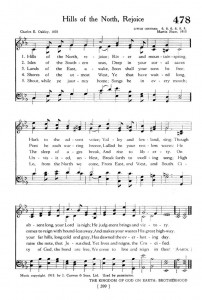
Hills of the north, rejoice;
River and mountain spring,
Hark to the advent voice;
Valley and lowland, sing;
Though absent long, your Lord is nigh;
He judgment brings and victory.
Isles of the southern seas,
Deep in your coral caves
Pent be each warring breeze,
Lulled be your restless waves:
He comes to reign with boundless sway,
And makes your wastes His great highway.
Lands of the East, awake,
Soon shall your sons be free;
The sleep of ages break,
And rise to liberty.
On your far hills, long cold and grey,
Has dawned the everlasting day.
Shores of the utmost West,
Ye that have waited long,
Unvisited, unblest,
Break forth to swelling song;
High raise the note, that Jesus died,
Yet lives and reigns, the Crucified.
Shout, while ye journey home;
Songs be in every mouth;
Lo, from the North we come,
From East, and West, and South.
City of God, the bond are free,
We come to live and reign in thee!
Text: Charles Edward Oakley, 1832-65
Music: Martin Shaw, Tune: Little Cornard, Meter: 6 6 6 6 8 8
Feel free to copy and paste Oakley’s words for your own congregation this Advent. Advent begins on Sunday 27th November this year (2016). It is a time of preparation for the coming of the Lord in the year-book of the Church of England, England’s established church. But you don’t have to be Anglican to sing it!
Charles Oakley’s life
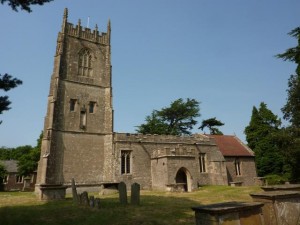
Charles Edward Oakley M.A. was born near Chatham in Kent in 1832. He was educated at Rugby School and Pembroke College, Oxford, and then at Magdalen College as a Demy (scholar), he took a First Class in Literae Humaniores (Greek and Latin literature and philosophy) in 1854, and a First Class in Law and Modern History (1855), when he was also Johnson Theological Scholar (1855).
He entered Holy Orders in 1855 and served as a chaplain to the army in the Crimean War (1855). He became rector of Wickwar, Gloucestershire (1856-63) and then later Rector of St. Paul’s, Covent Garden, London in 1863.
He died at Abergele, near Rhyl, North Wales on 15th September 1865 after a tragically short incumbency. In short, Oakley was a very clever as well as a holy young man.
His fine Missionary hymn, “Hills of the north, rejoice,” appeared in Bp. T. V. French’s Hymns adapted to the Christian Seasons, and the Hymnal Companion in 1870. (John Julian, Dictionary of Hymnology, Appendix, Part II (1907)) The tune now associated with the hymn, Little Cornard, was written by composer Martin Shaw in 1915.
Beware of the modern version!
Above are C.E.Oakley’s original words. The modern version of this hymn (scroll down in the link) still carries an advent message, but uncomfortable notions like ‘judgment’ and ‘victory’ have been expunged. Jesus becomes a personal saviour who doesn’t reign any more. In the last verse, ‘they’ come, not ‘we’. And rather than ‘live and reign’, with all the responsibility and action that implies, ‘they … find their rest’. Maybe the Victorian sentiments are politically incorrect these days, but Oakley captured the majesty of Christ and created something singable and uplifting, an inspiring hymn full of hope and destiny.
Based solidly on scripture
There is some Victorian romanticism in the Southern Seas and so on, but even there the hymn is inspired. The rhymes and construction are simply faultless. Each verse has its four lines of geography and its final two lines of triumphant theology. Note the hymn has nothing to do with British imperialism. Oakley was not imagining himself in Gloucestershire but in Jerusalem, in the ‘City of God’.
The scripture message he had in mind starts in the Psalms:
Psalm 107:1 O give thanks unto the LORD, for he is good: for his mercy endureth for ever. 2 Let the redeemed of the LORD say so, whom he hath redeemed from the hand of the enemy; 3 And gathered them out of the lands, from the east, and from the west, from the north, and from the south.
In Isaiah (and in Jeremiah) it becomes a promise to regather Israel:
Isaiah 43:5 Fear not: for I am with thee: I will bring thy seed from the east, and gather thee from the west; 6 I will say to the north, Give up; and to the south, Keep not back: bring my sons from far, and my daughters from the ends of the earth; (cf Jer 16:14-15, 23:7-8, 31:8)
Finally, in the Gospel, our Lord himself applies the great gathering to his believers:
Luke 13:29 And they shall come from the east, and from the west, and from the north, and from the south, and shall sit down in the kingdom of God.
That is what the hymn is about. More could be written on it.
Copy and Paste
Once again, you don’t have to be an Anglican to sing this great hymn. It will grace and bless any church. Remember there is no longer any copyright on Oakley’s words, so you can indeed feel free to copy and paste them for your own congregation. To hear the tune, click here (opens in a new tab).
Find out how to join Christian Voice and stand up for the King of kings (clicking on the link below does not commit you to join)

Please note that persons wishing to comment on this story must enter a valid email address. Comments from persons leaving fictitious email addresses will be trashed.






Well, this is extraordinary, Folks. Guess the utmost West must be the US of A, especially around the lil old Rockie Mountains.
It can hardly be New Zealand, because that is already doing its duty as an isle of the southern seas.
But in the USof A, folks do know one thing, they do know that their country is blessed by the Lord ! It’s more blessed than any other country on Earth (apart from the input of Mr Trump). I never did hear any man in Scotland or Wales dare say that his country was blessed, not like folks do in the US of A. What was this Charles Ma thinking of ?
As for “unvisited”, I reckon even in 1865 the Federal Tourist Board might have had something to say about that.
It’s not only “Hills of the North, Rejoice” which sounds lovely until you scrutinise it, but I suppose that’s poetry. Other hymn-writers have got away with murder.
“Fountain” may rhyme very conveniently with “mountain”, but (you know what I’m going to say !) fields and moorland and fountains don’t sound very much like a journey to Jerusalem from Orienta, wherever John Henry Hopkins thought that was. To be fair, in the original, they don’t “travel”, they “traverse”, which puts the accent more on tough mountaineering than on fields, but the traditional camels don’t work very well on stony mountain terrain (it hurts their feet).
Again, it sounds like Scotland, doesn’t it ? I can imagine the kings of Ulster, Connaught and Leinster travelling from Hibernia to a royal birth in Scotland, according to legend having seen a star in the East, presumably over Edinburgh).
Come to think of it, having seen the star in the east, nobody would doubt my story that the Irish kings moved eastwards to Edinburgh.
So doesn’t this mean that if the Magi saw the star in the east and travelled to the East, they would have come from the West, perhaps from Greece, where perhaps they were philosophers, or had consulted an oracle ?
No. Here is the scripture:
Matt 2:1 Now when Jesus was born in Bethlehem of Judaea in the days of Herod the king, behold, there came wise men from the east to Jerusalem, 2 Saying, Where is he that is born King of the Jews? for we have seen his star in the east, and are come to worship him.
They came FROM the east and saw his star while they were IN the east.
This will depend on exactly how you view the authenticity of the Bible, but how would Matthew know EXACTLY what the Magi had said to Herod some 80 years earlier ? He apparently didn’t know their names, but the names Caspar, Melchior and Balthazar (various spellings) were added later, this being altogether a tradition which it is tempting to embroider with camels etc. How do we know that these names aren’t correct, gathered from another source ? They are used in the 6th century mosaics in Ravenna, where all three are depicted as Parthians.
However, coming back to my revolutionary version, I don’t think somebody from the East would have actually said this with the meaning you and others suppose. Supposing I live in Bristol and go on holiday to Great Yarmouth. When I get back to Bristol, supposing I say “While I was on holiday, I saw the new comet which has appeared in the East”. There is no doubt that “in the East” would refer to the eastern sky, not to Great Yarmouth ! And particularly so as the new comet is visible from Bristol too. And I would have said exactly the same thing if I had spotted the comet while on holiday in Cornwall (expecting to be closer to the comet in Bristol).
This corresponds to what they say in the Latin tradition :
” Vidimus enim stellam eius in oriente: et venimus adorare eum.”
If that is indeed more or less what they said, it would follow that they saw his star in the eastern sky and came east to see him (with no mention of where they started, but west of Jerusalem makes more sense).
It is Matthew or St Jerome who has described them in the Vulgate as “magi ab oriente”, probably following a tradition which had already built up, possibly through a similar misunderstanding: “We in the East saw his star” would be different from “We saw his star in the East”, and who knows who passed on what in what language in the course of some 80 years ? An adult servant from the court of Herod who actually witnessed this would have turned 100.
Some translations into other modern languages are firmly based on the Parthian tradition. Hence in French we have d’Orient and en Orient , and in German Luther gives us “Weise aus dem Morgenland” and “seinen Stern im Morgenland”. But Latin has no capital letters to establish “oriente” as a place, nor has the Authorised Version for “east”.
One can carry on endlessly, some translations being left with the original ambiguity more than others. So in Czech :
” Viděli jsme na východě jeho hvězdu” , where na východě simply means in the east. In the Orient would be “na Orientu”. [The locative ending for the two words is different ]
However, in Italian it is firmly “in Oriente” where they saw the star.
I wonder !
Maybe, just maybe, they were Parthian academics who noticed the star while at a conference in Athens !
Hi Rox
How did Matthew know what the Magi said to Herod? don’t know. How do you prove that the Bible is the Word of God, infallible, inerrant, etc? Others may be able to answer this better than me, but we do know that most, if not all, of the 12 Apostles/disciples of Jesus went to horrific deaths because they refused to deny their testimony. Would they really have done this for something they KNEW to be a lie? And the “mass hypnosis” hypothesis doesn’t work either.