
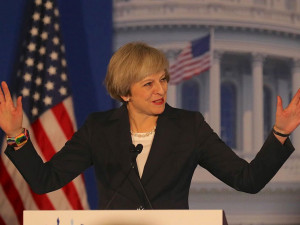
Prime Minister Theresa May addressed the Republican Party conference on 26th January 2017
These are excepts. Sentences and whole paragraphs are missing. The below should not be taken as reflecting Mrs May’s whole context. For the full speech on the Downing Street website click here.
Copy starts here:
… And later, in the aftermath of these wars, our 2 countries led the West through the Cold War, confronting communism and ultimately defeating it not just through military might, but by winning the war of ideas. And by proving that open, liberal, democratic societies will always defeat those that are closed, coercive and cruel.
The United Nations – in need of reform, but vital still – has its foundations in the special relationship, from the original Declaration of St James’ Palace to the Declaration by United Nations, signed in Washington, and drafted themselves by Winston Churchill and President Franklin D. Roosevelt.
The World Bank and International Monetary Fund, born in the post-war world at Bretton Woods, were conceived by our two nations working together.
And NATO – the cornerstone of the West’s defence – was established on the bonds of trust and mutual interests that exist between us.
Some of these organisations are in need of reform and renewal to make them relevant to our needs today. But we should be proud of the role our 2 nations – working in partnership – played in bringing them into being, and in bringing peace and prosperity to billions of people as a result.
Because it is through our actions over many years, working together to defeat evil or to open up the world, that we have been able to fulfil the promise of those who first spoke of the special nature of the relationship between us. The promise of freedom, liberty and the rights of man.
“We must never cease”, Churchill said, “to proclaim in fearless tones the great principles of freedom and the rights of man which are the joint inheritance of the English-speaking world and which through Magna Carta, the Bill of Rights, the Habeas Corpus, trial by jury, and the English common law, find their most famous expression in the American Declaration of Independence”.
Change in America
For I speak to you not just as Prime Minister of the United Kingdom, but as a fellow Conservative who believes in the same principles that underpin the agenda of your party. The value of liberty. The dignity of work. The principles of nationhood, family, economic prudence, patriotism – and putting power in the hands of the people.
Principles instilled in me from a young age. Principles my parents taught me in the vicarage in Southern England in which I was raised.
Change in Britain
And a newly emboldened, confident America is good for the world.
Britain is the only country in the G20 – other than yours – to meet its commitment to spend 2% of GDP on defence, and to invest 20% of that in upgrading equipment. It is why Britain is the only country in the G20 to spend 0.7% of gross national income on overseas development. It is why my first act as prime minister last year was to lead the debate in Parliament that ensured the renewal of Britain’s independent nuclear deterrent. And it is why the government I lead will increase spending on defence in every year of this Parliament.
It is why Britain is a leading member – alongside the United States – of the coalition working successfully to defeat Daesh; why we have agreed to send 800 troops to Estonia and Poland as part of NATO’s forward presence in eastern Europe; why we are increasing our troop contribution to NATO’s Resolute Support mission that defends the Afghan government from terrorism; and it is why we are reinforcing our commitment to peacekeeping operations in Kosovo, South Sudan and Somalia.
We will build a new partnership with our friends in Europe. We are not turning our back on them, or on the interests and the values that we share. It remains overwhelmingly in our interests – and in those of the wider world – that the EU should succeed. And for as long as we remain members we will continue to play our full part, just as we will continue to co-operate on security, foreign policy and trade once we have left.
But we have chosen a different future for our country.
A future that sees us restore our parliamentary sovereignty and national self-determination, and to become even more global and internationalist in action and in spirit.
A future that sees us take back control of the things that matter to us – things like our national borders and immigration policy, and the way we decide and interpret our own laws – so that we are able to shape a better, more prosperous future for the working men and women of Britain.
A future that sees us step up with confidence to a new, even more internationalist role, where we meet our responsibilities to our friends and allies, champion the international co-operation and partnerships that project our values around the world, and continue to act as one of the strongest and most forceful advocates for business, free markets and free trade anywhere around the globe.
This is a vision of a future that my country can unite around – and that I hope your country, as our closest friend and ally, can welcome and support.
A renewed special relationship
So as we rediscover our confidence together – as you renew your nation just as we renew ours – we have the opportunity – indeed the responsibility – to renew the special relationship for this new age. We have the opportunity to lead, together, again.
I believe it is in our national interest to do so. Because the world is increasingly marked by instability and threats that risk undermining our way of life and the very things that we hold dear.
The end of the Cold War did not give rise to a New World Order. It did not herald the end of history. It did not lead to a new age of peace, prosperity and predictability in world affairs.
For some – the citizens of Central and Eastern Europe in particular – it brought new freedom.
But across the world, ancient ethnic, religious and national rivalries – rivalries that had been frozen through the decades of the Cold War – returned.
New enemies of the West and our values – in particular in the form of radical Islamists – have emerged.
And countries with little tradition of democracy, liberty and human rights – notably China and Russia – have grown more assertive in world affairs.
… difficult military interventions in Iraq and Afghanistan – have led many to fear that, in this century, we will experience the eclipse of the West.
But even if they do not, our interests will remain. Our values will endure. And the need to defend them and project them will be as important as ever.
This cannot mean a return to the failed policies of the past. The days of Britain and America intervening in sovereign countries in an attempt to remake the world in our own image are over. But nor can we afford to stand idly by when the threat is real and when it is in our own interests to intervene. We must be strong, smart and hard-headed. And we must demonstrate the resolve necessary to stand up for our interests.
And whether it is the security of Israel in the Middle East or the Baltic states in Eastern Europe, we must always stand up for our friends and allies in democratic countries that find themselves in tough neighbourhoods too.
… your determination to take on and defeat Daesh and the ideology of Islamist extremism that inspires them and many others terrorist groups in the world today. It is in both our national interests to do so. This will require us to use the intelligence provided by the finest security agencies in the world. And it will require the use of military might.
And as they are defeated on the ground, the terrorists are exploiting the internet and social media to spread this ideology that is preying on vulnerable citizens in our own countries, inspiring them to commit acts of terror in our own cities.
That is why the UK has led the world in developing a strategy for preventing violent extremism, and why the British and American governments are working together to take on and defeat the ideology of Islamist Extremism. I look forward to working with the president and his administration to step up our efforts still further in order to defeat this evil ideology.
But of course, we should always be careful to distinguish between this extreme and hateful ideology, and the peaceful religion of Islam and the hundreds of millions of its adherents – including millions of our own citizens and those further afield who are so often the first victims of this ideology’s terror. And nor is it enough merely to focus on violent extremism. We need to address the whole spectrum of extremism, starting with the bigotry and hatred that can so often turn to violence.
Yet ultimately to defeat Daesh, we must employ all of the diplomatic means at our disposal. That means working internationally to secure a political solution in Syria and challenging the alliance between the Syrian regime and its backers in Tehran.
When it comes to Russia, as so often it is wise to turn to the example of President Reagan who – during his negotiations with his opposite number Mikhail Gorbachev – used to abide by the adage “trust but verify”. With President Putin, my advice is to “engage but beware”.
There is nothing inevitable about conflict between Russia and the West. And nothing unavoidable about retreating to the days of the Cold War. But we should engage with Russia from a position of strength. And we should build the relationships, systems and processes that make co-operation more likely than conflict – and that, particularly after the illegal annexation of Crimea, give assurance to Russia’s neighbouring states that their security is not in question.
We should not jeopardise the freedoms that President Reagan and Mrs Thatcher brought to Eastern Europe by accepting President Putin’s claim that it is now in his sphere of influence.
And progress on this issue would also help to secure another of this nation’s priorities – to reduce Iran’s malign influence in the Middle East.
This is a priority for the UK too as we support our allies in the Gulf States to push back against Iran’s aggressive efforts to build an arc of influence from Tehran through to the Mediterranean.
The nuclear deal with Iran was controversial. But it has neutralised the possibility of the Iranians acquiring nuclear weapons for more than a decade. It has seen Iran remove 13,000 centrifuges together with associated infrastructure and eliminate its stock of 20% enriched uranium. That was vitally important for regional security. But the agreement must now be very carefully and rigorously policed – and any breaches should be dealt with firmly and immediately.
Strong institutions and nations
To deal with the threats of the modern world, we need to rebuild confidence in the institutions upon which we all rely.
In part that means multinational institutions. Because we know that so many of the threats we face today – global terrorism, climate change, organised crime, unprecedented mass movements of people – do not respect national borders. So we must turn towards those multinational institutions like the UN and NATO that encourage international co-operation and partnership.
Yet the most important institution is – and should always be – the nation state. Strong nations form strong institutions. And they form the basis of the international partnerships and cooperation that bring stability to our world.
Which is why if the countries of the European Union wish to integrate further, my view is that they should be free to do so. Because that is what they choose.
And of course, we have ties of kinship, language and culture to these United States too. As Churchill put it, we “speak the same language, kneel at the same altars and, to a very large extent, pursue the same ideals”.
So I am delighted that the new administration has made a trade agreement between our countries one of its earliest priorities. A new trade deal between Britain and America must work for both sides and serve both of our national interests. It must help to grow our respective economies and to provide the high-skilled, high-paid jobs of the future for working people across America and across the UK.
And it must work for those who have too often felt left behind by the forces of globalisation. People, often those on modest incomes living in relatively rich countries like our own, who feel that the global system of free markets and free trade is simply not working for them in its current form.
… I look forward to pursuing talks with President Trump and his new administration about a new UK/US free trade agreement in the coming months. It will take detailed work, but we welcome your openness to those discussions and hope we can make progress so that the new, Global Britain that emerges after Brexit is even better equipped to take its place confidently in the world.
Conclusion
… That better future is within reach. Together, we can build it.
Our comment – no mention of God let alone Jesus Christ anywhere. Psalm 2, anyone?