

Research done just three years ago has demolished any idea that we are evolved from bacteria, Christian Voice has discovered.
The study, published in the pro-evolution journal Nature, is never referred to by the proponents of evolution, who are more fond of quoting Lenski’s experiments on bacteria, in which E-Coli appeared to evolve an ability to digest citrate.
But Lenski started with E-Coli bacteria and ended with E-Coli bacteria. They did not evolve into anything else. And now we know why.
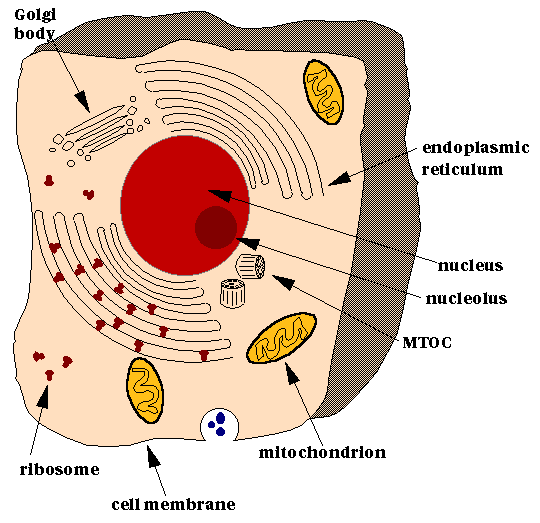
Every form of life more complex than bacteria is comprised of cells with a nucleus. Evolutionists have always said things like:
‘All species on Earth evolved from bacteria‘ (General point ‘1’)
‘Interestingly, scientists have learned that mitochondria evolved from bacteria a long, long time ago‘ (Introduction)
But statements like that can no longer be made, leaving evolutionists up a creek without a boat, let alone a paddle. Evolutionists commenting on articles on our website always distance evolution from abiogenesis, the idea that life arose from non-life. They recognise the lack of any evidence at all for abiogenesis, but regard the proposition that life as we see it today is accounted for by incremental changes over miiilions of years as one easier to sell to the public. But even that is now in jeopardy.
Nick Lane and his fellow researcher William Martin in “The energetics of genome complexity” (Nature, Oct 2010. 467 (7318): 929-934) start by saying this:
“All complex life is composed of eukaryotic (nucleated) cells. The eukaryotic cell arose from prokaryotes just once in four billion years, and otherwise prokaryotes show no tendency to evolve greater complexity. Why not?”
So “prokaryotes” (cells without a nucleus – such as bacteria) “show no tendency to evolve greater complexity”. Their claimed ‘arising’ of eukaryotes from prokaryotes is just conjecture, and their paper then demolishes the possibility that it could actually have happened. That is because their ‘Why not’ question has an answer, which they give: “Prokaryotic genome size is constrained by bioenergetics.” That’s the energy available to an organism, in layman’s terms.
Brian Thomas M.S., of the Institute for Creation Research, says they: ‘found that the total energy required to process eukaryotic DNA is far more than any bacterial system can produce.’
‘They therefore maintained that “mitochondria (cellular structures that contain the instructions and tiny machinery to produce energy in cells – SG) are prerequisite to [eukaryote] complexity.” They further wrote:
‘”The transition to complex life on Earth was a unique event that hinged on a bioenergetic jump afforded by spatially combinatorial relations between two cells and two genomes (endosymbiosis), rather than natural selection acting on mutations accumulated gradually among physically isolated prokaryotic individuals.” (emphasis added)’
This statement of Lane and Martin trips up evolution at its first primitive cell-with-a-nucleus hurdle. Eukaryotes have 1,000 times the DNA of bacteria – see the pro-evolution Arizona Biology Project) These authors say the transition from bacteria to the eukaryotic next stage cannot have happened by means of the evolutionary mechanisms (mutations and natural selection) upon which evolutionists rely.
It needed ‘a unique event’, ‘a bioenergetic jump’. It needed more energy than bacteria possess, or have ever possessed. It needed a miracle. It needed Deus ex Machina. They will never admit it, but life needs God.
What makes the Lane and Martin findings all the more powerful is that they are passionate evolutionists, continuing quite undaunted to write speculative articles about the mechanics of life ‘arising’ from the hostile conditions of sea vents. They need our prayers!
This post follows on from our earlier post BBC will need a miracle to change and a pro-evolution discussion on it initiated by Prof Alice Roberts.
Lane and Martin’s entire paper may be viewed HERE. (Thanks to Paul Atkin for the link)
Find out how to join Christian Voice and stand up for the King of kings (clicking on the link below does not commit you to join)

Please note that persons wishing to comment on this story must enter a valid email address. Comments from persons leaving fictitious email addresses will be trashed.







This highlights the utter stupidity of the whole evolutionary theory. One wonders how stupid darwin really was, and hos stupid the so-called intellectual world is and was to be duped by his crazy theories. How dumb can we get and still breath?. But still these crazy garbage evolutionaries stick to their theory like some religious obsession because they are too stupid to look again and the compelling evidence that utterly disproves and bins their theory into the trash can.
Brother Mike
Having studied that TRUE science agrees with GOD’s HOLY WORD the BIBLE may i point you to the little known fact that Charles Darwin was encouraged by Charles Lyell [ author of ” Principles of Geology ”; and staunch anti creation campaigner ]
Lyell was aware how Darwin had been enamoured by his discovery of unique species in the Galapagos Islands on his Beagle voyage and used this to encourage Darwin to formulate his evolution theory
Apparently it is on record that Darwin declared that if his theory remained unproven then it was to be ignored
Therefore i think it disingenuous to lay all the blame at Darwin’s door
Many historical figures have been duped and manipulated by others for thier nefarious agendas
Come LORD YESHUA
We need you more than ever
Then again the man of sin must be revealed first
May You and i not be duped into accepting his mark
May the LORD watch over you and guide you
Would not Darwinists agree that if prokaryotes were perfectly suited to their environment (and most appear to thrive only too well!) there would be no need for them to develop any further? To see them developing into eukaryotes, moreover, implies that they somehow knew that having a mitochondria would confer some kind of benefit. I am no expert, but is not this the kind of teleological approach that Richard Dawkins rejects? It sounds very like an explanation for how more complex organisms – notably, one would guess, human beings – ‘moved on’ from asexual reproduction.
“The study, published in the pro-evolution journal Nature, is never referred to by the proponents of evolution, who are more fond of quoting Lenski’s experiments on bacteria, in which E-Coli appeared to evolve an ability to digest citrate.
But Lenski started with E-Coli bacteria and ended with E-Coli bacteria. They did not evolve into anything else. And now we know why.”
Even the claim that the bacteria “evolved” (i.e. gained the ability) to metabolise citrate is false. The bacteria already have that ability, they just can’t normally do it in the presence of oxygen.
All that seems to have happened (in only one of a number of bacterial cultures, after 20 years of continuous laboratory growth) is that the bacteria LOST the ability to switch off that process.
You might as well say that a street light that stays on in broad daylight has “evolved” to give light! All that has happened is a fault in the mechanism that switches it off when not needed.
The simplest bacteria (let alone you and me!) are so incredibly complex in structure and biochemistry that there is no way they could have arisen by natural means.
You say “It needed ‘a unique event’, ‘a bioenergetic jump’. It needed more energy than bacteria possess, or have ever possessed. It needed a miracle. It needed Deus ex Machina. They will never admit it, but it needed God.”
But this seems like a God of the Gaps argument. Presumably you don’t want to constrain God’s hand to the bioenergetic jump? As such it seems a bit of a stretch to claim this paper as anti-evolution?
In any event, evolution through symbiosis in clearly important. This wikipedia article on symbiosis states: “While historically, symbiosis has received less attention than other interactions such as predation or competition,[33] it is increasingly recognized as an important selective force behind evolution,[11][34] with many species having a long history of interdependent co-evolution.[35] In fact, the evolution of all eukaryotes (plants, animals, fungi, and protists) is believed under the endosymbiotic theory to have resulted from a symbiosis between various sorts of bacteria.” (accessed 22 Jan 2014).
No, of course I’m not proposing ‘God of the gaps’, I was just pointing out the lunacy of expecting ‘a unique event’ to just happen.
The key to the conjectural statement from Wikipedia is the expression ‘is believed’. Evolution is indeed a belief system. And it is a belief system increasingly at odds with science, let alone mathematics, let alone Information Theory and let alone common sense.
You are making a fallacy of equivocation. It is not a ‘belief system’ as you use the term. It is based on empirical evidence, not faith and such is diametrically opposite to what you mean by belief.
Well, firstly, the ‘belief system’ of Christianity is based on evidence. We have the history of the Old Testament, we have three eye-witness accounts of the life of Jesus Christ (Matthew, Mark and John), we have the account both of the life of Christ and the doings of the early church written up by the historian Doctor Luke, we have the reports of the Apostle Paul, who stresses the evidence for Christ’s resurrection, and we have letters written by two apostles and two disciples, namely Peter, John, James and Jude.
Now, what evidence do you have that ‘all eukaryotes (plants, animals, fungi, and protists)’ ‘have resulted from a symbiosis between various sorts of bacteria’ to set against the findings of two learned researchers who say that cannot have happened?
Just proves evolution is a fairy tale for adults (and sadly taught to children)!
Psalm 14: 4 Have all the workers of iniquity no knowledge……..? WHY?
BECAUSE: 14:1 The fool has said in his heart, “There is no God.”
……………….They are corrupt, They have done abominable works………………….
I’m not an evolutionary biologist. I can’t go into every single aspect of the science for you, more because I don’t have time than anything else.
Let me help you with your anti-Evolutionary Theory pseudoscience, though. Here’s my tip: if you can find any piece of evidence that the theory is incorrect, publish it and get it peer-reviewed. Once it’s accepted by the scientific community, you can propose your scientifically-viable alternative, and claim the Nobel Prize.
Until you develop a proper understanding of anything to do with origins further than what you were indoctrinated with as children, however, you should probably stay out of such discussions so as to preserve your dignity. Okay?
Those two biologists HAVE published evidence that bacteria cannot evolve into the next evolutionary step, in a peer-reviewed journal, just as you want. And you still can’t ‘develop a proper understanding’ of that!
Adam, have you ever seen anything which has been created as a result of an explosion apart from a firework?
If I took every single loose moving part which makes up a car plus the shell and blew it up, do you really think that it would all settle into a perfect vehicle in pristine working order with all the nuts bolts springs cogs all fitting together, all shiny and gleaming new? Hmmm, somehow I doubt it – sounds more like Mary Poppins to me can you see the delusion here?
An entire planet with a sensitive eco-system, the right chemical composition to support all life on it; the perfect distance from the sun to stop us from frying, and enough distance to prevent us from freezing. The perfect balance of light, heat, water, and air to compliment and replenish all living things – a spinning core to keep us all on the ground rather than hurtling us all into out space due to an atmosphere, plus spinning on its axis perfectly… do you really think that came about by ‘chance’, ‘fate’ and evil-ution (yes, I know how its spelt).
Once a theory is proven, then it becomes a principle. So Darwin’s theory’s are simply just that, theory-tales not principles based on irrefutable Truth. Sorry!!! Still you can always watch Mary Poppins for a dose of realism!
But science also shows that lifeless chemicals coming together does not create life, that’s why they cannot create it in a lab so a person only needs to use their common sense and think about it to realise macro evolution is a load of nonsense
There’s quite a bit to say about this article; I’ll start off by pointing out that the conclusions you have drawn seem to be based upon a misunderstanding of the research paper upon which it’s based.
For the benefit of your readers who may not have followed the link to the Nature website that you kindly provided, here is the abstract of the paper in full (I haven’t yet brought myself to cough up the £22 for the full article):
“All complex life is composed of eukaryotic (nucleated) cells. The eukaryotic cell arose from prokaryotes just once in four billion years, and otherwise prokaryotes show no tendency to evolve greater complexity. Why not? Prokaryotic genome size is constrained by bioenergetics. The endosymbiosis that gave rise to mitochondria restructured the distribution of DNA in relation to bioenergetic membranes, permitting a remarkable 200,000-fold expansion in the number of genes expressed. This vast leap in genomic capacity was strictly dependent on mitochondrial power, and prerequisite to eukaryote complexity: the key innovation en route to multicellular life.”
In other words, although “Eukaryotes have 1,000 times the DNA of bacteria” now, they didn’t when the “endosymbios that gave rise to mitochondria” arose. It was this event, the authors of the paper say, that enabled the amount of DNA to increase and support the associated increase in eukaryote complexity. And at the time, it did not need “more energy than bacteria possess, or have ever possessed”.
So, far from demolishing any idea that we evolved from early bacteria-like life forms, or tripping up evolution at its first cell-with-a-nucleus hurdle, the paper simply explores from an energetic perspective the current hypothesis for how eukaryotes arose.
No misunderstanding here. And you are relying on conjecture when you claim that eukaryotes did not have 1,000 times the DNA of bacteria when they first ‘arose’. That figure came from a pro-evolution source. So, you tell us how many times the DNA of bacteria the ‘early’ eukaryotes had. You can also calculate for us how the bacteria had enough energy to make that jump.
All you claim about the possibility of an event that these bioenergenticists maintain was impossible is opposed to what the authors themselves plainly say.
Let’s repeat it: ”The transition to complex life on Earth was a unique event that hinged on a bioenergetic jump afforded by spatially combinatorial relations between two cells and two genomes (endosymbiosis), rather than natural selection acting on mutations accumulated gradually among physically isolated prokaryotic individuals.” (emphasis added)
In other words, evolution cannot account for the most basic building blocks of life: cells with a nucleus. Why not be scientific and honest and just admit it?
In fact, my comment is based entirely on the wording of the abstract of the Nature article; I haven’t added any conjecture. Picking out just the relevant phrases, the abstract says “…permitting a remarkable 200,000-fold expansion in the number of genes expressed. This vast leap in genomic capacity…”. So, the authors must think that “genomic capacity” at the time the proposed “endosymbiosis” occurred was 1/200,000th of what it eventually became; and, far from maintaining it was impossible, they clearly have no problems at all with the energetics of this event.
Ah, just relying on the abstract … Paul, in the actual article, which you have not read, they say it happened (which they have to) but go on to say that evolution simply cannot account for it, because the bacteria would have needed far more energy than they possess. (They are bioenergeticists, you see.) So as it could not happen naturally, they have to invoke ‘a unique event’, ‘a bioenergetic jump’, ‘Deus ex machina’ if you like:
”The transition to complex life on Earth was a unique event that hinged on a bioenergetic jump afforded by spatially combinatorial relations between two cells and two genomes (endosymbiosis), rather than natural selection acting on mutations accumulated gradually among physically isolated prokaryotic individuals.” (emphasis added)
One bacterium to another, quoting Scotty from Startrek: ‘I canne do it, Cap’n. We have nay got the power!’
No really Stephen, you’ve misunderstood it (although I love the Star Trek quote). It’s not that “evolution simply cannot account for it” – what they are saying is that the arising of eukaryotes happened as a result of a different type of event than mutations followed by natural selection. This event, they say, was that proto-mitochondria made their home inside the proto-eukaryote (my translation of “spatially combinatorial relations between two cells and two genomes (endosymbiosis)”). This is really a special case of the way organisms affect each others’ evolution through their interactions.
Once the proto-eukaryote was established with its proto-mitochondria, mutual evolution could then proceed through natural selection acting on mutations accumulated gradually, with a line in which the proto-mitochondria specialised in energy generation supporting increased genome complexity in the host and leading to today’s eukaryotes.
The reason this paper was considered of sufficient importance to appear in Nature, I think, is the authors’ contention that it had to happen this way – they exclude the possibility of eukaryotes arising from a single prokaryote line, for the reasons you have quoted.
Exactly how this “endosymbiosis” arose is unknown, of course – there’s no direct evidence available and so it must be studied using indirect means, such as the bioenergetic approach used by the paper’s authors.
Note: I’ve still not shelled out the £22 for the paper, so I’m relying on you to tell me whether anything I’ve said contradicts it!
They are in fact saying that evolution cannot account for it. That is why they invoke some ‘special event’.
I have found the original paper here. I see that firstly, what I surmised about its content in my posts above is correct; and secondly, that nowhere do they say that “evolution cannot account for it” (where by “it”, I presume you mean the arising of eukaryotes from prokaryotes). In fact, they account for “it” thus:
“For four billion years bacteria have remained in a local minimum in the complexity fitness landscape, a deep canyon bounded on all sides by steep energetic constraints. The possession of mitochondria enabled eukaryotes to tunnel through this mountainous energetic barrier. Mitochondria allowed their host to evolve, explore and express 200,000-fold more genes with no energetic penalty. This is because mitochondria obliterated the heavy selection pressure to remove superfluous DNA (and potential proteins), which is among the most pervasive selective forces in prokaryote genome evolution.”
So, not only do you misunderstand the article, you are also misrepresenting it.
Not at all. It is you who is misrepresenting the article by ducking and diving away from the bits of it which contradict your preconceptions.
In Lane & Martin’s terms, what they have written in that paragraph makes complete sense.
Eukaryotes (cells with a nucleus) need mitochondria. But to get those mitochondria into the bacteria is impossible without a ‘special event’. It could not happen naturally. As they say themselves:
“All complex life is composed of eukaryotic (nucleated) cells. The eukaryotic cell arose from prokaryotes just once in four billion years, and otherwise prokaryotes show no tendency to evolve greater complexity. Why not?”
And they gave the answer. The bacteria do not have the power. They don’t have it now. They never had it:
‘The prokaryote-to-eukaryote transition involved the origin of a multiplicity of new complex traits underpinned by some 3,000 new protein families 42,43. That evolutionary leap required energy to burn, orders of magnitude more energy than any prokaryote can offer. Mitochondria bestowed upon their host 105 –106 times more power per gene.’
But how did the mitochondria get into the prokaryotes, just that one time ‘in 4 billion years’? They don’t say, because they don’t know. All they know was that it didn’t happen by the accepted evolutionary route of mutations and natural selection.
Their concluding paragraph states it as clearly as is possible, and it is a paragraph you consistently refuse to confront:
‘The transition to complex life on Earth was a unique event that hinged on a bioenergetic jump afforded by spatially combinatorial relations between two cells and two genomes (endosymbiosis), rather than natural selection acting on mutations accumulated gradually among physically isolated prokaryotic individuals.’
Thanks for the link to the paper which all our readers can follow up on and see for themselves just how bioenergetics shows evolution by the usual narrative of mutations and natural selection to be mathematically impossible.
> It is you who is misrepresenting the article by ducking and diving away from the bits of it which contradict your preconceptions…it is a paragraph you consistently refuse to confront
Oh dear, you must be feeling it necessary to scrape the bottom of the barrel to come up with such nonsense. Perhaps you are relying on any readers of this discussion not scrolling up to my last but one post, where I wrote:
“what they are saying is that the arising of eukaryotes happened as a result of a different type of event than mutations followed by natural selection. This event, they say, was that proto-mitochondria made their home inside the proto-eukaryote (my translation of “spatially combinatorial relations between two cells and two genomes (endosymbiosis)”). This is really a special case of the way organisms affect each others’ evolution through their interactions.”
I have to point out here that I quoted from the paragraph that (according to you) I “refuse to confront”, in an effort (evidently unsuccessful) to explain it to you and overcome your misunderstanding of the article.
Let me have another go.
The article uses a bioenergetic argument to demonstrate that prokaryotes could not have evolved into eukaryotes from a single prokaryote line. They further demonstrate that once the proto-mitochondrion had established itself in the proto-eukaryote, its specialisation into the cell powerhouse through normal evolutionary mechanisms would allow a huge leap in genomic complexity, leading eventually to the various complex plants and animals that we see starting to appear in the fossil record from about 2.1 billion years ago (see http://www.sciencedaily.com/releases/2010/06/100630171711.htm).
The “unique event” that was not “natural selection acting on mutations accumulated gradually among physically isolated prokaryotic individuals” was when proto-mitochondria made their home inside the proto-eukaryote (my translation of “spatially combinatorial relations between two cells and two genomes (endosymbiosis)”).
The article makes no attempt whatsoever to explain how this “unique event” happened – its objective is to establish that it was necessary to allow eukaryotes to arise. Indeed, any attempt to explain it in detail must be conjecture, as there is no detailed evidence available.
Yet somehow you leap from this necessary state of uncertainty to state categorically that “It could not happen naturally.” Where is your evidence for this assertion? You have presented none, and obviously there is none in the article.
It seems to me that the key point that you need to assimilate in order to understand the article is to accept that ‘it’ (proto-mitochondria making their home inside the proto-eukaryote) could have happened naturally. For instance, one could imagine the proto-eukaryote engulfing the proto-mitochondrion in an attempt at predation, then failing to digest it or even kill it. Hey presto! we then have a scenario in which endosymbiosis can arise, leading to the events that the article describes. Conjecture, I know, but plausible.
It’s also clear that this event would have been essentially a physical movement of one organism from the exterior to the interior of another. Far from needing “more energy than bacteria possess, or have ever possessed”, it would have been energetically neutral.
I repeat – the objective of the article is to establish, on bioenergetic grounds, that some such event must have happened to allow eukaryotes to arise. Your assertion that it has “demolished any idea that we are evolved from bacteria” is based upon your misunderstanding of the article and is wholly unsupported by the article itself.
‘Must have happened’. No evidence it ever did. Like the boys say, it can’t have happened by mutations and natural selection, so the theory of evolution has broken down.
http://www.nature.com/nature/journal/v521/n7551/full/nature14447.html can anyone check this out?
the Nature article appears to be mere speculation and still does not appear to overcome the bioenergetics problem that bacteria – or any prokaryote – simply would not have enough energy to ‘evolve’ into a eukaryote.