Men consistently performed better than women during way-finding tasks in a virtual environment which they had just learned.
Using fMRI brain-scanning, the researchers saw that men in the study took several shortcuts, oriented themselves more using cardinal directions and used a different part of the brain than the women in the study.
To find out if the difference was down to cultural factors or sex-specific hormones, the researchers gave some of the women a small dose of testosterone under their tongue. Several of them were then able to orient themselves better in the four cardinal directions.
“Men’s sense of direction was more effective. They quite simply got to their destination faster,” says Carl Pintzka, a medical doctor and PhD candidate at the Norwegian University of Science and Technology (NTNU)’s Department of Neuroscience.
The men and women studied a virtual maze and were then set tasks. Men’s routes in blue, women’s routes in red. Credit: NTNU
Eighteen men and 18 women first took an hour to learn the layout of a maze before the scanning session began. In the MRI scanner, they were given 30 seconds for each of the 45 navigation tasks. One of the tasks, for example, was to “find the yellow car” from different starting points.
Pintzka concludes that women and men have different navigational strategies. Men, he found, use cardinal directions during navigation to a greater degree.
“If they’re going to the Student Society building in Trondheim, for example, men usually go in the general direction where it’s located. Women usually orient themselves along a route to get there, for example, ‘go past the hairdresser and then up the street and turn right after the store’,” he says.
The study shows using cardinal directions is more efficient because it is a more flexible strategy. The destination can be reached faster because the strategy depends less on where you start.
The fMRI brain images showed both men and women using large but different areas of the brain when they navigate. The men used the hippocampus more, whereas women used their frontal areas to a greater extent.
“That’s in sync with the fact that the hippocampus is necessary to make use of cardinal directions,” says Pintzka.
Depressingly, he has to explain his findings in evolutionary terms. He suggests:
‘Men are faster at finding the house’ – fotolia
“In ancient times, men were hunters and women were gatherers. Therefore, our brains probably evolved differently.”
What if our brains were designed differently by Almighty God and that men and women have simply decided to do those things for which we are better suited for our mutual benefit?
It is surely less plausible that our brains followed our activities than that our activities followed our brains.
Interestingly, other researchers have documented that women are better at finding objects locally than men. “In simple terms, women are faster at finding things in the house, and men are faster at finding the house,” Pintzka says.
The results support the Biblical model that men and women have complementary strengths and work together rather than the feminist doctrine popular in government and the broadcast media that the sexes have identical abilities and are in competition with each other.
The directional sense findings are part of Pintzka’s doctoral thesis on how the brain functions differently in men and women. Let’s pray his funding continues.
The UK Government is going to force firms to reveal the bonuses they pay to men and to women.
Apparently, in the UK, a woman on average earns around 80p for every £1 earned by a man. The Government will also make it a legal requirement for every company with more than 250 employees to publish the difference between the average pay of their male and female employees.
Earlier this year, business hit a target for the percentage of women on company boards. That was set at twenty-five percent by government adviser Lord Davies. Be in no doubt he will want that to go to fifty percent.
Our Prime Minister, Mr Cameron, has said: “You can’t have true opportunity without equality. There is no place for a pay gap in today’s society and we are delivering on our promises to address it.”
Maria Miller MP, who chairs the Commons Women and Equalities Committee chimed in, launching an inquiry by her committee into government strategy on reducing the difference between what women and men are paid.
Mrs Miller said unequal pay was predominantly a problem that affected women over forty and that measures already announced by the government did not account for this group.
I saw a video recently in which one Mike Buchanan was pointing to research indicating that having loads of women on company boards impacted negatively on their profitability.
GOD CREATED THE MAN TO WORK AND THE WOMAN TO HELP HIM
But I think my disquiet is more with the principle that gender pay equality is either achievable or desirable.
You see, in the beginning, God created the man, gave him some work, and then created the woman to be a helper for him. The pattern of a man as the head of the household, providing outside the home and women caring within it is still one which chimes with people and to which they aspire.
Even in what we regard as the most primitive societies, women stay near the camp, keeping their home smart, gathering stuff, looking after the children, while the men go out and hunt. The women usually cook what the men bring back.
Most women, in all the surveys I have seen, would rather be at home looking after their children than out at work. But sadly we have too many single-parent families today, and most of those are headed by a mother, and in two-parent households, governments have organised things so that today so many families need two incomes to survive.
GENDER PAY GAP IS A MYTH
I also want to suggest that this ‘gender pay gap’ might actually be a myth. After all, it’s illegal to pay a man more than a woman for doing an equivalent job.
So how do the Government come up with their 80% figure? Well, they just take a average of what every man earns and compare it with the average of what every woman earns, then round it up to the nearest 10%.
But men do more dirty and dangerous jobs, that pay more – and kill many of them. Many women – probably too many for the government’s liking – actually want to bring up their own children. Taking time out of a career inevitably impacts on earning ability.
And when you read about the real differences between men and women, you find that men are more driven and focused on achievements, while women are more concerned with relationships.
Lastly, if more men than women prioritise work, as the figures seem to show, won’t that, coupled with natural testosterone-fueled ambition, impact on relative earnings?
NEGATIVE PAY-GAPS
According to the Office for National Statistics, the gender pay gap is actually 9.4% for full-time employees. It only rises to 19.1% (not 20%) when part-time employees are included. And for part-time employees, they say, ‘the higher rate of pay for women than men results in a ‘negative’ gender pay gap’. The Government are not campaigning to address that problem, or seeking to raise the pay of young men to equal that of young women.
According to the Guardian newspaper, there is a negative gender pay gap among the young. ‘The pay gap is low or slightly reversed among 18 to 39-year-olds, but the gap for hourly earnings grows from the age of 40 onwards, reaching its highest point for women in their 50s’, said the paper. This is precisely the point where women are taking time out of their career for family reasons and men are nearing the peak of theirs.
The European Commission say: ‘A high pay gap is usually characteristic of a labour market which is highly segregated, meaning that women are more concentrated in a restricted number of sectors and/or professions (e.g. Czech Republic, Estonia and Finland), or in which a significant proportion of women work part-time (e.g. Germany and Austria)’. Both of those, to a certain extent, would apply to the United Kingdom.
Another pay gap is never talked about. It is the gap between what people earn in the private sector and in the public sector. According to ONS: ‘Private sector earnings have remained consistently at around 85% of public sector earnings since 2009.’
Find out how to join Christian Voice and stand up for the King of kings (clicking on the link below does not commit you to join)
Please note that persons wishing to comment on this story must enter a valid email address. Comments from persons leaving fictitious email addresses will be trashed.
Academic and author, Dr Sophie Coulombeau, suggests that women who adopt their husband’s surname are losing their identity.
In an article for BBC’s news magazine, Dr Sophie Coulombeau, raised the question of why a woman would want to share her husband’s last name.
In a well-researched historical surveyof female name-changing, Coulombeau suggested that a woman’s very identity as a person hinges on not adopting the surname of her husband, as if changing one’s name is tantamount to becoming a different person.
The novelist and Professor of English at Cardiff observed that “For me, to adopt the surname of my partner and relinquish my own would profoundly affect how I think about my own identity.”
Later she added that “To abandon my surname and take that of my partner would mean abandoning Sophie Coulombeau, along with all the errors, achievements and resonances she created over thirty years.”
Dr. Coulombeau is not alone. Writing in the Guardianlast year, Jill Filipovic suggested that adopting a husband’s surname is equivalent to allowing one’s identity to be obliterated, “subsuming your own identity into our husband’s.”
These ideas are achieving resonance with numerous women in the younger generation. In 2009, only 70% of womensaid they thought wives should adopt their husband’s surname.
Meanwhile, some are going to the opposite pole to suggest that a man should take his wife’s surname. Some couples are solving the problem by making up a brand new surname.
It is hard not to have some sympathy for the concerns various women have raised in the debate about name-changing. On the surface at least, there does seem to be something unfair in a tradition that insists a woman must change her name while a man is never expected to change his. Of greater concern to many women is the fact that name-changing might imply that a wife is simply an adjunct of her husband with no identity of her own. Others are concerned that this custom is simply a residual hang-over from our culture’s “patriarchal’ past – a past in which women allegedly had no rights and could be abused without consequences.
In this article I will attempt to interact with these concerns and to put forward some reasons why the custom of name-changing is worth preserving. But before getting into that, it may be helpful to explore some of the ideological origins of behind the current rejection of female name-changing.
Feminism and the Rise of Gender Equality
Despite the pervasive influence of feminism, most women still want to adopt the surname of their husband.
The growing move for women to keep their maiden names is directly tied to the rise of feminism, particularly feminist teaching about sexual equality.
Throughout the last hundred years, feminists have managed to convince the general public that equality of worth runs parallel to equality of role, with the consequence that in order for men and women to enjoy equal value, there must be sameness of function. Accordingly, feminism has left modern society without the categories for distinguishing diversities to be celebrated from inequalities to be lamented. In theory at least, all inequalities are viewed in a pejorative light. Thus, throughout the 20th century, there was pressure from feminists to remove all vestiges of gender differentiation from as many political and social areas as possible.
Despite their gains, feminists find it irksome that most women still choose to adopt their husband’s sunames. For a woman to adopt her husband’s name strikes at the heart of the utopia of gender neutrality towards which modern feminism strives. Consequently, feminists have fixated on this issue as part of their larger ambition to eradicate all gender distinctions from society.
The uneasiness about name-changing is understandable, since it is an emblem of a view of marriage that modern feminism rejects.
Feminism and the Changing Face of Marriage
In the older understanding, marriage had an institutional groundingthat was bigger than the couple, and which implicitly situated each marriage within an entire context of laws, taboos, traditions and expectations. The sense of marriage as an institution larger than the individuals involved was embodied in the practice of having the couple recite marriage vows that were given to them by the society, as well as in the tradition of a wife adopting the name of her husband’s family. Under this scheme of things, it is not up to any individual to define what marriage means; rather, marriage defines us.
In the revisionist understanding of marriage, it is the individual who defines her marriage and what it ultimately means to her.
By contrast, in the modern understanding of marriage championed by feminism, each woman should be able to define for herself what marriage means. This is one of the reasons it is becoming widespread for a couple to invent their own marriage vows. Customs and practices for marriage that are received (even when we do not understand the rationale behind them) are viewed as a limitation to the right we all have to define our own existence for ourselves. As such, whatever makes a woman feel more fulfilled, whether it is keeping her maiden name or adopting the surname of her husband, is legitimate. It is the individual who defines her marriage and what it ultimately means to her.
The causalities in this revisionist understanding of marriage are legion, and affect everything from our willingness to accept same-sex ‘marriage’ to our society’s approach to no-fault divorce. It also means that the custom of a woman accepting her husband’s name is viewed as little more than an anachronistic relic that has survived well beyond its years from our “patriarchal” past. In this regard it is significant that Coulombeau explicitly situated the debate about female name-changing within the larger context of the same revisionism that has rejected gender normativity:
And we might well ask, in the wake of last year’s Marriage (Same Sex Couples) Act, whether a custom that depends on a gender-normative idea of marriage – a woman automatically sacrificing her name to take that of a man – is starting to look more outdated than ever.
Guardian journalist, Jill Filipovic, has also drawn a connection between wives keeping their maiden name and the revisionist innovations of same-sex “marriage.”
An Attack on Christian Tradition
In her BBC article on the subject, Dr Sophie Coulombeau acknowledges the Christian origin to the tradition of a wife taking the name of her husband’s family, noting how around the turn of the 15th century, the English appropriated the French doctrine of coverture “based on scriptural ideas, which focused not on the husband’s power over his wife but on the unity that marriage gave them.” Coulombeau continued:
The English custom of designating a married woman by her husband’s surname dignified those who had previously occupied the status of vassals.
“In the words of the English jurist Henry de Bracton, they became ‘a single person, because they are one flesh and one blood’. As this idea gained ground, so did the clerical habit of designating a married woman by her husband’s surname.The married woman had formerly been a vassal with no surname at all, but now, in theory, she came to share the surname of her husband as a symbol of their legal and spiritual unity.”
This is significant, because it shows that far from being demeaning, the practice of a wife adopting her husband’s surname was dignifying, lifting her above the status of a vassal and giving her legal and spiritual unity with her husband.
This practice actually goes further back than the 15th century, as the Genesis narrative records Adam naming his wife Eve. The notion is also consistent with Biblical teaching regarding the headship of the husband. Though Christian cultures have not always practiced this custom, the idea itself is consonant with Biblical teaching.
Name-Changing and Female Identity
Even those who do not share our Christian convictions have good reasons to be concerned by the growing practice of married women preserving their maiden names. This is because the assumption behind keeping the maiden name is often rooted in the dangerous idea that a woman’s identity is precariously fragile, hinging only on what she is called. Sophie Coulombeau implies as much when she writesthat “Introducing myself as ‘Sophie Hardiman’ would mean that saying ‘I do’ had fundamentally changed the answer to the question ‘Who am I?’” Coulombeau goes on to quote followers of Lucy Stone, whose slogan in the 1920s was “My name is my identity and must not be lost.”
Does Jill Filipovic really believe a woman’s identity is fragile enough to be undermined by adopting her husband’s surname?
This echoes concerns articulated by Jill Filipovic in her Guardian article ‘Why should married women change their names? Let men change theirs.’ Filipovic wrote that adopting the name of a husband “lessens the belief that our existence is valuable unto itself, and that as individuals we are already whole. It disassociates us from ourselves…Jill Filipovic is my name and my identity. Jill Smith is a different person.”
Do these feminists really want us to think that female identity is so precarious, and that the billions of women throughout history who chose to adopt the name of their husband’s family thereby ceased to be less than themselves, that their personhood was sublimated to that of their husbands?
Having said that, there is a kernel of truth to the fears these feminists are articulating. Marriage makes us whole (if we were “already whole” before marriage, then there would be no reason to get marriage in the first place?), but it also involves change, sacrificing who we were in a dynamic process of becoming, of continual renegotiation of self in relation to the other. This is as true for a husband as it is for a wife. A woman changing her name is a visible sign of this dynamic process, but there are just as many ways (if not more) that marriage requires husbands to negotiate a new understanding of self in the mutual interplay of sacrifice and new life that forms the mystery of marriage. In the past, the feminists who found this loathsome – believing, with Filipovic, that “we are already whole” – attacked marriage itself and urged women to remain single. They recognized, not without warrant, that marriage is antithetical to the principles of individual self-assertion that form the bedrock of so much feminist ideology.
Part of the problem arises from thinking of marriage as a zero-sum game where the sacrifices and adjustments made for the sake of the other are correlative to loss of self. But in reality marriage is governed by the spiritual logic where the more we give the more fully we become ourselves. This applies as much to the sacrifices a husband has to make as it does to a women sacrificing her maiden name for that of her husband.
Name-Changing and Government Intrusion
Although I maintain there are good reasons for a wife taking her husband’s name, I do not believe any woman should be forced to do this against her will. However, a day may come in the not so distant future when women will be deprived of this choice and forced to keep their maiden names.
I have read (but have not verified it for myself) that in parts of Canada it is now actually illegalfor a woman to change her surname to that of her husband; the government forces her to keep her maiden name. Strange as this seems, it is a natural corollary to the notion that requiring women to change their name somehow implies that women are inferior. If the time-honoured practice really does treat women as inferior, then how is it not a species of the type of abuse that is usually forbidden in law? By asking questions like this we see that the arguments feminists are now making could be setting us on a trajectory that can only culminate in women being preventing from taking the name of their husband’s family.
The government may have its own reasons for wanting to abolish the custom I have been defending. Recognizable and traceable family structures (whether in the form of clans, tribes or extended networks of kinship) have historically proved to be one of the main hedges against the aspirations of powerful warlords and kings. Although this is less the case in the modern world, the strength of the family still functions as a significant barrier to the unrestrained power of the state. But it is hard to preserve these family structures when there is irregularity in how names are passed down. With everyone choosing their own surname, with some couples jointly taking on the wife’s surname, with other couples inventing a new surname, and with children having to decide whether to adopt their mother’s surname or their father’s surname (a choice that may be different to that of their siblings), we will increasingly have to lean towards the state to help clarify the boundary markers of each family.
It is significant in this regard that many who are agitating for women to keep their maiden name are appealing to a notion of family based on legal rather than natural bonds. For example, Filipovic writes that an alternative to the traditional family is to “embrace a modern vision of family where individuals form social and legal bonds out of love and loyalty, instead of defining family as a group coalesced under one male figurehead and a singular name.” This continues the trajectory of gay marriage where the boundaries of what constitute a family are becoming purely a legal fiction.
It is tempting to say that the consequence of each woman making her own choice extends no further than her own family. However, if the concerns I have registered are legitimate, then that is an overly naive and simplistic view. Without wanting to over-dramatize things, what is at stake is the future of the family itself.
Find out how to join Christian Voice and stand up for the King of kings (clicking on the link below does not commit you to join)
Please note that persons wishing to comment on this story must enter a valid email address. Comments from persons leaving fictitious email addresses will be trashed.
The six-colour rainbow ”diversity’ flag on display at a homosexual rally.
A rainbow flag has been raised in Leicester to mark the beginning of February as ‘Lesbian, Gay, Bisexual and Trans History Month’.
The flag was raised on Monday by Labour Councillor Manjula Sood, a previous Lord Mayor of Leicester, and currently assistant Mayor and Vice Chair of Equal Opportunities, Education and Social Services for Leicester City Council
She said: “The city council is committed to celebrating Leicester’s diversity.”
How celebrating sodomy will increase a sense of city cohesion within Leicester’s Christian and Muslim communities was not stated.
Cllr Sood is Leicester City’s only female Asian elected councillor, a position held since 1996. She is of course a Hindu with strong links to India. According to her biography, she has partaken in the last three International Women’s Day.
Councillor Manjjula Sood
Cllr Sood is very busy promoting diversity. She is Trustee and an Executive Director for the Leicester Council of Faiths, Vice Chair and Women’s Officer for the local Constituency Labour Party, Member of Asian Refuge Shelter, Member of the Afro-Caribbean Working Party (what has she to offer there?) Member of the Children and Young Persons scrutiny committee, Member of the Leicester Domestic Violence forum, naturally, Member of the Faith Regeneration Advisory Group, engaged with developing a multi religion centre in Leicester (very New Age, that) and Member of the Inter Faith Network UK since 1995.
The rainbow flag is also flying outside Leicestershire police headquarters in Enderby, as well as County Hall in Glenfield.
Leicestershire’s assistant chief constable Steph (sic) Morgan, who speaks on LGBT issues for the Association of Chief Police Officers, explained away his and the council’s flying of the flag like this: “Flying the rainbow flag together in this way is a symbol of our joint commitment to the LGBT community locally and is part of ongoing work with our local authority partners to create a just and fair society for all.
“As national LGBT strategic policing lead, I was pleased to see 10 police forces, including Leicestershire police, featured in the Stonewall 100 Index of gay-friendly employers in January 2013.”
Concentrating on such divisive issues as being ‘gay-friendly’ may explain why the police now have no time to investigate internet fraud and why there seem to have been so many recent financial scandals involving senior police officers.
Find out how to join Christian Voice and stand up for the King of kings (clicking on the link below does not commit you to join)
Please note that persons wishing to comment on this story must enter a valid email address. Comments from persons leaving fictitious email addresses will be trashed.
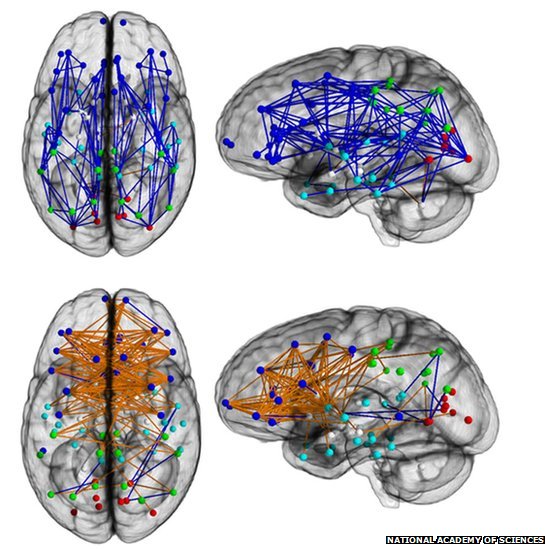
Male brains are wired front to back, with few connections bridging the two hemispheres. In females, the connections criss-cross between left and right
US researchers at the University of Pennsylvania scanned the brains of nearly 1,000 men, women, boys and girls and found striking differences, reports the BBC.
The “connectome maps” reveal the differences between the male brain (seen in blue) and the female brain (orange)
Male brains are wired front to back, with few connections bridging the two hemispheres. In females, the connections criss-cross between left and right.
These differences might explain why men, in general, tend to be better at learning and performing a single task, like cycling or navigating, whereas women are more equipped for multitasking, say the researchers in the journal Proceedings of the National Academy of Sciences (PNAS).
The same volunteers were asked to perform a series of cognitive tests, and the results appeared to support this notion.
Women scored well on attention, word and face memory, and social cognition. Men performed better on spatial processing and sensori-motor speed.
Researcher Dr Ruben Gur said: “It’s quite striking how complementary the brains of women and men really are.
“Detailed connectome maps of the brain will not only help us better understand the differences between how men and women think, but it will also give us more insight into the roots of neurological disorders, which are often sex related.”
On the same day, under a headline ‘Britain ravaged by sexism: women know your place!’ the Daily Telegraph reported that nearly four in 10 Brits believe women should not work in a range of jobs including soldier, pilot, mechanic or surgeon, suggesting sexism is still “prevalent” in the workplace.
Some 40 per cent of the UK population also believe men should not do jobs such as midwife, nurse, nanny or beautician, the study of 2,026 adults found.
Among the least trusted professionals are male nannies, female electricians, male primary school teachers and female bus drivers, the study by WorldPay Zinc, a payment processing firm, revealed.
Geraldine Wilson, managing director of WorldPay Zinc, said: “People in Britain are prone to stereotyping men and women based on their gender. Strong opinions on which jobs are for men and which are for women still exist, as do beliefs that men are better in stereotypically masculine roles such as plumber and electrician, whilst women make better nurses and florists. Both sexes are still being held back from pursuing occupations that might not be seen as suitable for their gender.”
Throughout the survey men “expressed more dated opinions and attitudes than women”, voicing a lack of trust in both men and women doing jobs not historically associated with their gender. Only 56 per cent of men believe that women should be free to do any job they like. Similarly, only 52 per cent of men think that men should be able to become beauticians, nannies or midwives.
In the Bible, men did the heavy lifting and the fighting while midwives were female and women cared for all children until boys left the care of their mother and began to learn their father’s business at the age of 12 or 13. The girls stayed under their mother’s care but under their father’s authority.
In addition, God gave leadership roles to men:
Exod 18:21 Moreover thou shalt provide out of all the people able men, such as fear God, men of truth, hating covetousness; and place such over them, to be rulers of thousands, and rulers of hundreds, rulers of fifties, and rulers of tens:
And the Prophet Isaiah condemned a society in which men had relinquished their leadership roles:
Isaiah 3:12 As for my people, children are their oppressors, and women rule over them. O my people, they which lead thee cause thee to err, and destroy the way of thy paths.
So perhaps the minority who would restrict jobs according to sex are driven, not by sexism and dated opinions, but by scriptural truth and up-to-date science.
Find out how to join Christian Voice and stand up for the King of kings (clicking on the link below does not commit you to join)
Please note that persons wishing to comment on this story must enter a valid email address. Comments from persons leaving fictitious email addresses will be trashed.
Chivalry is demeaning towards women and a sign of ‘sexism’ in men, feminist psychologists now claim.
The controversial claims follow a report for the Psychology of Women Quarterly which asserts that there is a cluster of behaviours called ‘benevolent sexism’ which manifests itself in everything from opening doors for girls to men offering to help women choose the right computer. (See Andy Bloxham’s Telegraph article, “Chivalry is actually ‘benevolent sexism’, feminists conclude.”)
Playing the part of a gentleman is a particularly insidious form of ‘benevolent sexism’, rooted in warm feelings towards women, the researchers claim. While gentlemanly behaviour might at first appear to be positive towards women, it is actually a form of gender colonialism.
“The warm, fuzzy feelings surrounding benevolent sexism come at a cost,” warned Melanie Tannenbaum in the Scientific American last April, “and that cost is often actual, objective gender equality.”
Social scientists have even claimed that equality is threatened when a man tells a woman that he cannot live without her or when he ‘cherishes’ her.
The radical claims were published in the Psychology of Women Quarterly, the official publication of the Society for the Psychology of Women. The authors of the study, Julia Becker and Janet Swim, warned that “Women endorse sexist beliefs, at least in part, because they do not attend to subtle, aggregate forms of sexism in their personal lives. …women…are the victims of ‘benevolent sexism’.” They warned that sexist attitudes include an “odd…conjunction of what at first seemed inherently incompatible: subjective affection as a form of prejudice…”
Although most women welcome benevolent sexism, social scientists are alerting them to the danger. As the Science Daily reported,
“Benevolent sexism motivates chivalrous acts that many women may welcome, such as a man’s offer to lift heavy boxes or install the new computer. While the path to benevolent sexism may be paved with good intentions, it reinforces the assumption that men possess greater competence than women, whom benevolent sexists view as wonderful, but weak and fragile.”
The report for the Psychology of Women Quarterly drew on the work of social psychologists Dr. Peter Glick and Dr. Susan Fiske who wrote a paper in 1996 which postulated the existence of ambivalent sexism. Ambivalent sexism is a category thought to include both ‘hostile sexism’ (things like rape, wife-beating, etc.) and ‘benevolent sexism’ (things like offering to carry a woman’s luggage, opening doors, etc.). The authors claimed that their research proved that both hostile and benevolent sexism are composed of three subcomponents: paternalism, gender differentiation, and heterosexuality. Both forms of sexism also have origin in men’s desire to dominate women: “[Benevolent sexism is] a subjectively positive orientation of protection, idealization, and affection directed toward women that, like hostile sexism, serves to justify women’s subordinate status to men.”
Glick and Fiske believe that the gender differentiation and heterosexuality that are integral to benevolent sexism emerge in ‘protective paternalism’, intimacy-seeking, male self-disclosure (how sexist to assume a woman will be a sympathetic ear!) and romantic love. As Glick and Fiske write, “the attitudes we define as characterizing benevolent sexism” include “protective attitudes towards women, a reverence for the role of women as wives and mothers, and an idealization of women as romantic love objects.”
Other tell-tale signs of ‘benevolent sexism’ include the belief that “women should be cherished and protected by men”, the belief that “men should sacrifice to provide for women”, or when a man offers to do the driving on a long distance journey (‘protective paternalism’ again). Even saving a woman’s life is offensive, for according to Swim the statement that “in a disaster, women should be saved before men” is sexist.
Being Positive is Being Negative
It is not only males who are being accused of perpetuating ‘benevolent sexism’. If a woman think too highly of her sex, then that is a sign that she too has fallen victim of certain sexist myths. As the Scientific American reported, “women who were exposed to benevolent sexism were more likely to think that there are many advantages to being a woman.” One of the questions used to determine ‘benevolent sexism’ is whether a woman agrees with the statement, ‘there are some things that a woman understands better than a man.’
On the surface, it is strange that any feminist would have a problem with a woman complimenting her own sex. However, given their fixation with ‘gender equality’, the only thing feminists hate more than someone suggested women are inferior to men is for someone to suggest that women are superior to men. The compliment is offensive precisely because the suggestion that women are superior implies that men and women are not the same.
We have seen that the theory of ‘benevolent sexism’ argues that there is a strange juxtaposition between praising women and hating them, that acting positive towards a woman is actually negative; being nice to women is actually not so nice. At first this seems completely bizarre. How can positive feelings towards women be negative? How can it be not quite nice to treat a woman nicely?
The answer to these questions can be found in the pervasive suspicion that if men sacrifice for women or look after them, then this implies women are weak or even (God-forbid) that women are not entirely self-sufficient without men, and visa versa. But classical feminism denies that women need men. By classifying ‘benevolent sexism’ in the same class as ‘hostile sexism’ (rape, wife-beating, etc.), feminist theorists are targeting any kind of mutual dependence and complementarity among the sexes – what Glick and Fiske refer to pejoratively as “complementary gender differentiation.”
These ideas are not limited to fringe feminist academics. If you don’t believe me, try this little experiment. Go into a big city and spend the day looking for acts of chivalry you can do towards women. It could be anything from opening doors for women to helping them on with their coats. You may find that you will have an experience similar to the 55-year-old businessman named Tony whose experience Wendy Shalit chronicled in her book A Return to Modesty.
I was out with my wife and one other woman and when I got the other woman’s coat for her and reached to help her with it, she practically ripped the coat out of my hands, said “Nobody has ever done that for me!” and stomped off and waited, fuming, by the door.”
Such is the topsy-turvy world in which we live, where being nice to women is considered demeaning.
Social Consequences
The irony is that without the concept of gender differentiation, and without a high premium placed on men acting as gentlemen, women are actually vulnerable to the very types of exploitation and abuses to which feminism claims to be the solution.
Glick and Fiske have shown that ‘benevolent sexism’ lurks whenever women are made the objects of men’s adoration, protection, and provision. But don’t we see the results of women not being the recipients of male protection and provision all around us? We do, and it isn’t reassuring. All around us we see the result of a world in which men no longer think they need to protect women. Every day in the news we are reminded what a society looks like where it is no longer cool for a man to be a gentleman.
Not only do we live in a world where a man can claim the moral high ground by repudiating the role of gentleman, but feminists have given us a world in which it is praiseworthy for women not to act as ladies. For let’s not forget that the concept of ‘benevolent sexism’ not only targets men who act as gentlemen, but also women who have a kind of feminine pride, who think of themselves as special, who gravitate towards men who will protect and adore them, and who try to act as ‘ladies.’
When we turn away from the academic theorizing of feminist social scientists to the real world and look at what goes on in the street, it is doubtful that the erosion of female dignity is actually good for women. It isn’t a complicated point that an attractive woman who believes there is a special dignity about being female is more likely to have the inner resources to resist the lucrative pull of the porn industry. A woman who believes that she has a right to male provision and protection merely because she is a woman will be less likely to let herself be victimized by unscrupulous men. A woman who thinks of herself with dignity and who appreciates the advantages of being a woman is going to be more likely to seek out men who will protect and cherish her.
So perhaps ‘benevolent sexism’ isn’t so bad after all. In fact, I’ll go further. Without an appropriate sense of ‘benevolent sexism’, it becomes difficult to rightly assess the tragedy of sexual abuse against women. Let me explain.
Remember that one of the components of ‘benevolent sexism’ is gender differentiation. But without a strong sense of gender differences—what we might call the womanliness of women and the manliness of men—we might legitimately ask whether the violation of female sexuality is really that bad. For some thinkers the answer seems to be no.
For example, the original text of Eve Ensler’s award-winning play, ‘The Vagina Monologues’ venerates rape performed on a 13-year-old girl, who declares, “If it was rape, it was a good rape.” In her book Sex, Art, and American Culture: Essays, Camille Paglia write that if rape “is a totally devastating psychological experience for a woman, then she doesn’t have a proper attitude about sex.” Significantly, Paglia bases this idea on a non-benevolent view of women, saying, if we have the “kind of attitude” that women “are basically nurturing, benevolent people…then of course rape is going to be a total violation of your entire life…” In her own approach, however, a woman being raped is just like a man getting beaten up.
Although these comments should fill us with horror, they are not without a certain feminist logic. If there is no gender differentiation, rape cannot be said to be a crime against one’s womanhood and female dignity, but only a crime against the body. This is because these theories assert that womanhood and female dignity, as something differentiated and complementary to manhood, either do not exist in an ultimate objective sense, or exists as merely the residue of our patriarchal culture. Indeed, when all aspects of our humanity are reduced to gender-neutral categories, then what is left to be called a “woman” has hardly any right to complain that rape is qualitatively different to being beat up, or that prostitution is different than any other type of profession (hence the debates among feminists on whether prostitution should be legalized).
Once gender differentiation is seen to be a species of sexism, then not only is the gentleman seen to be an icon of our sexist past, but the virtuous woman is seen to be an icon of female subordination. This frightening logic has been realized in various movements in which feminists have intentionally appropriated to themselves the language of female hatred. One thinks of Elizabeth Wurtzel book Bitch, or the ‘Slutwalk’ phenomenon which attempted to reclaim the word “slut,” or New York State University’s taxpayer-funded ‘Revolting Behavior’ conference which attempted to reclaim the word “Shameless Hussy”, or the International GoTopless Day which attempts to bring to men sights that at one time would have been restricted to a brothel, or movements like ‘V-Day’ which attempt to reclaim certain slang and offensive terms for the female genitalia. The irony of all these movements are that they sponsored by feminists who, in the name of equality, have embraced themes that used to be the province of misogynist men, while those males who remain gentleman are demonized.
In Defense of Chivalry
Chivalry is unpopular today precisely because it is an emblem of masculinity among the men who practice it and an emblem of femininity in the women who receive it, even as feminine modesty reminds us that there is a difference in how responsible men and women dress. Chivalrous behavior thus presupposes certain things about our humanity. It assumes, for example, that women ought to be treated in a special way because they are women, just as feminine modesty proclaims that women ought to dress in a certain way because they are women. When a man embraces his calling to look after and protect women, or when a woman embraces her obligation to dress modestly, both are proclaiming that there is a fundamental difference between the sexes.
However, in a world where women have been “liberated” to be the same as men, where we are taught that all gender-specific roles (including men showing special honor to women) are oppressive, it is inevitable that strong attack will be leveled against men behaving as gentlemen and women acting as ladies. However, the irony is that by turning female honor and dignity into something dirty, feminism opens women up to new forms of exploitation.
By contrast, being ladies and gentlemen—embracing ‘benevolent sexism’ as something good—acts as a hedge against the sexual reductionism of our society. Good sexual manners—whether it be man offering to carry a women’s heavy suit case or a lady making sure her clothes are not transparent—constantly reaffirms that the raw matter of our world has a certain shape and poetry beyond the brute facts of existence. It also affirms what Glick and Fiske argue is a central tenant of ‘benevolent sexism’ but which might not actually be that bad to recover: the notion that “women are to be loved, cherished, and protected.”
Find out how to join Christian Voice and stand up for the King of kings (clicking on the link below does not commit you to join)
Please note that persons wishing to comment on this story must enter a valid email address. Comments from persons leaving fictitious email addresses will be trashed.
In Hadley Arkes’ book Natural Rights and the Right to Choose, he makes some penetrating observations about American society which apply with equal force to some of the issues Britain is now facing. He writes,
In the name of ‘privacy’ and ‘autonomy’, [Americans] have unfolded, since 1965, vast new claims of liberty, all of them bound up in some way with the notion of sexual freedom. In the first steps, there was a liberty, for married couples, but then soon for unmarried persons, to have unregulated access to contraceptives. Next, the claim of privacy was extended into a private right to end a pregnancy, or destroy a child in the womb, at any time in a pregnancy, for virtually any reason. That same claim of privacy was soon extended to the freedom to end the lives of newborns afflicted with Down’s syndrome or spina bifda. After the briefest interval, that same doctrine of personal autonomy was applied to the other end of the scale of age and converted into a claim to assisted suicide.
Ironically, this unfolding scheme of liberation has advanced even while privacy, in other domains, has been progressively crimped and disrespected by the law. Private corporations, private clubs, private households, have found themselves under thicker regulation, and the overhanging threat of lawsuits. The combined effect has been to remove the attribute most prized about privacy: the freedom to arrange one’s own association, or private enclave, according to one’s own, private criteria. But this recession of privacy and freedom seems to count for very little when set against the expansion of rights associated with sexual freedom. The dismantling of restraints on sexuality has evidently been taken as far more liberating, even exhilirating, perhaps because it has been taken as a matter of the most irreducible ‘personal’ freedom. And yet these freedoms, celebrated as pre-eminently ‘personal,’ have required the assistance or intervention of surgeons and counselors, and they have quickly annexed to their cause the demand to have the support of public monies, drawn from tax-payers with the coercions of the law. It must surely count, too, as one of the paradoxes of this new phase in our law that people seem to identify their well-being, not with an obligation to preserve life or go to its rescue, but with the creation of vast new franchises to destroy human life, for wholly private reasons, without the need to offer a justification.
Each step in liberation has been marked, then, by a further detachment of people from the traditional restraints of the law. The corollary, of course, is that, as restraints have been removed, persons once protected by those restraints have been removed from that protection. Vast new liberties come along with vast new injuries – unless, of course, the victims no longer count. In any event, there is little doubt that these alterations in our law over the past thirty years have been taken as the hallmarks of a new regime of personal freedom; a freedom so vital to those who savor it, that any threat of having it qualified or diminished in any degree is taken as nothing less than an assault on the constitutional order itself.
Find out how to join Christian Voice and stand up for the King of kings (clicking on the link below does not commit you to join)
Please note that persons wishing to comment on this story must enter a valid email address. Comments from persons leaving fictitious email addresses will be trashed.
The Swedish arm of Toys R Us is suggesting girls play with guns. Zero Tolerance think this will reduce violence. But only against women. Violence against men doesn’t matter.
Nursery children in Scotland are the target of a new campaign that aims to end sexism in pre-schools and prevent future domestic violence by encouraging boys to swap their cars for dolls and little girls to dress up as pirates, says The Times.
The ‘Just Like a Child’ initiative being launched this week by ‘Zero Tolerance’, a charity that claims to ‘fight violence against women’, aims to ‘end gender stereotyping in nurseries’ by giving boys dolls to play with and encouraging girls to play with guns and be ‘strong and tough’.
Jenny Kemp, Zero Tolerance coordinator, writes: “We believe that it is never too early to question what is seen as ‘normal’ or what is traditionally expected of boys and girls in our society. In fact, we believe that doing so from a very young age helps to protect children from the negative consequences of inequality and discrimination as they grow into adults.”
Liz Ely, a ‘development officer’ at Zero Tolerance, said: “From the moment children are born they are told that boys must be strong and tough, and girls are delicate and pretty. These stereotypes have real and lasting consequences. The fact that as a society we tell boys not to express their emotions, and girls that they are not suited to science and maths, sets children on a path to inequality; this inequality lays the foundations for abuse and violence in later life.”
Dr Sarah Morton, a ‘family expert’ and psychologist at the University of Edinburgh, said ‘our research has found a clear link between gender stereotypes and violence against women and children.’
It would be interesting to see that research, and how ‘gender stereotypes’ were quantified, because common sense might lean to the view that it is insecurity rather than some supposed ‘inequality’ which lies at the heart of a desire to lash out, and that by encouraging insecurity in their gender identity this programme will increase the likelihood that these boys and girls will grow up unbalanced and abusive.
The website www.zerotolerance.org.uk says the organisation ‘is a charity working to tackle the causes of men’s violence against women. Too many women in Scotland, and around the world, experience violence from men – most often men they are close to and/or who are in a position of power over them. Men’s violence against women is caused by gender inequality, and it helps this inequality to continue.’
There is so much wrong in that unbalanced statement it is hard to know where to begin. For a start, women’s violence and abuse against men apparently either does not happen or does not matter to ‘Zero Tolerance’. The idea that men are always ‘in a position of power’ over women is laughable. Lastly, where does the idea come from that violence is simply and exclusively ’caused by gender inequality?’ Abuse of any sort is caused by sin, and the roots of it can lie in insecurity, irritation, drunkenness, provocation, mental problems or plain old wickedness. And the fair sex are not immune from any of those.
One strongly gets the impression that there is either an anti-Christian, feminist political agenda behind the approach of ‘Zero Tolerance’ or there are some personal issues becoming rather too public. Either way, it is not just sad but frankly mendacious to involve children in a social experiment which could leave them trying to work out problems with gender identity later in life.
It would be better and more effective to teach boys that they have a responsibility to protect and care for girls, but of course that would reinforce the very ‘gender stereotype’ that the feministas at Zero Tolerance so detest.
Genesis 2:18 And the LORD God said, It is not good that the man should be alone; I will make him an help meet for him.
Isaiah 3:12 As for my people, children are their oppressors, and women rule over them. O my people, they which lead thee cause thee to err, and destroy the way of thy paths.
1Peter 3:7 Likewise, ye husbands, dwell with them according to knowledge, giving honour unto the wife, as unto the weaker vessel, and as being heirs together of the grace of life; that your prayers be not hindered
Find out how to join Christian Voice and stand up for the King of kings (clicking on the link below does not commit you to join)
Please note that persons wishing to comment on this story must enter a valid email address. Comments from persons leaving fictitious email addresses will be trashed.
Only the Muslims are doing what their bodies were designed to do and having lots of children
A Lords committee has warned that the UK is “woefully underprepared” for the social and economic challenges of an ageing society, according to a BBC news report last week.
Drawing on figures from the Office for National Statistics, the committee predicted “a series of crises” in public service provisions.
If current trends continue, then between 2010 and 2030 there will be a 50% rise in the number of over-65s while the number of over-85s will double. Since this is not being balanced by a rise in Britain’s younger population, officials are concerned that we could be accelerating into a situation where we are unable to offer proper care to the elderly.
“As a country we are not ready for the rapid ageing of our population,” said Lord Filkin, the Labour peer who chaired the committee. “Our population is older now and will get more so over the next decade. The public are entitled to an honest conversation about the implications,” he said.
Baroness Greengross, chief executive of the International Longevity Centre UK and a crossbench member of the House of Lords, expressed similar concerns: “Our society is in denial of the inevitability of ageing. We have put off the difficult decisions for far too long.”
Underlying Issues
There are a number of reasons for this demographic shift, including the fact that improved medicine allows people to live longer. That is not a problem and should be treated as a blessing. The real problem, which is not being addressed in any of this discussion, is that we are not having enough children.
Business and feminism have worked together in a pincer movement to drive women into the work place.
Over the years Christian Voice has drawn attention to some of the underlying causes of the declining birth rate. This includes economic policies that have made it increasingly difficult for parents to support children. Despite benefits available to struggling parents, the cumulative effect of the debt-spending required to sustain our welfare state has resulted in a decrease in the purchasing power of the pound. The devaluing of the currency has made it increasingly difficult for parents to support more than a couple children, if even that. Even middle class families are finding it increasingly difficult to bring up their children because of crippling taxation.
Christian Voice has also frequently drawn attention to the many social programs that implicitly discourage marriage. (See our article from last year ‘The Cost of a Permissive Society.’)
Another key factor has been the way business and feminism have worked together in a pincer movement to drive women into the work place. As a result, many women are waiting until later in life to have children, only to find that their biological clock has stopped ticking.
Only the Muslims are doing what their bodies were designed to do and having lots of children. However, this is creating its own demographic problem, as we warned in our report ‘Islam Growing at Astronomical Rate in the UK.’
Find out how to join Christian Voice and stand up for the King of kings (clicking on the link below does not commit you to join)
Please note that persons wishing to comment on this story must enter a valid email address. Comments from persons leaving fictitious email addresses will be trashed.
The Prince of Wales if right to raise concerns about the way the Succession to the Crown Bill is being rushed through Parliament without adequate attention being given to the possible ramifications, Christian Voice announced today.
While it may seem like a nice gesture to remove the prohibition on the monarch marrying a Roman Catholic, Prince Charles is right that doing so could set off a chain of unintended consequences that would ultimately destabilize the institution of the monarchy.
But first, what is the Act of Settlement and how did it arise?
Background to the Act of Settlement
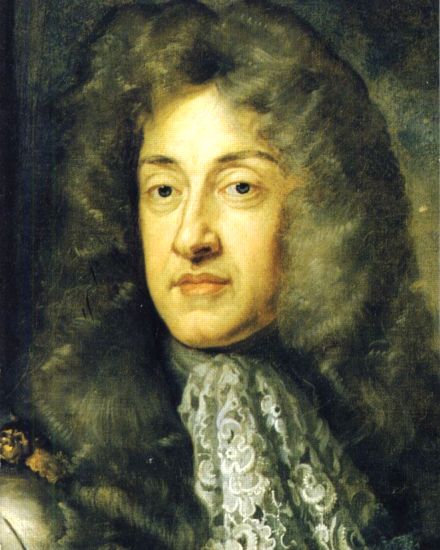
James II of England and VII of Scotland
During the reign of James II of England and VII of Scotland (r. 1633 –1701), James managed to alienate himself from his fellow Englishman through his Roman Catholic, pro-French and absolutist policies. When his wife, Queen Mary, produced a Roman Catholic heir in 1688, it was too much for English Protestants to endure. Hoping to divert a Catholic dynasty, seven English nobleman (known later as the ‘Immortal Seven’) invited James’ eldest Protestant daughter, Mary, to come to Britain and rule. She agreed on the condition that she would rule the country jointly with her Dutch husband, William the Prince of Orange.
William came over with an army prepared to fight for the throne against his father-in-law. However, knowing it would be impossible to win a war without popular support, James II retreated to France. This bloodless revolution, known as ‘the Glorious Revolution,’ established the Hanoverian line of British monarchs – a line preserved through the present House of Windsor.
In order to give legal legitimization to Hanoverian rule, Parliament passed the Bill of Rights in December 1689. This was designed to protect Parliament from arbitrary rule of another Sovereign such as the deposed James II, to ensure the continuation of the Protestant faith, and to preserve common law freedoms.
Princess Sophia of Hanover (1630-1714)
Towards the close of the reign of King William III (r. 1650 –1702), it began to look as if the king would die without a legal heir. Since the Bill of Rights had not specified the line of succession far enough into the future to cover such an eventuality, Parliament began to worry that the deposed James II or his offspring might try to capitalize on the situation and claim the throne. In order to simultaneously solve this problem and fix the line of succession ad infinitum, a law known as the Act of Settlement was introduced. It specified that the heirs to the throne would always be descendants of Princess Sophia of Hanover (1630-1714), who was also appointed heir presumptive by the same Act. Sophia was the granddaughter of James I of England.
The Act of Settlement also specified that the monarch must always be Protestant, and it states that if the monarch is ‘reconciled to the See of Rome’ or ‘marries a Papist’ ‘…in all and every such Case or Cases the People of these Realms shall be and are thereby absolved of their allegiance’.
The Act of Settlement, which was extended to Scotland in 1707, also lays down other rules of constitutional import, including male preference primogeniture. The Act of Settlement came to apply to all of the Commonwealth realms in 1931 through the Statute of Westminster. The Statute of Westminster 1931 actively forbids any alteration to the rules of succession without the agreement of all 16 nations that share the throne. That is why current attempts to ‘modernize’ the laws of succession must first be approved by all 16 legislatures, from the little island of Tuvalu with a population of 11,000 to the United Kingdom. If even one nation disagrees, the proposed changes cannot be enacted. (See Zoe Kirk-Robinson’s article ‘Why Kate’s First-born May Not Be Crowned.’)
So each of the nations in the Commonwealth who share the Queen as monarch (the ‘realms’) must ask themselves whether the Act of Settlement is still relevant in the modern world. Is there any reason to think that this relic from the early 18th century should still be preserved?
As each of the Commonwealth realms considers this question, they must take into account the fact that constitutional experts believe that changing the laws could precipitate a constitutional crisis. As soon as the monarch is allowed to marry a Roman Catholic, the possibility exists that the future heir to the throne could be raised Catholic. Indeed, Roman Catholic common law mandates that if even one of the parents is Catholic, the children must be raised catholic. If that were to happen, then there would either have to be an abdication crisis, or the law would need to be changed to allow Roman Catholics to succeed to the throne, reversing Henry VIII’s historic break with Rome. If the latter course prevailed, then it could lead to the bizarre situation of having a Roman Catholic as the supreme head of the Church of England.
In his 2003 Spectator article ‘The Price of Liberty’, Adrian Hilton presented a strong case for preserving the prohibition on the monarch marrying a Roman Catholic:
Since [Roman Catholic] canon law requires that all children of Roman Catholics be brought up in that faith, such a proposed amendment would eventually create an exclusively Catholic royal dynasty, whose primary allegiance would be to the higher spiritual and temporal authority — the Papacy….
The Papacy is, by its own admission, a political institution, and still claims universal legislative authority or jurisdiction. It would be intolerable to have, as the sovereign of a Protestant and free country, one who owes any allegiance to the head of any other state.…
It is not possible to discuss the removal of the bars on Catholics and the monarchy without at the same time discussing the constitutional position of the Church of England; and therein lies the principal division among Catholics. There are many who regard the establishment of the Church of England as a great advantage for the faith because it perpetuates Christianity as the ‘official’ religion through its presence in Parliament. For those who hold this view, a minor historical relic of anti-Catholic discrimination is a lesser evil to be tolerated than the alternative. For when the protective barrier of Anglican establishment is torn away, Christianity would lose a political voice and Britain its cultural governmental foundation as a Christian nation.
The Act therefore demands that the sovereign must ‘join in communion with the Church of England as by law established’. While earlier monarchs have come from Calvinist and Lutheran traditions and have not been prevented by their own Church discipline from receiving the Eucharist, the position of Rome is quite different. These difficulties do not emanate from the Church of England but from the Roman Catholic Church, which prohibits its adherents from receiving Holy Communion at Anglican services. To forbid an Anglican Eucharist to a Roman Catholic monarch who remains Supreme Governor of the Church of England is not only absurd but plainly regressive.
Further, since Rome does not recognise the Church of England as a Christian Church in the full and proper sense of that term, it does not recognise the Holy Orders of Anglican clergy, which Pope Leo XIII condemned as ‘absolutely null and utterly void’. The present Pope has reiterated this view. A Roman Catholic monarch who followed the teaching of the Mother Church would therefore have to regard the archbishops, bishops and clergy of the Church of England (and, incidentally, of the Church of Scotland) as lay people, lacking the ordained authority to preach and celebrate the sacraments. And further still, a Roman Catholic monarch would be unable to be crowned by the Archbishop of Canterbury. As long as the coronation service involves a priestly anointing, no ‘utterly void’ Anglican could administer it. Presumably a future Roman Catholic monarch would receive the crown from the Pope, and the wheel would have come full circle.”
More recently Telegraph journalist Charles Moore has tried to raise awareness of these and other potential problems. Writing in the Telegraph in December 2011, Moore drew attention to the chain of unintended consequences that could be set in motion by lifting the prohibition on a monarch marrying a Roman Catholic:
Suppose the heir to the throne does marry a Catholic, which, under the new rules, he/she will be permitted to do. Suppose that they have a child. Suppose the child, as the Catholic Church requires, is brought up a Catholic. Under the law, even as reformed, that child cannot become Monarch. “Are you asking me,” the doubting MP might inquire, “to vote for a reform which could precipitate a constitutional-cum-religious crisis?”
If, on the other hand, the law were changed to permit a Catholic to come to the throne, there would be a lot more questions. What would happen to the monarch’s headship of the Church of England? How would he/she be crowned? “Are you proposing, Prime Minister,” the awkward MP could ask, “to disestablish the Church? If so, please lay before us your legislation for doing so.” Untune that string, as Shakespeare famously put it, and hark what discord follows. There may be a way around these problems, but at the least Government should be inviting a rigorous public debate about these implications, instead of conducting the changes in a semi-secret environment
Implications for Hereditary Titles
Halsbury Laws of England
What about Prince Charles’ other concern, regarding hereditary titles? Here again, the Prince has identified a problem that has received almost no attention in the public discourse.
Changing the succession laws for the crown will almost certainly result in gender equality being extended to the inheritance of peerages. Although succession of hereditary peerages forms no part of any proposed change, it would be hard to preserve the older system of inheritance once male primogeniture had been abandoned with respect to the crown. This is especially true given that the heir to the throne succeeds to a number of peerages. If male primogeniture is changed, then will succession in the dukedoms, earldoms and baronetcies attached to the throne devolve to the eldest child, or will there be a two-tier system whereby the titles to which the throne is attached will still devolve to the eldest male?
Hereditary peerages are created by writ, by Act of Parliament, by charter, or by letters patent. The rules governing the order of succession of future heirs are specified in the original grant for the peerage in question. The preferred method by which peerages are created is by letters patent. With few exceptions, the patents transmit titles only to male offspring, a system known as “tail male.” As Halsbury’s Laws of England states:
“Letters patent creating a peerage must specify the patentee, the name of the dignity and its limitation to future heirs of the patentee. The limitation must be one known to the law. The rule in England is a limitation to heirs male of the body with an occasional addition of special remainders to bring in the daughters and their issue, brothers, nephews and collaterals, but ultimately the descent is always fixed in an heir male line.”
This “limitation to heirs male of the body” for the succession of peerages is even stricter than the rules regulating the succession of the crown (which allows a female to inherit when she is without brothers) and can result in peerages becoming extinct. As Regency Researcher Nancy Mayer has explained,
The descent of most hereditary English peerages is determined by the patent by which the peerage was created. Except in very rare cases, the patents say that the peerage should descend to heirs male of the body of the one for whom it was created. That means that ordinarily the peerage becomes extinct if the first earl, for instance, doesn’t have a son. Once in a while patent will let a brother or a nephew inherit if the man does not have a son. When Admiral Lord Nelson died without a son, his patent allowed his brother to inherit. On the other hand, and much more typical, was what happened to Admiral Lord Collingswood’s peerage. It became extinct on his death because he had only daughters.
In the event that a statute were to change the presumption of male descent with respect to the Crown, it would only be a matter of time before the eldest daughter of a peer will challenge original letters patent on the grounds that these too are unfair and out of step with the rules governing the thrown. Such a challenge would be hard to resist once male primogeniture has been abandoned with respect of the monarchy.
There is good reason to be cautious about equal absolute primogeniture with respect to peerages. It is true that under the current system a peerage may become extinct in the absence of male heirs or it may move to another branch of the family. While this may seem undesirable, the alternative is that this inheritance passes out of the family completely. Indeed, if current letters patent were to be altered by law to remove the distinction between the sexes, the title and its associated property could only then be traced in future through a complicated maze of ancestors, one generation passing perhaps through the mother, the next through the father. Without the tribal system and the periodic restructuring of the ancient Hebrew Jubilee laws, it would be difficult to ensure that property remained in the original family if daughters could succeed to a title.
As this suggests, a change in the order of succession does not just affect the Monarchy, but could have ripple effects in every dukedom, earldom, baronetcy in the land. Prince Charles is right to raise the concerns that he has.
Find out how to join Christian Voice and stand up for the King of kings (clicking on the link below does not commit you to join)
Please note that persons wishing to comment on this story must enter a valid email address. Comments from persons leaving fictitious email addresses will be trashed.
The Prince of Wales has raised concerns with senior Whitehall officials about the Succession to the Crown Bill, which he believes could let off a chain of “unintended consequences.”
In a private meeting last month with Richard Heaton, permanent secretary at the Cabinet Office, Prince Charles confided his fear that attempts to overturn the ancient laws governing the crown’s succession are being fast-tracked without adequate attention to the possible ramifications.
Details of the meeting were communicated to the Daily Mail last week by “a well-placed source,” who said the Prince was very worried what would happen if his future grandchild were to marry a Roman Catholic.
Currently the 1701 Act of Settlement prohibits the heir to the throne from marrying a Roman Catholic, but this is set to be scrapped in the reforms being introduced by the Coalition Government.
The anxiety voiced by the Prince of Wales echoes concerns raised by constitutional experts, who have pointed out that if the law were changed to allow a future monarch to marry a Roman Catholic, then the possibility exists that the future heir to the throne could be raised Catholic. If that were to happen, then there would either have to be an abdication crisis, or the law would need to be changed to allow Roman Catholics to succeed to the throne, reversing Henry VIII’s historic break with Rome. If the latter course prevailed, then it could lead to the bizarre situation of having a Roman Catholic as the supreme head of the Church of England.
Prince Charles was told that all such issues could be resolved through negotiations with the Vatican, a solution he reportedly found “unsatisfactory and unconvincing.”
Deputy Prime Minister Nick Clegg dismissed the legitimacy of Prince’s concerns by declaring in the Commons: “I can give him complete reassurance that these proposals will not in any way alter the status of the established Church or the status of the monarch as head as head of the church. There is absolutely nothing in these proposals to alter the status of the church.”
The Prince of Wales also raised questions about the lack of detailed consultation over the Bill, which threatens to throw the entire aristocracy into turmoil. The prince said that while he accepts the abolition of male primogeniture in principle, he is very worried what could happen if the changes spilled over into other hereditary titles currently regulated by peerage law.
Meanwhile, the legislative framework for the succession changes are being hammered out in private, under the coordination of New Zealand Secretary of the Cabinet and Clerk of the Executive Council, Rebecca Kitteridge. The details of the process are being kept secret, as is the legal advice the Government is receiving.
Deputy Prime Minister Nick Clegg is in charge of getting the changes moved through the UK Parliament and he has seen fit to do so with procedures normally reserved for anti-terror laws. The process has been so fast that the Queen was not informed of the decision to legislate until very soon before the Bill was published, while Prince Charles was not consulted at all.
But are the concerns raised by Prince Charles legitimate? We think they are, and in a future post we will explain why.
Find out how to join Christian Voice and stand up for the King of kings (clicking on the link below does not commit you to join)
Please note that persons wishing to comment on this story must enter a valid email address. Comments from persons leaving fictitious email addresses will be trashed.
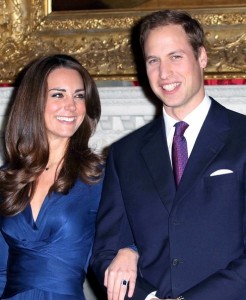
An MP is proposing legislation that would prevent Princess Kate from ever becoming Queen.
The move to bring equality to the laws of succession has taken a strange twist as an MP has proposed legislation that would prevent the Duchess of Cambridge from ever becoming Queen.
John Hemming, MP, is attempting to add a clause to the Succession to the Crown Bill that would mean HRH would be called “Princess consort” rather than Queen when Prince William ascends to the throne.
The proposed amendment is based on allegations that the current system is ‘sexist’ since it allows the wife of a King to be called Queen but it does not allow the husband of a queen to be called King. Mr Hemming said: “It’s not right that a Queen Regnant is treated as less important than a King Regnant.”
Later this month Mr Hemming will be officially tabling his proposed amendment. If the House of Commons agrees to add it to the Succession Bill, then the royal family could become the first victims of the equality measures they have tacitly supported.
A spokesman from Clarence House said, “It’s a matter for the Government”, suggesting that the royal couple is prepared to acquiesce with whatever Parliament decides.
Any changes will not affect Camilla because Prince Charles has already said she will be Princess Consort because of the complications of their past divorces.
John Hemming
Meanwhile, the media continues to promote the idea that the rules governing the laws of succession have already been changed to allow first-born daughters to inherit the crown ahead of younger brothers. (See section below for more information on what these changes involve and why we are against them.) The Royal Central website has announced that “Until 2011, men had priority over any women in the line of succession, this was changed after a commonwealth heads of government meeting in 2011, meaning whatever gender the Royal baby is, it will definitely reign as King or Queen.”
The truth is that The Succession of the Crown Billhas only had its first reading, which took place on 13 December 2012. (Watch the progress of the bill on Parliament’s website here.) Beyond that, all that has happened is that the heads of state for the various Commonwealth realms have all individually agreed to ask their respective governments to pass legislation in favour of these changes. Between now and when those laws finish passing through the parliamentary process is the time for critical debate. The British government is trying to short-circuit all debate by telling everyone that the changes have already been made and that the final legislative process is merely “a few parliamentary turns of the wheel.”
PRAY: Ever since it emerged that Government was planning to tamper with the succession changes, Christian Voice has been warning that this is a slippery slope. Even a year ago it would have been unthinkable for the Duchess of Cambridge to face the prospect of never becoming Prince William’s Queen. But once the Pandora’s box of gender equality has been opened, we have entered a fairy tale world in which almost anything could come about. Pray that the Lord will protect the monarchy from those who would seek to use the rhetoric of equality to disband the monarchy completely.
Also pray that the Duchess has conceived a boy so that all the hype the hassle about having to quickly change the succession laws would die down.
WRITE to your MP asking him/her to vote against Hemming’s proposed amendment. Ask for your concerns to be forwarded to the appropriate minister. Also write to Her Majesty the Queen and ask her to voice opposition to these proposals. Her Majesty The Queen, to Buckingham Palace, London SW1A 1AA.
The Order of Succession and the Current Debate
The “order of succession” is the procedure regulated by Parliamentary statute for determining who the new monarch will be at the time the old one dies. The current laws regulating the order of succession follow a system known as ‘male primogeniture’, which is short for “male preference cognatic primogeniture.” Halsbury’s Laws of England explain this system as follows:
“In the absence of statutory limitations, therefore, the Crown would descend lineally to the issue of the reigning monarch, males being preferred to females, and subject to the right of primogeniture amongst both males and females of equal degree, whilst children would represent their deceased ancestors ‘per stirpes in infinitum.’ Upon failure of lineal descendants, the Crown would pass under the rule to the nearest collateral relation descended from the blood royal.”
Put simply, this means that younger sons take precedence over their older sisters in line for the throne. A woman will only inherit the throne of Britain if she has no eligible male siblings. A younger brother – no matter how young – will always take precedent over older sisters in the order of succession. Given the system of male primogeniture, our present queen became monarch only because she did not have any brothers. Similarly, Queen Victoria (1819 –1901) was only able to inherit the throne because she had been the only child of Edward, Duke of Kent and Victoria Maria Louisa of Saxe-Coburg. Under the present system, if Prince William and Catherine’s first-born child happens to be a daughter, she would only become a direct heir to the throne if she is not later followed by the birth of a male brother.
An example of a younger brother inheriting the throne ahead of a younger sister occurred when Queen Victoria’s son Edward VII inherited the throne in 1901 over his older sister Princess Victoria. Had Princess Victoria become the next queen, she would have been Queen Victoria II while her son, Kaiser Wilhelm II, would likely have been king over a huge British-German Empire.
Those who oppose the present system have pointed to the changes introduced in the succession laws of other European monarchies which have transitioned over to the system of absolute primogeniture. For example, Sweden changed over to absolute primogeniture in 1980, the Netherlands in 1983, Norway in 1990, Belgium in 1991, Denmark in 2009 and Luxembourg in 2011.
While the previous Labour Government supported a change from male primogeniture to absolute primogeniture, this had not been considered an issue of any urgency. This is because a change in the law would affect neither Prince Charles (the current heir to the throne), nor Prince William (the second in line for the throne) since neither of them have older sisters. It was not until the lead-up to the wedding of Prince William and Kate Middleton that the issue was again thrust into the national limelight. Policy makers began to speculate what would happen if the royal couple’s first-born child happened to be a female. Wouldn’t it be unfair if such a child was not able to enjoy an equal right to the throne? Shouldn’t Britain change its laws to reflect “modern” values such as “equality” and “fairness”?
The debate culminated at the Commonwealth of Nations summit in Australia on 28 October 2011 when David Cameron sought agreement from the heads of the Commonwealth realms to change the rules. He had prepared the ground by writing a letter earlier in the month to all the countries urging them to support a change and suggesting that present rules “enshrine male superiority.”
The reason it was necessary for the UK Government to consult with the sixteen Commonwealth realms is because the law prevents the British Parliament from making unilateral changes to the rules of succession without first getting approval of the other nations that share the crown.
Despite the fact that the individual governments have not yet had a chance to vote on the proposed changes, both the media and the British Government have been talking about the matter as if the changes have already been introduced. For example, on 29 October 2011, the Daily Mailran an article with the dramatic title: ‘If Wills and Kate have a girl first, she’ll be queen! Commonwealth agrees historic change to give sex equality in Royal succession.’
It has been a shrewd tactical move on the part of the media and the British Government to keep telling everyone that the succession laws have already been changed. Now that it is approaching the time for a vote, the Government is telling members of Parliament that they must merely ratify what has already been agreed. What should in fact be an occasion of robust debate will be presented as a mere formality. This is a point that Telegraph journalist Charles Moore picked up upon in an article in December 2011, when he drew attention to the ‘widespread delusion’ that the laws had already been changed and predicted the events that are nor transpiring.
“There is a widespread delusion, I find, that the succession to the throne has been changed. If William and Kate have a first-born daughter, people think, that girl will be Queen.… It’s all been sorted out, apparently. There will be what is called – without any apparent sense of absurdity – a Royal Equality Act, and then Bob’s your uncle (though your poor uncle Bob, if currently in line to the throne, will now have to give place to your first-born aunt).
It is not surprising that people think this, because that is what they have been told to think.
It is being put together semi-secretly, and our Government will not disclose the legal advice it is receiving. It is also, in spirit, imperialist: the British Government decides, and then tries to push all the ‘lesser’ countries into agreeing.
When the reforms do eventually reach the 16 parliaments, the government line will be that this has all been agreed and so legislators should just nod it through. The Queen may be embarrassed, but since, constitutionally, she can act only on the advice of her ministers, she will be powerless. At this point, any self-respecting Member of Parliament would be entitled to say: ‘Wait a minute! You are trying to change the rules by which our head of state is chosen and controlled. Is this good for her and her heirs? Is it good for our country? I am going to ask some difficult questions.’”
So why are we against changing the laws of succession? There are a number of reasons, but the main reason is that we find all the arguments for changing the law woefully lacking. Though the rhetoric against male primogeniture takes a variety of forms, it usually always reduces to one of four arguments. Although each of these four arguments has a prima facie appeal, as we unpack each one it will become apparent that they are based either on factual misunderstanding or faulty reasoning. Even more crucially, three out of these four arguments threaten to undermine the very existence of the monarchy itself.
Faulty Argument # 1: The current succession laws are out of keeping with modern society
Advocates of absolute primogeniture typically avoid appealing to any objective ethical criteria but instead argue on the grounds that the current system is “old fashioned” or “out of keeping with modern society.” For example, deputy Prime Minister Nick Clegg has commented:
“Prince William and Catherine Middleton might have a baby daughter for instance as their first child, I think most people in this day and age would think it’s worth considering whether we change the rules so that that baby girl then could become the future monarch.
“I think that would be in keeping with the changes that happen in society as a whole. My own personal view is that in this day and age the idea that only a man should ascend to the throne I think would strike most people as a little old-fashioned. I think it is worth thinking about, I think it is worth talking about. It is worth looking at what other countries that would be affected also feel on the subject.”
Notice that Clegg’s personal view is based, not on reasoned argument, but on an appeal to being up to date and modern. He appeals twice to “this day and age” and suggests that the current system may be “a little old-fashioned.” Mr Clegg is not alone. Keith Vaz, MP, echoed the opinion of many when he referred to the laws as “out-dated”and stated in Parliament that
“Whereas [male-preference primogeniture] might have been acceptable in another age, I believe that at this time in our history Britain is a modern…society and that this ought to be reflected in our succession rules…. We have a 21st century monarch and we need 21st century succession rules to match.”
Finally, when David Cameron announced the changes at the Commonwealth of Nations conference, he also appealed to the need to be modern as if this alone furnished the only justification required for changing the laws:
“Attitudes have changed fundamentally over the centuries and some outdated rules, like some of the rules on succession, just don’t make sense to us anymore.”
“The idea that a younger son should become monarch instead of an elder daughter simply because he is a man… – this way of thinking is at odds with the modern countries that we have become.”
In reality, it is completely false that male primogeniture is out of keeping with the twenty-first century, since the royal houses in Spain, Monaco, Thailand, Portugal and Swaziland all follow the same system of male primogeniture as Britain. But even if this were not the case, the appeal to modernity is plagued with a host of problems. Chief among these problems is that it presupposes a chronological criterion of truth by which ideas and policies are being evaluated, not by the standard of right or wrong, truth or falsehood, but according to whether they are antiquated or modern. Such an approach can often be effective in creating prejudice against an idea through false assumptions, thus siphoning the debate away from more objective criteria. Herbert Schlossberg described the psychology that occurs in this process of creating prejudice through hidden assumptions:
“No serious thought can be constructed without assumptions, but recognizing them – in our own thinking as well as in others is vital if we are to avoid falling into serious error. Assumptions are beliefs; if they were proven they would not be assumptions. And they are beliefs so taken for granted that it is not deemed necessary to prove them. That makes them doubly seductive: first, because the careless or untrained are misled into accepting conclusions without recognizing their shaky foundation of unstated beliefs; and second, the very fact that the most dubious beliefs are so taken for granted by experts lends an aura of verisimilitude that beguiles the overly respectful into accepting them without question.” Herbert Schlossberg, Idols for Destruction: The Conflict of Christian Faith and American Culture (Crossway, 1993), 8.
The chronological criterion of truth is just such a hidden assumption. C.S. Lewis called this type of reasoning “chronological snobbery” and described it as “the uncritical acceptance of the intellectual climate common to our own age and the assumption that whatever has gone out of date is on that account discredited.” Lewis went on to point out that
You must find why it went out of date. Was it ever refuted (and if so by whom, where, and how
conclusively) or did it merely die away as fashions do? If the latter, this tells us nothing about its truth or falsehood. From seeing this, one passes to the realization that our own age is also “a period,” and certainly has, like all periods, its own characteristic illusions. They are likeliest to lurk in those widespread assumptions which are so ingrained in the age that no one dares to attack or feels it necessary to defend them. [C.S. Lewis, Surprised by Joy: The Shape of My Early Life (Houghton Mifflin Harcourt, 1995), 201.]
C.S. Lewis
If Lewis’s words are applied to the question of our succession laws, it follows that it is insufficient for our leaders to merely assert that some of the rules on succession are old fashion and just don’t make sense in our modern world. We must find out why these rules no longer make sense, and whether the reason for them no longer making sense is rational or not.
More seriously, the hidden set of assumptions which animate Faulty Argument #1 could threaten the very existence of the monarchy itself. Those who have sought to spread the poison of republicanism throughout the Commonwealth have often done so with similar appeals to “this day and age”, suggesting that the monarchy itself is out of date and a relic from the past. If the chronological criterion of truth is allowed to flourish when it comes to changing the order of succession, it may be only a matter of time before the same principle begins buttressing those who wish to challenge the very institution of the monarchy.
Few people have bothered to ask why the appeal to “modernity” settles the issue and removes the need for critical reflection. One of the only people, outside those of us at Christian Voice, who has been asking these difficult questions is journalist Charles Moore. In an article for the Telegraph on 7 December, Moore wrote:
When I spoke to ministers this week to ask why it was good to change the succession to the British throne, I was told that it was “modern”, as if that settled the argument.
Most people will probably be too polite to contest the Government’s proposal that the firstborn child of the monarch, or of his/her heirs, will henceforth succeed to the throne regardless of sex. But what is “modern” about a system which prefers the firstborn over any other child? Why is that not being changed? When I asked this question, no one could give me an answer. What is “modern”, indeed, about the idea that the British head of state should be appointed because of blood at all? In what sense is the principle of monarchy modern? Did the Queen get where she is today, the most popular and respected person in the country, by being modern?
Similarly, it is “modern”, say ministers, that the proposed Bill will abolish the rule that no one in line to the throne may marry a Roman Catholic. Yet it would not be modern, apparently, to get rid of the law which says that the Sovereign must be in communion with the Church of England. That law will stay. According to “modern” logic, why?
When they made their bids for leadership, Tony Blair and David Cameron put a great deal of weight on the m-word. It separated them in people’s minds from the long-standing defects of their own parties, and gave them a non-ideological excuse for cleaning the slate….
Faulty Argument # 2: Most people want the succession laws to be changed
In addition to suggesting that male primogeniture is “old-fashioned,” Mr Clegg has also appealed to what “most people” supposedly want. This was implicit in his comment that the current system may strike “most people as a little old-fashioned.” Others have argued against male primogeniture on similar grounds, as if the legitimacy of the practice is automatically thrown into question as soon as a majority are against it. For example, when Mr Vaz was arguing for a change of law in Parliament, he commented, “The reality is that the public want more women to take high office”and pointed out that the majority of citizens allegedly support absolute primogeniture.
Creating policy by majority opinion is a dangerous way to conduct the business of Government. If this impulse were followed to its logical extension, the UK would ultimately collapse into the type of direct democracy attempted by the ancient Athenians.
Once majority opinion is taken to be even implicitly authoritative, then does the legitimacy of the monarchy itself become dependent on 51% of the vote? This was the view reflected by journalist Peregrine Worsthorne when he said, “If a majority of the nation wanted to put an end to monarchy, then, of course, it ought to go.”
Reports indicate that in some Commonwealth countries a majority of the population may already be sceptical of the monarchy. If this is the case, then giving in to the populist impulse with regard to primogeniture may set off a chain reaction that could have unintended consequences. As Daniel Martin has observed, “there are fears that the change [in succession laws] could fuel the republican movement in Australia, where campaigners could use the opportunity to amend legislation to oust the Queen.”In Jamaica the situation is even more unpredictable. Even Britain itself has a virulent anti-monarchy lobby that will use any opportunity – including a public discussion of the succession laws – to challenge the legitimacy of the crown.
Faulty Argument #3: The Current Succession laws are ‘sexist’ and discriminate against women.
Perhaps the most common argument for changing the succession laws is that of equality. Stated crudely, it just isn’t fair that males should take precedent over females in the succession to the throne. In a society committed to equal rights, isn’t it hypocritical for the law to give males a greater chance of inheriting the throne than females? Surely it would be more fair for both sexes to have an equal chance at the crown. Keith Vaz MP gave voice to these sentiments in January 2011:
“At the centre of this debate is a great principle: gender equality…. Our country leads the way in equality issues, and that should be reflected in our succession rules…. Sex discrimination has been illegal in the United Kingdom since 1975. Some 35 years after the passage of the Sex Discrimination Act 1975, Britain’s employers must ensure equality between the sexes. Those who break the law are rightly punished. The Bill attempts to bring such gender equality into our succession rules.”
Mr. Vaz words were echoed in David Cameron’s letter to the Commonwealth countries, in which he wrote that “We espouse gender equality in all other aspects of life and it is an anomaly that in the rules relating to the highest public office we continue to enshrine male superiority.”
It is hard not to have some sympathy for this line of reasoning, which is certainly more compelling than Faulty Arguments #1 and #2. Analysts have identified the sense of fairness as being one of the core ethical values embedded within the human intuition. Women especially may feel that the current succession rules are a case of institutionalized discrimination against their sex.
Before exploring the problems with the equality argument, we should note that those who make this objection often over-exaggerate the extent to which the current system excludes women from the throne. Telegraph writer Gerald Warner rightly pointed out in 2009 that
…the present succession rules do not originate in the Act of Settlement, but in our ancient history and tradition. Nor do they effectively discriminate against women. In the period since the Act was passed, we have been ruled by men for 174 years and by women for 134 years.
But while male-preference primogeniture does not prevent a woman from ruling, it always ensures that it will be statistically more probable that a man will inherit the throne. So the question arises: is this a form of institutionalized inequality and gender discrimination? The short answer is yes. However, if we consider the nature of equality we soon find that it is far from obvious that gender discrimination is always a bad thing.
In his book The Retreat of Reason: Political Correctness and the Corruption of Public Debate in Modern Britain, Anthony Browne showed that gender discrimination is not only accepted in many instances, but many times is necessary, laudable and defensible. Browne wrote:
“Young men pay higher rates for car insurance than young women and older men, because young men are, on average, more dangerous drivers than young women and older men. A young man who is a safe driver is thus discriminated against because of the characteristics of other people in his age and sex group….Anti-discrimination campaigners may publicly declare that all discrimination on the grounds of sex should be outlawed, but they are unlikely to agree that all men should have the right to use women’s toilets, that men should be allowed to go to women’s gyms, or to demand overturning the right of women’s clothes shops to refuse to employ men….Men pay smaller pension contributions than women for a given level of private pension, for the simple reason that, on average, they have shorter lives and so on average claim less….The various forms of rational discrimination that are widely accepted are not often called discrimination – although that is clearly what they are – because accepting that some discrimination is actually essential to the working of a society would undermine the public acceptance of a ‘zero tolerance of all forms of discrimination’. The war on discrimination would become meaningless if there were general public awareness that actually some forms of discrimination are needed.”
Given that many forms of gender discrimination are publically practiced and acceptable in modern Britain, we are in a position to identify the basic flaw in the equality argument against male-preference primogeniture. This will be easier to do if we reduce the argument to a simple syllogism:
All gender discrimination is wrong.
Male primogeniture is a case of gender discrimination.
Therefore, male primogeniture is wrong.
The argument follows a classic form and is structurally valid. That is, the conclusion necessarily follows from the first two premises. However, in order for an argument to be sound, it must not only be logically valid, but the premises must also be factually accurate. In the case of the above syllogism, premise 1 is actually false. While some forms of gender discrimination are wrong, Mr Browne is correct when he notes that many forms of gender discrimination are also necessary and justifiable. In fact, our public policy assumes that there are many legitimate forms of discrimination. Thus, David Cameron’s statement that “We espouse gender equality in all other aspects of life” is simply not true.
Gender discrimination simply means treating a person differently than you would if that person were a different sex. For example, when a man dates a woman he is, in a sense, ‘discriminating’ since he would not offer the same treatment to members of his own gender category, assuming he is a heterosexual. In short, there are many cases where men and women are unequal, and these are diversities to be celebrated rather than inequalities to be lamented. (For more about the differences between men and women see Salvo Magazine’s articles ‘Unmaking a Difference‘ and ‘Gender Benders‘.) The real question, therefore, is not whether something is a case of sex discrimination, but whether it is a case of justifiable sex discrimination.
It follows that what we need to be asking is more specific than simply, “Is discrimination wrong?” We need to be asking specifically whether or not sex discrimination with respect to male primogeniture is rationally justified or not. We cannot know that male primogeniture is wrong merely from the fact that it discriminates against women.
We would argue further that the burden rests on those who wish to overturn centuries of precedent to first establish that male primogeniture is a case of unjustifiable discrimination. However, instead of making this case, opponents of male primogeniture tend to simply assume that the discrimination in the succession laws is equivalent to illegal and unjust discrimination. For example, Keith Vaz MP told Parliament: “Sex discrimination has been illegal in the U.K. since 1975 and those who break the law are rightly punished. This rule attempts to bring gender equality into our succession rules.” This is manifestly untrue: only certain types of sex discrimination, namely those deemed to be wrong, have been illegal. In order to show that the discrimination inherent in the succession laws must join the category of illegal discrimination, it is necessary to first establish that such discrimination is wrong. But that is something that none of the critics of male primogeniture have yet been able to do.
Few realize that if the false principles on which the anti-discrimination argument is based were extended to their logical conclusion, it would throw into question the very legitimacy of the monarchy itself. If, under the mantra of ‘equal rights’, we altered the succession rules so as not to discriminate against firstborn females, then it would be hard to know how to answer those who said that such a system is unjust for discriminating against second-born children, or even children from another family. An hereditary monarchy occupied by only one person is inherently antithetical to the idea of ‘equal rights.’ This is one of the reasons that Telegraph commentator Charles Moore was correct to point out that “If you cast doubt on the succession, you cast doubt on the whole thing.”
The power of this logic has not been lost on the virulent anti-monarchy lobby that is at work to destroy the crown. In researching for this paper I wrote to the anti-monarchy group Republic and asked if they saw the debate about succession as an opportunity to make the case for abandoning the monarchy completely. A representative from the group wrote back and said, revealingly, that
“once we concede the principle that the throne should be open to women, the debate will raise a lot more questions: why not a second born daughter? Why not someone else’s daughter? So, we are looking forward to this debate to enable us to highlight the unfairness of the hereditary principle in and of itself.”
These words were echoed by Graham Smith, campaign manager for Republic, when asked about the proposed changes in October 2011. “In practice,” he said, “it simply means that the eldest child of one family is preferred over all others. Inequality is therefore further entrenched in the system.”
Often Faulty Argument #3 is combined with Faulty Argument #1, when it is urged that Britain’s present system is a sexist hangover from its archaic past in which unjust discrimination against women was allegedly institutionalized. For example, Julia Gillard, prime minister of Australia, combined Faulty Argument #1 with Faulty Argument #3 when she noted, “To our modern minds these seem like simple and very rational changes, that there would no longer be a discrimination against women in the way in which the line of succession works…” The problem with combining Faulty Argument #1 and 3 together is the same problem that exists if you put one leaky bucket inside another leaky bucket: you still have a bucket that doesn’t hold any water.
Faulty Argument #4: Britain has had very good Queens in the past and will therefore benefit from a change in the succession laws.
While it is true that Britain has had some very good Queens in the past, this does not in itself prove that the succession laws should be changed to allow for more female monarchs. If it did, then we might equally argue that the succession laws should be changed to allow for even more kings since Britain has had some excellent male monarchs in the past. But that is absurd. It is also worth noting that one of the worst times in British history occurred under the reign of a Queen, namely Mary Tudor, or Bloody Mary (1496–1533).
Find out how to join Christian Voice and stand up for the King of kings (clicking on the link below does not commit you to join)
Please note that persons wishing to comment on this story must enter a valid email address. Comments from persons leaving fictitious email addresses will be trashed.
Reg Travis was cleared of rape and is now campaigning for equality before the law for rape defendants with accusers.
The not guilty verdict in the rape case brought against the late singer Amy Winehouse’s ex-boyfriend illustrates the potential for false accusations in rape cases.
It isn’t the first time that CCTV has come to the aid of a man facing a false rape charge,
In a case which did not make it to court, a female complainant alleged that, while on a night out with friends in a local nightclub, she was grabbed by an unknown male, dragged into nearby toilets and raped.
CID went to the nightclub and checked the CCTV. The police said afterwards: ‘CCTV shows her and this man climb over this rope together, go upstairs, and disappear off into one of the toilets. About twenty minutes later, they come out. You can see her straightening her clothing—I think she gives him a peck on the cheek—and then they exchange telephone numbers before going away.’
What makes matters worse is that accusers of rape are protected with anonymity by the law, but defendants are not.
Reg Traviss is now making the very fair point that the criminal justice system, by siding with his accuser in granting her but not him anonymity, has forgotten the basic biblical principle, that all are equal before the law.
It does not seem fair but it would be an even bigger travesty of justice if those accused of rape were allowed to remain anonymous because it would suggest that rape victims were generally not to be trusted.
While there will always be women who “cry” rape, most of those who do pluck up the courage to go to the police are genuine victims and should be treated as such.
Such is the social stigma around rape that women not only feel too embarrassed or ashamed to report the crime, they are also frightened that they will not be believed.
That situation would get worse if those accused of rape were afforded the special privilege of remaining anonymous.
… the police … do women no favours whatsoever by attracting publicity for the very rare cases when rape victims are making it up.
Is Camilla Tominey right? Are these ‘very rare cases’? Are most complainants ‘genuine victims’? Not according to the figures. Only about 10% of rape complaints make it to court, and of those, just over half, 58%, result in a conviction. Since the law was changed in 1994 to allow cases to be brought with no corroborating evidence, rape cases are often now ‘his word against hers’. The more plausible of the two is likely to be believed, wherever the truth lies, resulting in miscarriage of justice.
Daniel Abeyomi, 19, told the court that he noticed the woman arguing with a man then crying alone, while he was walking home along Heavitree Road. He said she walked with him, they chatted and she kissed him, asked to go back to his home, which he refused, then she initiated sex.
Defence counsel Ian Strongman, summing up his case, said the woman was not making “malicious allegations” but she had “gaps in her memory” from that night, and her friends had then wrongly assumed that she had been raped and had “persuaded her” that this was the case.
In some cases, evidence, often from CCTV, shows the alleged victim was making it all up.
Hilliard, 20, dragged Grant into a Basildon railway station toilet for sex, but later told police that he had forced himself on her. Just a week after the alleged attack, she applied for criminal injuries compensation, which could have netted her £7,500.
Her plan came unstuck when CCTV footage and mobile phone records proved Grant’s innocence. But her twisted story drove Grant to the brink of suicide after he was hounded out of his home and spat at in the street.
What his sister called ‘six months of hell’ started when a woman alleged that he had raped her in a park in 2011.
The court heard that the woman, who said she had drunk more than eight pints of lager and drank spirits during the evening, gave different accounts to police of what had happened. She also texted a friend to tell her she was pregnant, before telling her she had been raped.
CCTV images showed the pair leaving a pub in Holton Road together.
‘False complaints may arise for a variety of reasons. Examples commonly mentioned by respondents during research interviews included: a complainant’s attempts to conceal or deny discovered infidelity; minors concealing consensual under-age sexual activity; consensual sexual activity that is subsequently regretted; and historic complaints following the breakdown of a relationship.’
Rape is a serious crime; a capital crime in the eyes of God. It is a devastating thing to happen, and equally devastating to be accused of wrongly. In far too many cases, too much drink impairs the capacity to make a rational decision, and regrets in the morning turn to a rape accusation.
On other occasions, false accusations can be made to deny a father access to his children in divorce cases, or just to be spiteful after a marriage has come to an end, or perhaps when the husband remarries.
To contradict Camilla Tominey, a ‘special privilege’ – that of remaining anonymous – is already given to rape accusers. In fact, on her own Sunday Express page, she contradicts herself. Having said that women ‘very rarely’ make rape accusations up, she describes 80% of women as liars in a footnote:
‘More than half of British women admit to flirting with men to get their own way, with a fifth saying they do so at work. Just 20%? What a load of fibbers! It might not be what feminists want to hear but a woman who does not use her wiles to get what she wants does not have a pulse.’
That is not to say those acquitted of rape have always behaved impeccably. Our society has slid into a swamp of sexual license where promiscuity abounds and sexual intercourse has become, less the holy expression of love in marriage, more a recreational activity. If we respected biblical morality, young women would be chaste and modest and young men chivalrous and protective. But those whose cases are cited above were innocent of the crime they were accused of.
And just as there are rapists walking free who would be behind bars if it were not for their eloquence in a court-room, there are innocent men in prison just because an untruthful woman was more plausible on the day.
That cannot be right.
Amos 5:24 But let judgment run down as waters, and righteousness as a mighty stream.
Find out how to join Christian Voice and stand up for the King of kings (clicking on the link below does not commit you to join). Anyone joining before 1st January gets a free one-year Bible Reading Plan. If you want a Bible Reading Plan but do not want to join, click HERE.
Please note that while we welcome comments, persons wishing to comment on this story must enter a valid email address. Comments from persons leaving fictitious email addresses will be trashed.
Douglas Wilson has some good things to say here about some of the issues upstream of the modesty debate, which echoes some of the concerns we raised in the July 2011 Christian Voice newsletter when we covered the ‘slutwalks.’
Wilson also helpfully reminds us that when a woman reveals too much flesh, it is often not because she has too much sexual security but too less. Wilson writes,
One of the most striking things about these flesh parades is how unattractive it all is. As in, gekkk. … There are clearly numerous young ladies who have no one in their lives willing to speak to them truthfully. And when women don’t have someone who loves them like they ought to, they become susceptible to any number of fads, so long as someone — most likely a peer with the same emotional problems — is willing to tell them it is “cute.” Well, it isn’t. Sorry to break it to you. There also appears to be an inverse relationship between the class of the person and how many square feet are covered by the tattoo.
The problem here, at least within the church, is that hints don’t get you anywhere, no effect at all, and if you state the problem plainly, it flattens the poor girl for months, like somebody took a pastoral mallet to her. By “hints,” I mean general references in sermons to modesty and decorum, and by “stating plainly” I mean suggesting that she come to church next week with the mammalian pride dialed back just a skosh. The problem is not that she is secure in her sexuality — it is just the reverse. You can tell this because women who want to be “secure” in their sexuality in this way at the same time do not want men around them who are secure in their sexuality in a comparable way.
When Wilson suggests that the problem with women who parade their flesh is not that they are too secure in their sexuality but that they are too insecure in it, I thought of the recent controversy over Lara Pulver’s nude scene in the pre-watershed BBC1 Sherlock Holmes.
Actress Lara Pulver commented that it was "really empowering" to go completely naked in the new Sherlock Holmes series
Significantly, after appearing completely nude in front of Benedict Cumberbatch (Sherlock) and Martin Freeman (Dr Watson) for eight hours during the shooting (to say nothing of the more than 10 million viewers who were able to see sustained footage of Pulver in her birthday suit), Mrs. Pulver commented that “something really empowering takes over.”
This echoes many of the comments made by those women who participated in the slutwalks, who said that they felt “empowered” when they paraded down the streets of London in various stages of nudity.
If Douglas Wilson is right, a woman who is secure in herself and in her sexuality does not need to take off all her clothes to feel empowered. Indeed, when women think it is empowering to undress in front of men, that is often evidence that our society in general, and fathers in particular, are not giving them the respect and dignity they deserve. Lacking an inherent sense of their own worth, they feel compelled to prove themselves by parading their flesh. Sadly, this often gives women a false empowering that acts as a substitute to genuine female dignity.
(To read more about nudity in films and the implications this has for how we view the body, see the article recently published by the Chuck Colson Center titled ‘Nudity and the Christian worldview.’)
Join Christian Voice by clicking the Join button or send a donation via the Donate button below:
News that David Cameron is supporting changes to the laws regulating the crown’s succession was met with a firestorm of protest by lobby group, Christian Voice.
The activist organization claimed that the current laws, which give preference to firstborn males, are rooted in the Bible and cannot be changed without seriously compromising the integrity of the monarchy.
In a public announcement on 18 October, Christian Voice pledged to take all possible action to block the proposed changes, which seek to amend the 1701 Act of Settlement.
The group also said that they were putting together a Parliamentary Briefing Paper outlining the legal and scriptural reasons for maintaining the current rules.
The present laws of succession, rooted in traditions going back at least to the time of the Norman invasion, were condemned by David Cameron last week as ‘an anomaly’ that allegedly helps to ‘enshrine male superiority.’
Although the previous Labour government supported a change to the rules, it was not until the lead-up to the wedding of Prince William and Kate Middleton that the issue was again thrust into the national limelight. Policy makers began to point out that if the royal couple’s first-born child happens to be female, it would be unfair to deprive her of the throne. Leicester East MP Keith Vaz even went so far as to argue that the present rules constitute a case of ‘sex discrimination.’
Robin Phillips, press secretary for Christian Voice, commented today, “Fairness isn’t the pertinent issue here. An hereditary monarchy is already about as unfair as you can get. If we were to alter the succession rules in order to not ‘discriminate’ against firstborn females, then it would be hard to answer those who are using similar arguments to suggest that the monarchy should be completely abandoned. A representative of the anti-monarchy group Republic recently wrote me saying, ‘once we concede the principle that the throne should be open to women, the debate will raise a lot more questions: why not a second born daughter? Why not someone else’s daughter? So, we are looking forward to this debate to enable us to highlight the unfairness of the hereditary principle in and of itself.’ If we begin pandering to the idol of equality and political correctness, we may find that we have inadvertently unlocked a Pandora’s box that can only culminate in ceding ground to those republicans who wish to dissolve the monarchy completely.”
Phillips pointed out that “Critics of male-preference primogeniture often speak about it as a simple matter of getting the Commonwealth countries to agree to amend the Act of Settlement. What they normally fail to take into account is that the Act of Settlement was only legal in the first place because it was rooted in centuries of English common law. Tampering with the common law in order to meet the demands of political correctness is something that William Blackstone warned against back in the 1760s when he wrote his Commentaries on the Laws of England.”
When asked about the Queen having ‘let it be known’ that she supports such a change, Mr Phillips replied, “Her Majesty the Queen is certainly free to support the present proposals if she so desires. However, we must not forget that her fundamental obligation remains to be ‘ever mindful of the Law and the Gospel of God as the Rule for the whole life and government of Christian Princes.’ Her primary responsibility as our sovereign is to conform the monarchy to the standards of God’s laws. We will be arguing in our briefing paper that scripture supports male preference primogeniture and we trust that Her Majesty the Queen will take our arguments seriously.”
The Prime Minister will raise the issue for discussion at the Commonwealth Heads of Government meeting later this month. If his proposals are eventually implemented, then a first-born daughter of the Duke and Duchess of Cambridge could become Queen.
The death of Cpl Sarah Bryant in Afghanistan has again thrown the Armed Forces’ policy of allowing women to serve in action into stark relief.
Stephen Green, National Director of Christian Voice, said tonight:
‘It has been rightly said that any country which asks its women to fight for it is not worth fighting for. It was bad enough that hundreds of young British men have been sacrificed to be killed or maimed in Iraq and Afghanistan , but now a young wife has had her life taken.
‘If we have some strategic interest in Afghanistan , let the politicians tell us what it is. If it is an oil pipeline, let’s hear it. And if bringing ‘Democracy’ to far-away places with strange-sounding names is in our strategic interest, why don’t they explain how, exactly?
‘If it is just ‘Democracy’ for its own sake, why aren’t we extending our generosity to Zimbabwe, a Commonwealth country where we actually have friends and relations? In fact, why don’t we deploy all the troops at present being viewed as an occupying army in Iraq and Afghanistan into Zimbabwe, where they would be rightly seen as liberators?’
The law on royal succession which puts any son ahead of his elder sister are under attack again. Jeffrey, Lord Archer was the last parliamentarian to introduce a bill to change the rules before he was sent to prison.
Now Vera Baird, the Solicitor General has weighed in with an extraordinarily patronising statement that ‘what we have to do with the Royal Family is integrate them as far as possible into the human race.’ The ban on the monarch marrying a Roman Catholic is also ‘discriminatory’. A Single Equality Bill expected later this year may include measures to change both practises.
Libdem equality ‘spokesperson’, Lynne Featherstone MP, said a reform on the succession rules would receive cross-party support. ‘We can’t allow a blatantly sexist law on royal succession to continue,’ she said, ‘Let’s confine this outdated message that men are better than women to the dustbin of history.’
Even the Queen is said to be supportive of the change, which would only affect the children of Prince William, in the event he were to succeed and sire a legitimate daughter before a son. In fact, by the time Her Majesty’s great grand-child is due to succeed to what is left of the throne, Britain could be a very different place, so on one level to change the rules does not matter.
However, it will not have escaped the notice of those agitating for this change that the order of succession derives from the Christian faith. The Crown is treated in our law as property to be inherited which means the principles established in the case of Zelophehad’s Daughters apply. Numbers 27:8 established that inheritance should pass to the daughters if a man died and had no son. And whether the feminocracy like it or not, God made the man to rule over the woman. As it happens, they don’t like it, so this move to change the law is one more instance of overturning God’s created order and chipping away at our Christian Constitution.
The bulk of the human race to which the Royal Family is being invited to join is actually quite happy to see the man as head of the household. Businesses pass to sons along with aristocratic titles. and a woman marrying will take her husband’s name, as Lynne Featherstone (née Ryness) and Vera Baird (née Thomas) will no doubt testify.
Join Christian Voice
Christian Voice is a prophetic ministry in the ‘forthtelling’ sense for those Christians who are fed up with the way things are, have had enough of secularist politicians imposing wickedness on the rest of us and who are not satisfied with trying to get ‘Christian influence in a secular world’ because they know ‘The earth is the Lord’s and the fullness thereof; the world and they that dwell therein’ (Psalm 24:1). If you want instead to lift high the Crown Rights of the King of kings, you have found the right place!
Membership Application
Yes, I/we wish to join Christian Voice. (Husband and wife may join as one)
I/we unreservedly support the aims of Christian Voice and agree with the Statement of Faith.
Please send me my free copy of Britain in Sin, which lifts the lid on the unrighteous legislation of the past fifity years and its devastating social consequences, my free copy of Understanding Islam, which will tell me all I need to know about Islam, my free copy of Labelling Halal, which exposes the secret sale of Islamic meat, and the latest Christian Voice newsletter, full of confidential prayer targets, which never goes up on the web.
I/we agree to computer storage of all information provided, solely for the use of Christian Voice.
Aims of Christian Voice
To uphold Christianity as the Faith of the United Kingdom.
To be a voice for Biblical values in law and public policy.
To defend and support traditional family life.
At all times to rely humbly on the blessing of Almighty God.
Statement of Faith
We believe in one creator God, eternally existent in three persons, Father, Son and Holy Spirit, as stated in the historic creeds of the Christian church.
We acknowledge Jesus Christ as Lord over all creation.
We believe the Holy Bible to be the inspired, infallible, written Word of God to whose precepts, given for the good of nations and individuals, all man’s laws must submit.
We believe all government to be under the authority of God and that its purpose is the maintenance of freedom and justice solely in accordance with Biblical principles.
Cost of annual membership is £20.00
If you agree with the Aims & Statement of Faith then click the button below.
If you wish to renew your membership please click the button below. We will match your details to our records.
The Royal Navy’s decision to put a young mother at risk was condemned as ‘irresponsible’ tonight by a Christian prayer group a day after the woman in question, Faye Turney, was paraded on Iranian television and had an interview which was recorded hours before her capture published in a daily newspaper.
Mrs Turney, a Leading Seaman, was captured by Iranian forces last Friday along with 14 sailors from HMS Cornwall after boarding a vessel in the Shatt Al-Arab waterway.
Last night she was pictured clad in a Muslim head-dress and smoking a cigarette before speaking on camera. Despite UK Government insistence that the sailors had been on the Iraqi side, Mrs Turney was shown confessing to being in Iranian waters, raising concerns that some kind of pressure had been applied to her. She was the only one of the sailors who was broadcast and the only woman amongst those seized.
Stephen Green, National Director of Christian Voice, said tonight:
‘It seems beyond doubt that psychological pressure has been brought to bear against Mrs Turney, possibly by playing on her natural motherly desire to return to her three-year-old daughter. The Iranians must have read the article in Wednesday’s Independent and even if they had not already discovered Mrs Turney’s maternal status in questioning, they would not be slow in using that to their purpose.’
In the article, Mrs Turney, 26, admits she is missing seeing her little girl grow up. Journalist Terri Judd said, ‘When I encountered her on the deck on HMS Cornwall, the first subject she talked about was Molly – a theme she returned to often during our numerous conversations.’
Mrs Turney spoke of the excitement of piloting the Navy’s inflatable speedboats and of the possible dangers of the mission. ‘But it was Molly, her three-year-old daughter, that she spoke of most,’ wrote Terri Judd. ‘She described the guilt of leaving behind her “bubbly, head-strong” little girl to be looked after by her husband Adam, also serving in the Navy but based in Plymouth . But she believed emphatically that this sacrifice would give her daughter every opportunity in life.’
Stephen Green continued:
‘Mrs Turney’s husband is a Petty Officer, the naval equivalent of a sergeant. It is certain that he has work to do in Plymouth , so the reality is that Molly is in some kind of day-care. Although I realise that the Government has ensured through the crippling burden of taxation that all but the best-off families now need two incomes to survive, even the wages of a leading seaman cannot possibly compensate for the lack of a mother’s day-to-day love, care and sheer presence in a child’s life.
‘A more civilised age would also set more value on Mrs Turney’s duty to be at her husband’s side in his demanding job. When the Bible speaks of Eve as a ‘help meet’ for Adam it gives recognition not just to a deep human need but to the reality of a healthy male-female relationship.
‘As for the Admiralty, their conduct in placing a woman, let alone a young mother, in such danger is as irresponsible as it is politically correct. They have put the mother of a three-year-old at risk, and on top of that have allowed her to be captured by Muslim men who are known to hold women in utter contempt.
‘It isn’t clever, it isn’t modern, it isn’t liberated for this country’s menfolk to expect our women to fight for us, it is barbaric and an insult to the next generation for whom they should be caring. I am ashamed to be part of a nation which separates young mothers from their children and exposes them to harm in battle all to appease the god of equality.
I am praying for the sailors’ release, and especially for Mrs Turney to be reunited with her husband and her daughter. I shall also pray the Navy ensures she does not leave her daughter again, and that other young mothers in the Navy – and it would be interesting to know how many there are – will be brought home. May God have mercy on us for exposing our women to such danger and for abandoning a generation of infants to the vagaries of childcare.’